In Indian Cutlure...
Why do we celebrate Ganesh chaturthi?
As Indians, we are often asked how we worship an elephant-headed, pot-bellied, broken-tusked god who travels on a mouse. But as strange as it seems, every little peculiarity of Lord Ganesha's has a deep spiritual significance. As we go along in this article, we will look at the meaning of this symbolic representation of Lord Ganesha. Before we do, however, let's take a look at Lord Ganesha's mythological origin.
Mythological anecdotes of Lord Ganesha
Desiring to take a bath, Mother Parvati, Lord Shiva's consort, created a boy from dirt to guard Her home when She was bathing. As it happened, Lord Shiva returned while Mother Parvati was away. Surprised to see a stranger outside the home, the Lord demanded that He be allowed to enter His home. Much to His dismay, the boy refused to allow Him in. Infuriated at being barred from entering His home, the Lord cut off the boy's head. On returning, Mother Parvati was inconsolable when she found out what the Lord had done. To alleviate her suffering, Lord Shiva commanded his troops to get the head of the first living being they came across. The first living being they chanced upon happened to be an elephant calf. Finally, Lord Shiva, on receiving the head of the calf, placed it on the boy's body and restored life to him. Thus Lord Ganesha was created.
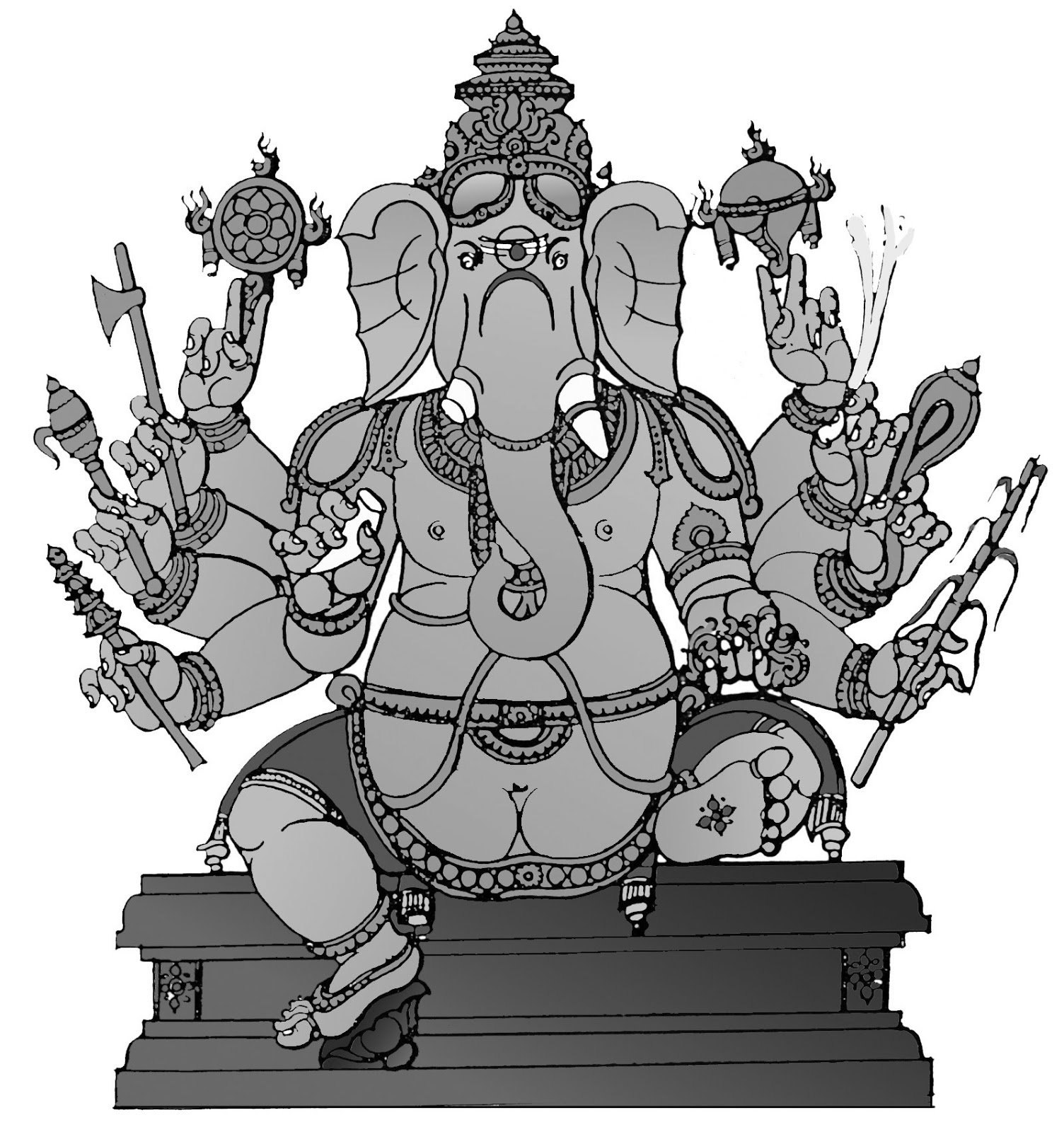
Lord Shiva represents the divine Self. Lord Ganesha, being His son, is symbolic of a person who has attained that state of Divinity. While representing the Divinity, Lord Ganesha also represents the way to attain that exalted state.
Lord Ganesha's elephant head symbolises the immense wisdom of a person of Perfection. Wisdom is something that comes out of manana, independent thinking and reflection. This manana can happen only when one has taken in spiritual knowledge i.e. the process of shravana has taken place. This process of shravana or intake of spiritual knowledge is portrayed as Lord Ganesha's large ears where one listens to a teacher. It also symbolises that even the wisest people are always open to hearing fresh ideas and opinions. In other words, the wise are those who always keep an open mind.
Broken tusk
Emerging from the Lord's head is the elephant trunk. This trunk visually depicts a well-developed intellect that arises out of wisdom, the elephant head. Our intellect is of two kinds, gross and subtle. The gross intellect is used to discriminate between pairs of opposites in the world; black and white, hard and soft, easy and difficult. The subtle intellect, on the other hand, discriminates between right and wrong; permanent and impermanent and is colloquially called the conscience.
In a person who has realised the Self, this intellect is extremely well-developed; both gross and subtle. Such people have clarity of thinking and a clear sense of right and wrong. At a relative level, even people who have made progress on the spiritual path experience this. Choices become clear and life becomes a lot simpler. Without clarity of thought, our worldview is bound to be confused and coloured by our own prejudices and preconceptions. Lord Ganesha's well-shaped trunk depicts a crystal clear intellect that a person of Perfection develops.
One of the key attributes of people who are Self-Realised is that they rise above their likes and dislikes and the pairs of opposites that world presents before them. Established in the permanent Divinity, they remain unperturbed by what the world has to offer; the joys and sorrows, the victories and losses. They understand the ways of the world and take to life as a sportsperson takes to sport. Giving their best at every juncture, yet understanding that, in the ultimate analysis, it is only a game. Relatively speaking, genuine seekers on the spiritual path also achieve this sense of peace to the extent that they have identified with the Self.
This transcendence over the pairs of opposites (two tusks) in a person of Perfection is indicated beautifully by Lord Ganesha's broken tusk. For it is only when we have risen above the play of opposites in the world that we can stomach the challenges that life throws at us. This idea is depicted by Lord Ganesha's large stomach. People who attained the supreme state have tremendous mental strength to brush aside the greatest setbacks while keeping their heads in the midst of immensely joyous experience.
Lord Ganesha's posture
The Lord's posture with one foot on the ground and the other folded up conveys to us that while we must operate in the world there must also be a constant alignment with Atman in and through all our experiences. In the relative, whatever we do, there must be an unwavering focus on our higher spiritual goal. Without this focus, it is impossible to make spiritual progress.
Food at the feet of Lord Ganesha
The food at the feet of Lord Ganesha
symbolise material wealth and power. Through this, the Lord subtly indicates that the world rewards those live a life of truth. Those who turn spiritual acquire merit in their respective fields of activity and those with merit seldom go unacknowledged. They command respect and wealth even though they may not desire it.
Four arms which hold:-
ankush - symbol for control over the mind.
ladu - for happiness
pash - axe to punish the indriyas and antakaran
ashirvad mudra - blessings for the well being of humanity.
 |
| Ganesha riding on his mount, mouse. |
Mouse
The mouse as the Lord's mode of transport magnifies the challenge that a spiritual person faces when trying to communicate the knowledge of the infinite Self through the finite equipments of body, mind and intellect. Atman cannot be touched with the body, felt through emotion or understood with the intellect. One can only become It through spiritual practice.
 |
Common four-armed form of Ganesha.
Miniature of Nurpur school (circa 1810).
Museum of Chandigarh. |
|
Symbolism behind Lord Ganesha's four hands
In his four hands, Lord Ganesha holds an axe, a rope, a modak (sweetened rice ball) and a lotus. The axe represents the annihilation of desire with the axe of spirituality. The rope is spiritual knowledge which helps us to remove ourselves from the samsara , material world, that we are entrenched in. The modak symbolises the happiness and joy a seeker derives from the spiritual pursuit. And the lotus stands for that Divine state of Self-Realisation that every human being aspires for, consciously or unconsciously. The lotus sustains itself in dirty ponds but yet is above it all. Similarly, a person of Perfection can live in the world, enjoy life and yet be above it all by identifying with the Self.
The occasion of
Ganesh Chaturthi gives us, as spiritual aspirants, an opportunity to remember what
Lord Ganesha stands for. A chance to reignite ourselves in our search for Divinity.
Ganapati vivah (Marriage)
When Shiva and Parvati decided to have their sons, Kartikeya and Ganesh, married, they stipulated that he who circumambulated the earth first would be considered the best deity and would be married first. Kartikeya flew off on his vehicle - a peacock. Poor Ganesh's vehicle was a mouse; no match for a peacock!
Being a
matrubhakta, Ganeshji performed
pradakshina of his parents. He then stated: 'One who offers
pujan and performs
pradakshina of his parents, receives the same merit as performing
pradakshina of the earth. Thus he was married first, and boosted the glory of the principle that by venerating
Bhagwan and one's parents, one also becomes venerable in the world.
Ganesh is invoked first in all auscipious events, rites and rituals, such as marriage, opening ceremonies, ground-breaking rituals and
yagnas. (Shiv Puran, Rudra Samhita, Kumarkhand - 19). The phrase
"Shri Ganesh" itself is a synonym for
"auspicious beginning".
The
Shiv Puran cites another story.
Prajapati had two daughters,
Siddhi (wealth) and
Riddhi (intellect). He approached Parvati and Shiva for the girls' marriage to Kartikeya and Ganesha. However, both girls wished to marry only the latter. Thus, they married him. Siddhi gave birth to a son named
Shubh (
auspiciousness) and Riddhi to
Labh (merit).
Therefore, when businessmen and merchants offer
pujan to Ganeshji and Lakshmiji, they write
Shubh and Labh inside their ledgers to invoke the two deities (
Shiv Puran, Rudra Samhita, Kumarkhand -20).
--------------------------------------------------
Source: 1]An Article by Smt. Jaya Rao.
2] Excerpts from the book "Hindu Festivals" by Sadhu Mukundcharandas
---------------------------------------------------