 |
| Adi Shankara with his disciples |
Guru: Your Gateway to Eternity
The festivity of guru purnima hallows the tradition of the guru-disciple relationship. According to the Vedas, Lord Vishnu - Narayana - imparted teachings to the sages in ancient times. Beginning with Narayana, who taught Brahma, who in turn taught Sage Vyasa, who in turn taught Shuka, a succession of Gurus and disiciples has proceeded down through the ages through Shri Shankaracharya to the present.
Idea behind Guru purnima
The idea behind guru purnima is that God is the Guru of Gurus; He is the inner prompter in every heart. But to develop an awareness of God's presence and His dynamic grace requires an artistic understanding -- a knowledge that is not academic; for one cannot learn in a university how to be aware of the Divine presence, how to explore the inner recesses of one's heart, how to climb the heights of wisdom and spiritual awareness, how to attain Liberation from the cycle of birth and death; how to discover the Treasure of treasures, the power of all powers, the Light of all lights, discovering which, one becomes supremely joyous.
The answer to that "how" lies in the hands of one's guru or spiritual preceptor. You must try to understand this concept rationally. It is often difficult for Westerners to understand why gurus are accorded even more honor than traditional symbols of religion, such as temples, churches and pilgrimage ceers. A guru in Vedic tradition is much more holier than a thousand temples or pilgrimage centers, "Why," many ask, "should such prominence be given to a mortal man?"
Vedic Culture
In the Vedic culture, young students are always reminded of the following great teachings from the Upanisahds:
[1] matr devo bhava" - Let your mother be your God;
[2] "pitr devo bhava" - Let your father be your God;
[3] "acarya devo bhava" - Let your guru be worshipped as your God.
These served to propel the youths towards the loftly realization that the entire creation is God: sarvam Brahmamayam jagat".
One begins to discover God in the person to whom your heart is most easily drawn: your own mother. You see her tenderness, warm and good feelings for you. You marvel at her ability to forgive you inspite of your defects. Then you begin to recognize God in your father. Ordinarily, one's father is not as tender as one's mother, for his love expresses itself more firmly; it is usually up to him to do the disciplining. But you love him all the same because he is your father, and thus you begin to recognize God in him, too.
As you evolve further, you are directed towards an acharya or guru. You discover that there is a vast dimension of the unknown that awaits your exploration, and guru becomes the key to your doing this. Thus you begin to love your guru. In that love for him you find a greater fulfilment of the love that you felt for your mother and father and other relatives. Through guru, then you begin to love God, and in that act the entire world becomes God.
The guru is God Himself manifesting in a personal form to guide the aspirant. Grace of God takes the form of the Guru. To see the Guru is to see God. The guru is united with God. He inspires devotion in others. His presence purifies all.
The guru is verily a link between the individual and the immortal. He is being who has raised himself from this into That, and thus has free and unhampered access into both the realms. He stands, as it were, upon the threshold of immortality; and, bending down he raises the struggling individuals with his one hand, and with the other lifts them up into the empyrean of everlasting joy and infinite Truth-Consciousness.
 |
| Maitreyi and Yagnavalkya |
The Sadguru
To be a Guru, one must have a command from God. Mere study of books cannot make one a Guru. One who has studied the Vedas, and who has direct knowledge of the Atman (Self) through experience, can alone be enrolled as a Guru. A liberated sage (jivanmukta) is the real Guru or spiritual preceptor. He is the Sadguru. He is identical with Brahman or the Supreme Self. He is a Knower of Brahman.
A Sadguru is endowed with countless psychic powers (siddhi). He possess all divine powers (aisvarya), all the wealth of the Lord Possession of special powers, however, is not the test to declare the greatness of a sage or to prove that he has attained Self-realization. Sadguru generally do not exhibit any miracles or psychic powers. Sometimes, however, they may do so in order to convince the aspirants of the existence of super physical things, give them encouragement and instill faith in their hearts.
The Sadguru is Brahman Himself. He is an ocean of bliss, knowledge and mercy. He is the captain of your soul. He is the foundation of joy. He removes all your troubles, sorrows and obstacles. He shows you the right divine path.
He tears apart your veil if ignorance. He makes you immortal and divine. He transmutes your lower, diabolical nature. He gives you the rope of knowledge and takes you up when you are drowning in this ocean of samsara (cycle of birth and death). Do not consider him to be only a man. Worship your Guru and bow to him with reverence.
Guru is God. A word from him is a word from God. He need not teach anything. Even his presence or company is elevating, inspiring and stirring. His very company is self-illumination. Living in his company is spiritual education. Read the holy scripture of the Sikh religion (the Granth Sahib). You will come to know the greatness of the Guru.
Man can learn only from man and hence God teaches through human body. In your Guru, you have your human ideal of perfection. He is the pattern into which you wish to mould yourself. Your mind will readily be convinced that such a great soul, is fit to be worshipped and revered.
Guru is the door to liberation. He is the gateway to the transcendental Truth Consciousness. But, it is the aspirant who has to enter through it. The Guru is a help but the actual task of spiritual practice falls on the aspirant himself.
The Need for a Guru
For a beginner in the spiritual path, a Guru is necessary. To light a candle, you need a burning candle. An illumined soul alone can enlighten another soul.
Some do meditation for some years independently. Later on, they actually feel the necessity of a Guru. They come across some obstacles to the way. They are unable to know how to obviate these impediments or stumbling blocks. Then they begin to search for a Master.
Only the man who has already been to Badrinath will be able to tell you the road. In the case of spiritual path, it is still more difficult to find your way. The mind may mislead you very often. The Guru will be able to remove pitfalls and obstacles, and lead you along the right path. He will tell you: "This road leads you to liberation; this one leads to bondage:" Without this guidance, you might want to go to Badrinath, but find yourself in Delhi.!
The scriptures are like a forest. There are ambiguous passages. There are passages that are apparently contradictory. There are passages that have esoteric meanings, diverse significance, and hidden explanations. There are cross-references. You are in need of a Guru or a preceptor who will explain to you the right meaning, who will remove doubts and ambiguities, who will place before you the essence of the teachings.
A Guru is absolutely necessary for every aspirant in the spiritual path. It is only the Guru who will find your defects. The nature of egoism is such that you will not be able to find out your own defects. Just as a man cannot see his back, so also he cannot see his own errors. He must live under a Guru for the eradication of his evil qualities and defects.
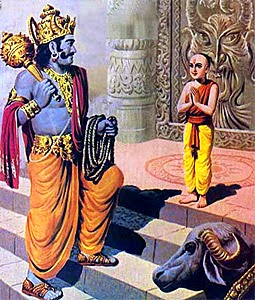 |
| Naciketan and his guru Yama |
The aspirant who is under the guidance of a Master or Guru is safe from being led astray.
Satsang or association with the Guru is an armor and fortress to guard you against all temptations and unfavourable forces of the material world.
Cases of those who had attained perfection without study under any Guru should not be cited as authority against the necessity of a Guru; for such great men are the anomalies of spiritual life, and not the common normality. They come into existence as a spiritual masters as a result of the intense service, study and meditation practiced in previous births. They had already studied under the Guru. The present birth is only its continuative spiritual effect. Hence, the importance of Guru is not lessened thereby.
 |
| Narada and Sanatkumara |
All great ones had their teachers. All the sages, saints, prophets, world-teachers, incarnations, great men, have had their own
Gurus, however great they might have been.
Shvetaketu learnt the nature of Truth from
Uddalaka, Maitreyi from
Yagnavalkya, Bhirgu from
Varuna, Narada from
Sanatkumara, Nachiketas from
Yama, Indra from
Prapajati; and several others humbly went to wise ones, observed strict
brahmacharya, practiced rigorous discipline and learnt the science of God
(Brahma vidya) from them.
Lord Krishna sat
at the feet of His Guru
Sandeepani. Lord Rama had Guru
Vasishtha who gave Him
Upadeesa (spiritual advice).
Lord Jesus sought
John to be baptized by him on the banks of the river Jordan. Even
Devas (celestial beings) have
Brihaspati as their Guru. Even the greatest among the divine beings sat at the feet of
Guru Dakshinamurti.
 |
| Guru Sandeepana and Lord Krishna |
A neophyte must have a personal Guru first. He cannot have a God as Guru to begin with. He must have a pure mind. He must have ethical perfection. He must be intensely virtuous. He must be abode body-consciousness. Then alone can he have God as Guru.
 |
| Sri Dakshinamurthy |
How to choose your Guru?
If you find peace in the presence of a great soul, if you are inspired by his speeches, if he is able to clear your doubts, if he is free, from greed, anger, and list, if he is selfless, loving and I-less, you can take him as your Guru. He who is able to clear your doubts, he who is sympathetic in your spiritual practice, he who does not disturb your beliefs but helps you on from where you are, he in whose presence you feel spiritually elevated -- he is your Guru. Once you choose your Guru, implicitly follow him. God will guide you through the Guru.
Do not use your reason too much in the selection of your Guru. You will fail if you do so. Try to follow the instruction of a spiritual person who has been treading the path for some years, who has purity and other virtuous qualities, and who has some knowledge of the scriptures.
If you are not able to find any spiritual guide
you can follow the teachings contained in the books written by realized saints like
Shri Shankara, Dattatreya and others. You can keep a photo of such a realized Guru, if available, and worship the same with faith and devotion. Gradually you will get inspiration, and the Guru may appear in a dream and initiate and inspire you at the proper time. For a sincere aspirant, help comes in a mysterious manner. When the time ripe, the Guru and the disciples are brought together by the Lord in a mysterious way.
Siksa and Diksa Guru
Man has twofold duty here on earth--to preserve his life, and to realize his Self. To preserve his life, he has to learn to work for his daily bread. To realize his Self, he has to serve, love and meditate. The Guru who teaches him the knowledge of worldly arts is the
siksha Guru.
The Guru who shows him the path of Realization is the
diksha Guru.
Siksa Guru can be many - as many as the things he wishes to learn. The
diksha Guru can be only one -- the one who leads him to liberation
(moksa).
Stick to one Guru
Do not dig shallow pits here and there for getting water. The pits will dry up soon. Dig a very deep pit in one place. Centralize all your efforts here. You will get good water that can supply you throughout the year. Even so, try to imbibe thoroughly the spiritual teachings from one preceptor alone. Drink deep from one man. Sit at his feet for some years. There is no use of wandering from one man to another man, out of curiosity, losing faith in a short time. Follow the spiritual instructions of one man only. If you go to several people and follow the instructions of many persons, you will be bewildered. You will be in a dilemma.
From a doctor, you get a prescription. From two doctors, you get a consultation. From three doctors, you get your own cremation. Even so, if you have many Gurus, you will be bewildered. You will be at a loss to know what to do. One guru will tell you: "Do
Soham Japa." Another will tell you: "Do
Japa of Shri Ram." A third Guru will tell you: "Hear mystic sounds." You will be puzzled. Stick to one Guru and follow his instructions.
Listen to all, but follow one. Respect all, but adore one. Gather knowledge from all, but adopt the teachings of one Master. Then you will have rapid spiritual progress.
Grace and Self-effort
Realization cannot come to you as a miracle done by your Guru. Lord Buddha, Lord Jesus, Rama Tirtha have all done spiritual practice. Lord Krishna asks Arjuna to develop dispassion
(vairagya) and practice
(abhyasa). He did not say to him, "I will give you liberation now." Therefore, abandon the wrong notion that your Guru will give you liberation. Strive, purify, meditation and realize.
Grace of a Guru is very necessary. That does not mean that the disciple should sit idle. He must do rigid spiritual practices and the entire work must be done by the student. Now a days, people want a drop of water from the water pot of a renunciate and desire to enter into deep meditation immediately. They are not prepared to undergo any spiritual practice for purification and Self-realization. They want a magic pill to push them into the ultimate meditative state. If you have such delusion, give it up immediately.
The Guru and the scriptures can show you the path and remove your doubts. Direct experience of the
aparoksa kind or direct intutive knowledge is left for your own experience. A hungry man will have to eat for himself.
No doubt, the Guru's blessing can do everything.
But how can one have his [Guru] blessings? By pleasing the Guru. A Guru can be pleased with his disciple only if the latter carries out his spiritual instructions implicitly. Carefully follow, therefore, the instructions of the Guru. Act up to his instructions. Then only will you deserve his blessings and then alone his blessings can do everything.
~~~~~~~~~~~~~~~~~~~~~~~~~~~~~~~~~~~~~~~~~~~~~~~~~~
Source: An articles written by Swami Sivananda & Swami Jyotirmayananda taken from the book on "Guru - The Guiding Light" published by Mananam Publications.
~~~~~~~~~~~~~~~~~~~~~~~~~~~~~~~~~~~~~~~~~~~~~~~~~~~


