Search This Blog

Showing posts with label Lord Krishna. Show all posts

02 September, 2018

In Indian culture..Why do we celebrate Krishna Janmashtami?


In Indian culture..Why do we celebrate Krishna Janmashtami?


      Bhagwan Shri Krishna incarnated five thousand years ago, at the end of cosmic phase, known as Dwapar-yug.


Purpose of Incarnation


      In the Gita [4/7.8], Shri Krishna proclaims:

     "Yada yada hi dharmasya glanir bhavati Bharat...
     ... Dharma sansthapanarthaya sambhavami yuge yuge."

      i.e., I incarnate whenever Dharma declines and evil predominates, to establish Dharma Dharma and vanquish evil.
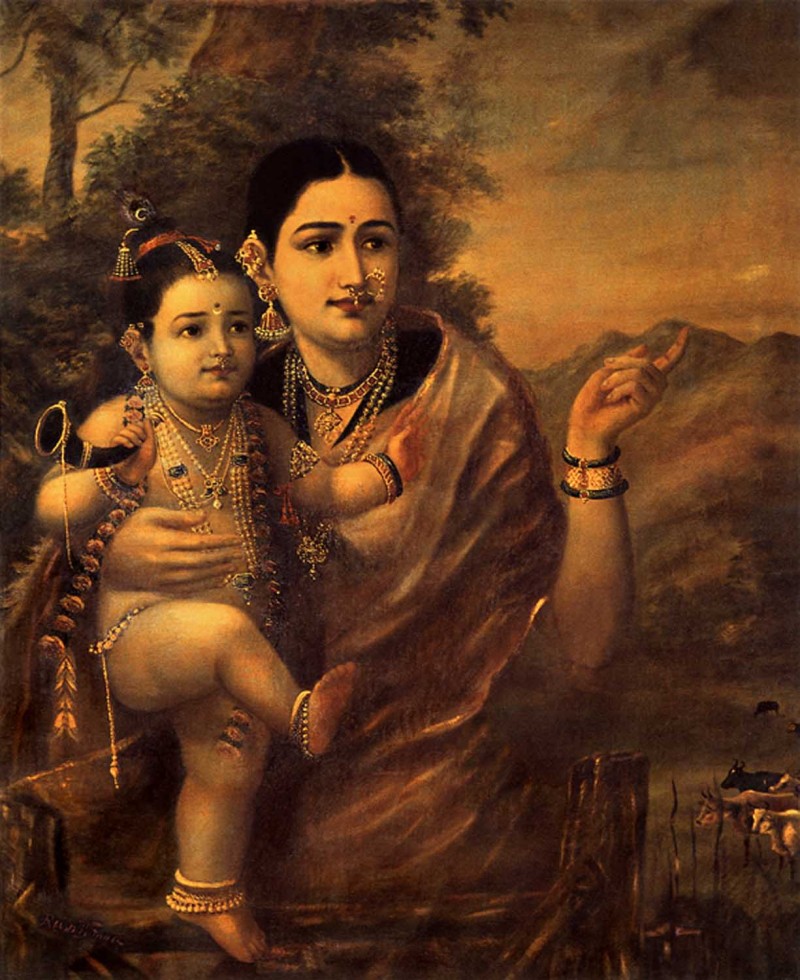

       In the Bhavishyottar Puran Shri Krishna himself extols the celebration of Janmashtami to Yudhishtir, the eldest of the five Pandavas.


       He incarnated in Mathura (Uttar Pradesh) to vanquish evil elements who were harassing pious people.  His second reason was to fulfill the pledge he gave to Vasudev and Devki.  When they married, Kamsa heard a divine proclamation that the couple's eighth son would be his nemesis.  To obviate this, Kamsa imprisoned the couple and killed the first seven sons born to Devki.  When Shri Krishna was born, Vasudev placed him in a cradle.  The prison's doors opened miraculously and he forded the river Yamuna with the divine child.  Thus, Shri Krishna survived.  


       During childhood he eradicated evil elements such as Bakasur, Aghasur, Putna, Kaliyanag and Kamsa.  Later he removed mighty evil kings from all over Bharat who were causing anarchy and inflicting needles misery on people.  By this mission, he fulfilled Paramatma's prophecy to remove evil and established dharma and peace in the whole of Bharat and reunified it.


Sentiments


       The first important sentiment of Janmashtami is to observe dharma.  Since humans are all imprisoned in samsar, Paramatma incarnates in this 'prison' with man, establishes dharma and redeems him from maya.  Man can transend maya only if he seeks Paramatma's aid, as did Arjun during the battle of Mahabharat.  As Bhagawan Ved Vyas proclaims:

       'Yato Krishnastato dharmaha, yato dharmastato jayaha."
       - Mahabharat Critical edition 13/153/39, 6/62/34

      i.e., Where there is Krishna, there is dhama,  where there is dharma, there is victory.  


       Since Duryodhan, leader of the Kauravas, did not observe dharma, he did not have Krishna.  No Krishna, no victory.


Sharanagati [Refuge]

   
      During the battle, Shri Krishna imparted divine knowledge to convince the relucatant Arjuna to fight.  This divine knowledge is known as Bhagavad Gita.  In the Bhagavad Gita 18/66 the following slok [18/66] as its essence:

       Sarva dharman parityajya maekam sharanam vraja,
       aham twa sarvapapebhyo mokshishyami ma shuchaha.

       i.e., O Arjun!  Forsake all your personal beliefs and surrender to me.  Do not lament for I shall deliver you free from all sins.

       Therefore, the true spirit of Janmashtami is for devotees to implicitly surrender at Paramatma's lotus - feet, while staunchly observing dharma.


Ideal Devotee


       Shri Krishna stipulates:
       "Brahma bhutaha prasannatma na shochati na kankshati,
       Samaha sarveshu bhuteshu madbhaktim labhate param." - Bhagavad Gita 18/54

       i.e., One who becomes brahma-rup and offers devotion to Parabrahma, forever remains blissful and attains the highest glory of Paramatma.  'Brahma-rup' simply means to become an ideal devotee, like Arjun, who represents Nar, and to then worship Krishna - Narayan.  Hence, the murtis of Nar-Narayan.


       Similarly, Shri Krishna played the Maha Ras (divine stick dance) with the Gopis of Vrundavan because of their unalloyed devotion to him.  Radha was the foremost among them.  Therefore, devotees should develop Gopi-bhav, to become Radha-rup (like Radha) to worship Shri Krishna.  Hence, the murtis of Radha-Krishna are consecrated in mandirs.  This establishes the eternal principle of worshipping Paramatma, by becoming Radha-rup, like His ideal devotee; to become Akshar-rup to worship Purushottam.  Hence to become Akshar-rup or gunatit, Shri Krishna has given two chapters in the Bhagavad Gita, aksharbrahma Yoga [Chapter 8] and Purushottam Yoga [Chapter 15].


       In addition to such surrenderance, how should an aspirant strive to attain the exalted state of the Gopis - Gopi-bhav - to please Paramatma?  Shri Krishna himelf provides the answer in the Bhagavatam.


Interesting age-related figures about Shri Krishna.

  • Shri Krishna was only a child of about 12 when he played Maha Ras with the Gopis, prior to leaving for Mathura at the age of 13.
  • He first met Pandavas prior to the battle, at the age of 83.
  • He always did pranams to Yudhishthir [aged 87] and Bhim [aged 86] since they were older than him.
  • When he attended Draupadi's svayamvar, he brought along with him, his son Samb and Pradyumna, and the latter's son Anirudh, from Dwarka.
  • He was 125 years old at his demise [Bhagavatam 11/625].

Such longevity was common then.  Even 2.5 millennia later, when the Greeks arrived around 300-200 BCE, a chronicler [Arian] noted "many Hindus aged 140 years olds and many more who are 100!"


~~~~~~~~~~~~~~~~~~~~~~~~~~~~~~~~~~~~~~~~~~~~~~~~~~~~~~~
Source: Excerpts from the book Hindu Festivals written by Sadhu Mukundcharandas
~~~~~~~~~~~~~~~~~~~~~~~~~~~~~~~~~~~~~~~~~~~~

31 March, 2017

RAMA AND KRISHNA - A comparison in symbology


       "Vedas deal with Dharma in two categories, one for the path of Pravruti (action in mundane life) and the other for the path of Nivruti (redemption from the thralldom of Samsara).  These are respectively symbolized by the lives of the two Avatars, Rama and Krishna.  The paths of their lives appear to be diametrically opposite to each other; and there is an eloquent lesson in that.  A comparative study of the main incidents in the lives of the two great incarnations is very revealing and extremely rewarding and interesting.  There are so many incidents in their lives which are in striking contrast.  


       A few of  them are enumerated here under: these are not exhaustive, but only illustrative.  Those who search may find many more.  It is said, "Live as Rama lived, and learn what Krishna taught."

PARENTS


       Rama was born of parents who had to issues for long, were pinning for that, and who had undergone a lot of penance to beget children, while Krishna was the eighth child of his parents who, for that reason and due to the circumstances in which they were placed, were not at all eager to get issues.

BIRTH


      Rama was born in broad day light, in a palace, as the eldest Krishna was born in the middle of the night in a prison, and was the youngest.

COMPLEXION


     Rama was very fair in complexion, while Krishna was dark.


LIFE


       Rama enjoyed life in the palace as a prince till his twelfth year, while the life of Krishna till his twelfth year was full of dangers and fights for his survival, as Kamsa had employed so many emissaries and stratagems to do away with this child. 

VICTIM


       The first victim of Rama was a woman (Tataka) while the first victim of Krishna in regular combat was a man (Kamsa).

       Rama's life was Dharma-oriented (Ramo vigrahavan Dharma); while that of Krishna was Karma - oriented.  Krishna even said "Sarva Dharmam Parityajaya".

WIFE


       Rama was a man of "Eka Patni Vrata" (devoted only to one woman all his life) while Krishna had "Bahu Bharyatwa", a population of wives, so to say, as the story goes.

BROTHER


       Lakshmana, the incarnation of Ananta, was a younger brother of Rama.  The same Ananta in his subsequent incarnation as Bala Rama was the elder brother of Krishna.


SURYA'S SON


       Rama protected the son of Surya (Sugriva) and killed the son of Indra (Vali) while Krishna did just the opposite.  He protected the son of Indra (Arjuna) and killed (caused to be killed) the son of Surya (Karna).


POISON


      Rama killed Tataka with a poisoned arrow, that is, he emitted poison.  Krishna absorbed poison and killed Putana.

DELUSION


       Rama was deluded for a time (fainted) in his war with Ravana.  Krishna brought back the deluded man, Arjuna, to his full faculties and made him fight to victory.

WIFE


       Rama's wife was forcibly taken by Ravana.  Krishna forcibly took away Rukmini and married her. 

       Rama was the cause for mutilating and deforming a woman, Soorp[anakha.  Krishna made the deformed woman, Kubja, straight and beautiful.

KING


       Rama was a king in his own right.  Krishna was never a king himself, but was a King-maker.

INCARNATION


       Rama never claimed that he was an incarnation.  In fact, he had to be reminded of that at the last stage in his life.  Krishna announced that he was the Lord Himself as soon as He was born.

DYNASTY


       Rama belonged to the Solar dynasty.  Krishna belonged to the Lunar dynasty - the Yadava Branch.

PARAMATMA


       Rama represented the perfected Jivatman - (Ramanate asmin Yoginaha iti Rama:), while Krishna was the Paramatman - the God (Krishnaat Krishna).  

       "Ramayana" means the "goings of Rama".  He was leading to the goal.  It can also mean "going to Rama", just as "Samudrayan" in the case of the river.  Whereas in the case of Krishna, he was the goal.  He was always calling unto Himself: "Mamekam saranam vraja".

BATTLE


       Rama fought the great battle himself: (Jivatman fighting the battle of samsara).  Krishna was the "Sakshi" in the great battle, While others fought.

CITY


       Rama left behind a prosperous Ayodhya, while Krishna had his city (Dwarka) and his entire Yadava race destroyed before he left.

       Even the names of the cities in which they lived held out opposite meanings.  "Ayodhya" means a city which is not vulnerable to any kind of wars, which should mean the mental state of the "sthithaprajna", while 'Dwarka', Krishna's city meant the "Door that opens into the Perfect State", one being the Means and the other the End.


WEEPING


       While Rama had to weep many a time in his life, Krishna lived throughout as a personification of cheerfulness.  Krishna's eyes became moist only once in his whole life; that was when his childhood friend Sudama called on him.

AVATAR


       Krishna is accepted as the Poorna-avatara.  Rama has not been accepted as such.     

WIFE


       Even with only one wife, Rama could not lead a happy and harmonious life with her, while Krishna, with an army of wives, could lead the happiest of lives with no complaint from any of those women that she had been neglected even for one evening.


FOREST


      While in the forest, Rama goes in search of the golden deer to satisfy his wife, meaning that he went in search of Kanchan to satisfy his Kamini.  In the attempt he lost both the Kamini and the Kanchan.  Krishna went into the forest in search of the jewel "Syamamantaka" and gets also two Kaminis in the bargain - namely Satyabhama and Jambavati, that is Krishna gains both Kamini and Kanchan at one shot.


BOW


       With the bow and the quiver always hanging on his shoulders, Rama had a warrior's life throughout, upholding and protecting Dharma.  Krishna went with a flute in his hands enchanting the world around with his divine music.  He too was protecting the righteous and upholding Dharma. While the former did it with his prowess, the latter did it with love.


ARMS


       Rama was ready to take-up arms whenever required.  Krishna refused to take up arms even when everybody expected him to do so.

       Sita was lost, Rama wandered in search of her, weeping and enquiring of even inanimate objects whether they had seen her.  On the other hand, it was Krishna who had been lost, and the Gopis in Brindavan did exactly the same thing as Rama did in Ramayana.


FOREST


      Rama had to go to the forest to fulfill the purpose of his incarnation, whereas for Krishna his mission took him to palaces frequently.

ENEMIES


       Rama was insulted by his enemy in so far as his wife was kidnapped by his enemy, while we see that Krishna was respected by his enemies (the Kauravas) when he entered their Durbar.

SON


       Ram's sons lived independently of him and were finally crowned by Rama himself before his departure.  Krishna's sons and grandsons lived under his shadow throughout, but where annihilated by the grand sire himself before his departure.

BAD NAME


       Rama got a bad name on account of Sita, for which he sent her to the forest when she was in an advanced state of pregnancy.  Krishna got a bad name, not on account of a woman but a jewel called Syamantaka.  He went to the forest in search of the jewel to vindicate himself and ultimately got the jewel and two women in the bargain.

SURNAME


       Rama's name is chanted as "Sitaram" prefixed with that of Sita, his legally wedded wife, whereas, in the case of Krishna, we chant his name as "Radha - Krshna" prefixing his name not with any of his legally wedded wives, but with that of another man's wife, simply on the basis of devotion.


       To crown all these, we find a very interesting fact when we compare the Ramayana and the Bhagavad Geeta - which is the essence of the Mahabharata.  They appear to approach the subject from exactly opposite directions.  In Ramayana, Valmiki narrates to Sage Narda all the qualities of a "Sthithaprajna" and asks him whether there is any person living who satisfies that description, for which Narada answers that Rama, the Scion of the Ikshawaku dynasty, is a standing example for that.  But, when we come to the Bhgavad Geeta, Arjuna does just the opposite.  He asks the Lord as to what qualities  distinguish a "Sthithaprajna", and the Lord recounts those qualities.  The purpose is the same, but the approaches are from diametrically opposite directions.

~~~~~~~~~~~~~~~~~~~~~~~~~~~~~~~~~~~~~~~~~~~~~~~~~~~~
Source: Excerpts from the book on SYMBOLISM IN HINDUISM published by Chinmaynanda Mission
~~~~~~~~~~~~~~~~~~~~~~~~~~~~~~~~~~~~~~~~~~~~~~~~~~~

17 August, 2013

In Indian Culture... Why do we celebrate Lord Krishna's birthday?


In Indian Culture...
Why do we celebrate Lord Krishna's birthday?


       Krishna was a dynamic incarnation of Lord Vishnu.  He was an Avatara.  An Avatara is one who is attuned to the supreme Consciousness from birth.  Krishna's incarnation brought about a profound and powerful influence upon Indian thought and life.  There is no aspect of Indian life, culture and civilisation which does not receive his revitalising touch.  India's philosophy and religion, mysticism and poetry, painting and sculpture, music an dance articulated Krishna's theme and thought.  Every aspect of Krishna's life and deeds has a mystic symbolism indicating a sublime truth.  Some of them are explained below.  They should set a direction to the reader for deeper study and discovery of the allegorical significance of the entire story of Krishna.


Krishna meaning


       Krishna in Sanskrit means dark.  Krishna represents the inner Self, Atman.  The Atman is dark in the sense that it is unknown to man as long as he is involved in his terrestrial experiences. Man's  knowledge  is limited to the realms of perceptions, emotions and thoughts.  He gains these experiences through his three equipments of body, mind and intellect.  He knows not the Atman within.  The body, mind and intellect by themselves are inert and insentient.  They constitute the material aspect of man.  The Atman is his spiritual being.  The Atman is the living principle in man which transforms his inert matter into a living being.


Krishna in blue colour and wears yellow clothes


       Krishna in blue colour and wears yellow clothes. Blue colour has always been associated with infinity.  The sky appears blue.  So does the ocean.  Yellow colour  represents  earth.  When sand is introduced in a colourless flame, the flame turns yellow.  The blue form of Krishna clothed in yellow therefore suggest the infinite Reality reduced to finite human being.


Krishna's incarnation


       The incarnation of Krishna represents the descent of God on earth.  This idea of the limitless, formless Reality being constricted and restricted to a limited, human form is again suggested by Krishna's birth in a prison.  The divine child was however not confined to the prison.  No sooner was Krishna born the prison doors miraculously flung open.  The guards could not hold the child back.  The child's father, Vasudeva, carried him out of the prison in spite of the severe restrictions imposed on him.

      This episode is meant to convey that the infinite Being can never be really restricted or limited to the human form.  A Godman is ever free and liberated.  The Atman in a man is limitless.  Only his body, mind and intellect are limited finite.  These material equipments have a beginning and an end.  They cannot restrict the Atman.  The Atman is eternal, all-pervading, infinite.  Krishna represents that Atman.


       Krishna was born in Mathura.  His uncle, Kamsa was a tyrant.  Kamsa imprisoned his father and usurped the throne of Mathura.  He reigned over Mathura.  His minister Chanura was equally wicked and cruel.  Under the rule of these two tyrants Mathura suffered greatly from confusion and chaos.  Krishna destroyed both and restored peace and order in that land.  The word mathuram means sweetness.  The land of Mathura represents the personality of man.  Man's essential nature is his Atman.  His real nature is ever sweet, peaceful and blissful.  But when the evil forces of ego and egocentric desires usurp man's personality he suffers from stress and strain, worries and  anxieties He is agitated and sorrowful. He loses his blissful nature.  To regain the lost bliss man as to destroy his ego and egocentric desires and establish his identity with his supreme Self.


Puranic Story


       There is a Puranic story which speaks of Krishna killing a mighty serpent with many heads.  It lived in a lake poisoning its water.  The entire village suffered because of this dragon.  Krishna ultimately crushed down its heads.  But as he crushed them other heads sprung up in their place.  Krishna ultimately crushed all the heads and vanquished the serpent.  He danced on its crested head playing the flute.  The wives of the dragon paid homage to the Lord.


Allegorical significance


       This story again has an allegorical significance.  The lake represents the mind.  The dragon and its many heads the ego and egocentric desires.  The ego and egocentric desires poison the mind and make its world miserable.  When man turns his attention inwards, when he contemplates and meditates upon his Atman, upon Krishna he overcomes his ego and egocentric desires. Thereafter he revels in the bliss of Realisation.  the sense-objects of the world become subservient to such a man.  This is symbolised by the wives of the serpent paying homage to Krishna.


Krishna playing a flute


       Krishna is often represented as playing a flute.  The enchanting music emanating from the flute of the Lord is the bliss of Godhood enjoyed by the Man-of-Realisation.  The flute is hollow but it can produce enchanting music.  So too when man empties himself of his vasanas and desires the Divinity within him flows out with enchanting bliss.  Man has to give up all his claims upon his body, mind and intellect, give up all his egocentric connections, all thoughts of 'mine' and 'thine', rise above them all and chant Om (Krishna), to remove all selfishness from the flute of his body and fill it with the divine breath of om.  Man becomes God.


Krishna with Gopis


       The milkmaids of Brindavan were called gopis.  These gopis were enchanted by the divine music flowing out of Krishna's flute.  They danced in their  ecstasy  around Krishna.  The dance of the gopi is known as rasa-lila.  


      Krishna again represents the Atman, pure consciousness while gopis represent thoughts.  Atman in man is the enlivening factor by which he becomes conscious of his thoughts.  Thoughts by themselves are insentient.  In the presence of Consciousness thoughts gain sentiency or consciousness.  Thoughts dance around the Atman as it were.  But the Atman is ever-immaculate.  It is unaffected by the thoughts around it.  So is Krishna pure, immaculate.  He remains detached and unaffected by the dancing gopis.  Losing this allegorical significance of the rasa-lila much criticism has been levelled against Krishna's association with the gopis.  

     The gopis were in fact deeply devoted to Lord Krishna.  They remembered Krishna  throughout  the day in all their activities.  Their limbs were ceaselessly engaged in their obligatory duties while their minds were constantly attuned to the Lord.  To dedicate oneself to a higher being and work in the world without ego and egocentric desire is karma yoga.  When man works in a spirit of karma yoga he gets rid of his vasans, desires. This idea is suggested by Krishna stealing the butter which the gopis had churned and collected in their pots.  The desires for realisation of the Self alone  remains.  The last  trace of desire gets eliminated by itself through single-pointed meditation upon the Lord.  

       In verse 66 of Chapter XVIII of the Bhagavad Gita the Lord gives man this assurance:

"Abandoning all dharmas, take refuge in Me alone, I will liberate thee from all sins, grieve not."

       There is yet another beautiful incident in Krishna's life indicating his absolute state of detachment.  It served as an eye-opener to the two wives of Krishna when they began to  doubt  his association with many gopis.

Sage Durvasa - Nitya upavasi


       One day the great sage Durvasa camped with his many disciples on the opposite bank of river Yamuna where Krishna lived.  Krishna wives saw the sage and prepared a lot of sweetmeats to take to him.  In the evening when both the ladies with their trays of delicacies approached the river it was flooded.  They could not cross over to the other bank to make the offering to the sage.  They returned and sought krishna's help.  Krishna asked them to go back to the river-side and pray to Mother Yamuna (the rivers in India are deified as goddesses), "If sage Durvasa is nitya upavasi please show us the way".  Nitya means eternal, permanent.  Upavasi means one who fasts.  So nitya upavasi is one who is always observing fast.  The ladies did not understand the implication.  They  followed Krishna's advice and prayed to Goddess Yamuna.  The goddess granted their prayer and instantly the waters subsided.  They crossed over and offered sweets to the sage.  The sage ate every bit of the food and returned the empty trays.  A nitya upavasi!

Krishna - Nithya brahmacari


       Krishna's wife took the sage's blessings and reached the river bank to return home.  Again, the river was flooded preventing them from crossing over.  This time they sought the help of Durvas.  The sage advised them to go back to the river bank and pray to goddess Yamuna, "If Krishna is a nitya brahmacari please show us the way".  Nitya brahmachari means permanent celibate.  The ladies followed the advice and prayed to the Yamuna.  To their amazement the waters subsided forthwith enabling the to cross over to the other bank.

Significance of the Durvasa Story


      The significance of this episode is obvious.  Durvasa was totally free from mental attachment to any type of food.  He had absolutely no desire or craving for them.  Eating to him was a ritual, an obligatory function.  Such a person though eating eats not.  A man of perfect detachment "even though acting acts not"  (BHagavad gita Chapter IV, Verse 20).  Durvasa belonged to that rare category.  He was ever mentally detached from food.  Hence, he was called a nitya upavasi even as he was eating like any other man.

       The same principle applies to Krishna.  It is not man's physical expression but his mental impression that determines his attachment or detachment to the world.  Krishna's association with the gopis did not in any way affect his total detachment, his mental resignation from them.  He was ever maintaining an inward dispassion and disinterest even as he was closely associating with the gopis.  His mind was ever in a state of Brahmacharya celibacy.  Hence, he was called nitya brahmacari. 


Krishna eaten mud


       In his childhood, Krishna is said to have eaten mud on an occasion.  His mother Yasoda chided him.  Krishna denied having eaten mud.  Yasoda would not take his word.  She asked him to open his mouth.  The child did so.  Yasoda was  wonder-struck  to see the entire universe within the child's mouth.  This episode has a deep philosophical implication.


       Krishna is the Infinite, Omnipresent, Omnipotent Reality. The Reality alone exists.  Nothing else does.  The universe is nothing but the same Reality, though seen differently by men with limited vision.  Yasoda was one of those who could not see the supreme Being in Krishna.  She only saw her child in him.  But in truth Krishna is that all-pervading Reality which includes the earth as well.  The earth is a part of the Reality which Krishna is.  Krishna therefore gave the right answer to his mother when he denied eating earth.  How can Krishna (Reality) eat mud (Reality)? Krishna was therefore speaking the Truth.  when Yasoda insisted on knowing the truth Krishna had to reveal it by opening his mouth and showing the universe in Him.


Krishna as a baby sucking his own big toe


       Man's essential nature is the supreme Reality.  The world is also nothing but Reality.  Yet man finds the necessity to run after the world of objects for his pleasures.  Is this not an absurd situation--Reality in the form of man  craving  to enjoy Reality in the form of the world?  This absurdity of man's pursuit is subtly implied when Krishna as a baby is showing sucking his own big toe.


Krishna holding a staff & jnana mudra in hand


       Lord Krishna is also described as a holding a staff in one hand and showing a symbol of wisdom, jnana mudra with the other.  A staff is used by a cowherd boy to drive the cattle to the pasture lands for grazing.  The jnana mudra is a symbol made by holding the little, ring and middle fingers erect and bringing the index finger to touch the middle portion of the thumb.  This again has a philosophical meaning.  Krishna represents the Atman in man.  Atman is the Life-Principle which enlivens his body, mind and intellect.  Without the life spark man cannot act at all.  All actions are possible because of the life spark.  Actions broadly classified fall under two distinct heads - actions that are degrading and devolutionary and those that are elevating and evolutionary.  Man can make use of the Atman to evolve or to devolve.  Atman is neutral.  It helps man to pursue whatever direction he wants.

       The first type of actions is indicated by Krishna holding the staff.  The cattle represents the sense organs.  The sense organs constantly feed upon the sense-objects of the world.  Eyes go to colour and form, ears go to sound, the tongue to taste etc.,  the sense-objects are the  pastures  for the sense organs.  Man spends all his life driving his sense organs to their respective fields of enjoyment for sensual pleasures.  He uses his Life-Principle   merely to indulge in sense gratification.  That seems to be his main occupation in life.


Jnana Mudra

     The other type of actions, indicated by the jnana mudra, leads man to Self-realisation.  the index finger represents the ego.  It is the pointing finger which creates duality, plurality.  Man develops his ego by his association and identification with his body, mind and intellect, with his gross, subtle and causal bodies, with his sattvika, rajasika and tamasika gunas.  This idea is indicated by the index finger remaining in contact with the other three fingers. The thumb  represents  represents the Atman by virtue of the vital role it plays in all actions.  The index finger bending towards the thumb to form a circle shows the ego's detachment from the three bodies or gunas and total surrender to the Atman.  When man does that he reaches his Infinite state, the state of Self-realisation.  This Infinitude is indicated by making a circle.  The circle has no beginning or end.  That which has no beginning or end is said to be infinite. Krishna gives this choice of action to man, that is to spend his life time in merely gratifying his senses or to transcend the limitations of his body, mind and intellect and reach the state of Realisation. Krishna is a mere witness, a sakshi.  He does not interfere with your choice.  He merely presents the truth for you to decide your course of life.


BHGAVAD GITA

       In the Bhagavad Gita, Arjuna surrenders to Krishna completely and seeks his advice.  Krishna gives him the entire philosophy of life in the eighteen chapters of the gita.  Towards the end of the last chapter he declares to Arjuna, "I have declared the highest wisdom to you, reflect upon it and act as you choose to".

----------------------------------------------------------
Source:  Excerpts from the book on The Symbolism of Hindu Gods and Rituals by Swami A Parthasarathy
-----------------------------------------------------------