Search This Blog

18 December, 2011

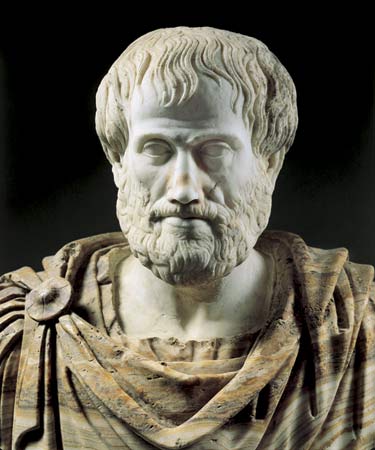
Aristotle's Search for Truth


       The question arises, as to what human intelligence can tell us about God.  Therein lies the whole thrust of philosophy and, more specifically, metaphysics.

       Aristotle wants truth.  He wants to establish a science of truth.  Make no mistake; metaphysics is in some respects a very difficult science.  We should not take lightly or oversimplify the means by which Aristotle comes to an intellectual knowledge of God.  It is not an easy process of deduction.  We need a level of intelligence that goes beyond the mere establishment of facts or an investigation of the how.  Metaphysics seeks to go beyond any notions of such-and-such a thing or such-and-such group of things, to grasp the very being of things.  That is why Aristotle says that object of metaphysical study is being in virtue of its own nature and not in its capacity as such-and-such a thing.

       To be convinced of the rigor of Aristotelian thought, we have only to read the Metaphysics, his analysis of substance, actuality, and potency, of the "one" and the "many," of motion, and of the definition of words in Book 5.  Aristotle seeks to penetrate the being of visible things and their movement, from their generation to their decay.  He hopes to come to know the light residing in them, their intelligibility, their capacity to be grasped by human intelligence.  And so he looks at their being, their existence.  But he also recognizes that visible things do not possess their existence; they are things in a state of motion, of "becoming."  From the way they come to be and yet do not have fullness of being in themselves, Aristotle deduces that beyond them there must necessarily be a being that simply is, eternal.  Aristotelian contemplation is the penetrating gaze of reason that sees - not with the eyes, but with the intelligence, a presence, the God.

       How does the metaphysician see God?  On the basis of the reality of movement and becoming, Aristotle seeks the origin of becoming, for all movement implies not only an efficient cause, a mover, but above all, a reason for the existence of the movement, a good that gives rise to the movement, which is the final cause.

      There is therefore also something which moves it [the First Heaven, which is the source of movement in the universe] and since that which is moved and moves is intermediate, there is something which moves without being moved, being eternal, substance, and actuality.  And the object of desire and the object of thought move in this way; they move without being moved.  (Metaphysics 1072a21).

       Aristotle also notes, 'If it were not true, the world would have proceeded out of night and 'all things together' (universal confusion) and out of night and 'all things together' (universal confusion) and out of non-being" (Metaphysics 1072a19-20), a possibility that he considers absurd.  It would be a negation of the intelligence.

       The first mover, then, exists of necessity; and in so far as it exists by necessity, its mode of being is good, and it is in this sense the first principle.... On such a principle, then, depend the heavens and the world of nature.  (Metaphysics 1072b10-14).

       In some very dense texts (Metaphysics 1072b-12-21), Aristotle tries to grasp what this life of God and in God is.  God is the sovereign thought that thinks on itself, for in God "the intelligence and the intelligible are the same."  And Aristotle adds that God always has the immense joy of contemplation - the joy that we possess only for a few fleeting moments.

       We say therefore that God is a living being, eternal most [the supreme] good, so that life and duration continuous and eternal belong to God; for this is God.  (Metaphysics 1072b26-30).

       Finally, Aristotle asks himself in what way the universe contains the good, the sovereign good:

       ... whether as something separate and by itself, or as the order of the parts.  Probably in both ways, as an army does; for its good is found both in its order and in its leader, and more in the latter; for he does not depend on the order but it depends on him.  And all things are ordered together somehow, but not all alike - both fishes and fowls and plants; and the world is not such that one thing has nothing to do with another, but they are connected.  For all are ordered together to one end. (Metaphysics 1075all-18).

       Obviously, the wise the philosopher becomes, the more this capacity to philosophize and contemplate takes root in him, the more this activity of looking at God, in and through visible things and their movement, becomes a source of joy.  It becomes the happiest, most blessed, most joyous activity and the source of  immense - I dare even say ecstatic  - pleasure.  This activity is not then intellectual investigation, a laborious labor, but leisure.  It is as if the intelligence has finally attained its principal object.  It rests in this object.  Of course the word "leisure" does not mean here what we commonly use it to mean, the opposite of serious activity.  It is the perfection of intellectual activity, which pauses and marvels in the greatest and finest of its objects:  God.  Thus the wise man extricates himself from the law of becoming and movement, from that of stress and political activity, to attain the eternal: the prime, unmoved mover.  Through contemplation, he takes his place, for a brief moment, outside of time.

Source: Excerpts from the Book on Made for Happiness, Discovering the Meaning of Life with Aristotle by Jean Vanier.

------------------------------------------------------------------------------------------------------
ABOUT THE AUTHOR JEAN VANIER
Jean Vanier is the son of a former Governor General of Canada, George Vanier.  Vanier wrote his doctoral thesis on Aristotle and taught philosophy at the University of Toronto.  In 1997, he received the Paul VI Prize for his work on behalf of human development and progress.  Jean Vanier lives in France. 
-------------------------------------------------------------------------------------------------------

17 December, 2011

Listening to Your Inner Voice


       Over a century ago, Ralph Waldo Emerson stated,        The key to tapping the inner voice lies in becoming quiet, stilling the mind, and allowing intuition to bubble up into your awareness.
"There is guidance for each of us, and by lowly listening we shall hear the right words." 

       You can achieve this stillness through any process that relaxes you and slows down your thoughts - meditation, visualization, long walks, exercise, driving on a country road, and so on.  In the midst of this silence, your intuition will speak to you in any number of ways -- through words, a bodily, a gut feeling, a picture, or just a general sense about things.  Be open to the way that is right for you.  Trust your own response.  In time and with practice, it will become clearer and easier to recognize.

       Like all great spiritual truths, the idea of listening to yourself is simply in theory, but difficult in practice.  This is because the higher voice is not only voice seeking your attention.  We have inside us a false voice, also known as the voice of the ego.  While the inner voice gives expression to who we really are, the false voice focuses on who we think we should be.  The inner voice supports our essential nature; the false voice denies it.

       Each of these voices is accompanied by a number of clear signs.  By recognizing these signs, we can learn to discern between the two. 

       The primary experience that emerges from listening to your inner voice is the presence of inner peace.  This is the "peace of God, which passeth all understanding," an inner tranquility that emerges from a place deep in the soul.  From this refuge, you can literally rise above any turmoil or chaos that surrounds you in the outer world.

       The second sign that accompanies the inner voice is that of joy.  The path of the spirit and the path of the heart are one and the same.  When you go through life with an open heart, you are truly blessed.  This is why mythologist Joseph Campbel advised his students, "Follow your bliss."

       Following the inner voice also bring abundant energy and vitality.  Have you ever wondered why certain people seem so enthusiastic and alive?  Aligning ourselves with our Higher Power allows the life force to flow through us more easily.

       Finally, you will be supported by invisible hands.  There is no doubt about this.  When you follow your heart's desire, life will support you.  When you do your share, God will do His.  When you reach out for what you want, the universe will reach back and meet you half way.  Take a moment to review your life or the lives of your friends.  You will find examples of how the universe assists us when we are being faithful to the calling of the inner voice.

Signs of the False Voice

       Just as the universe provides clues when we follow the inner voice, it also lets us know when we follow the false voice.  Following the false voice brings anxiety instead of peace, burden instead of joy, judgement instead of love, confusion instead of clarity, blocks instead of flow.

       One of the key ways to recognize the voice of the ego is through the presence of fear.  Going against family tradition, David dropped out of law school to pursue his passion for music.  Initially, he felt a surge of joy and excitement as his authentic self came to the surface.  Then suddenly a series of doubt flooded his awareness - "What if I fail?"  "How will I get the money?" "What will people say"  This was the voice of FEAR speaking - fear of failure, fear of poverty, and fear of criticism.

       Or perhaps you have just had an argument with your mate. You go within and still small voice says, "Take the first step towards reconciliation."  You feel a deep peace about this when suddenly the false voice pipes in, "It's too risky.  What if I am rejected?  I'm going to wait for the other person to reach out first."

       Moreover, while the inner voice is committed to the truth, the false voice preaches dishonesty.  Let's say that a bank has mistakenly credited you with a large sum of money.  The ego says. "I don't have to report the error.  They don't need the income as much as I do.  I think I will keep my mouth shut."  These fearful words express a belief in scarcity - for me to have more, others must have less.  The voice of love, on the other hand, lives in a consciousness of abundance.  It says, "I gladly share what I have, for I know that there is enough to provide for all."

       These voices can be further discerned by paying attention to the sensations in your body.  For example, you might be trying to decide between two job opportunities.  Become quiet and visualize each situation in your mind's eye.  Pretend that you have begun working in each location, and then focus on your body's cues.

       In seeing yourself in the first job, you may notice a heaviness or depression in the chest, rapid breathing, churning  in the stomach, or some other sensation of discomfort.  The presence of these sensations is telling you that something is amiss.

       In contemplating the second job, you may experience a warm sensation in the chest or stomach, a lightness in the heart, a feeling of enthusiasm, or a peace and tranquility.  This is your spirit's way of telling you that the second job is better choice.

       Try experimenting with these cues until you find the ones that work for you.  Over time, you will become skilled at discerning between the two voices and will choose the inner voice as the one to guide you.

Getting Off Track and How to Get Back On

       What happens when we choose to follow the false voice?  Consider the story of an elementary school teacher named Joan.  At the  beginning of the school year, she was offered a new teaching position.  Although she was happy in her current classroom, the new job offered more money, responsibility, and prestige.  "May be I should take it," she thought.

      Immediately after accepting the position, Joan had a dream in which she was just barely holding onto the top ledge of a thirty-five-story skyscraper.  As the week unfolded, her anxiety increased until she decided to become still, go inside, and ask for guidance.  The inner voice responded loudly and clearly, telling her that she was not ready for the new job and needed to remain in her present position.

       The next day, Joan nervously called her principal, fearing that she would be reprimanded for reneging on her contract.  But her guidance did not let her down.  The principal was understanding and said she would hire a different teacher.  As Joan hung up he phone, a week's worth of tension dissolved from her body; she experienced a deep inner peace.  Spirit was speaking.

       This story illustrates a number of important principles.  First, by listening to the voice of "should", Joan succumbed to the false voice.  In almost all instances, the "should" voice represents a parental or societal message about obligation and duty.  The inner voice, on the other hand, pursues a path for its own sake, for its own joy.

       Second, Joan was able to turn her situation around because she used her pain as feedback to obtain a greater understanding of her situation.  If she had denied or repressed her distress, it would have returned at a later point, perhaps as a physical illness.  Ignoring the pain only creates more pain and leaves the original problem unsolved.

       Third, Joan did not make the "wrong" decision.  When we view every action as increasing our self-knowledge, there are no failures, only learning experiences.  No matter what choice we make, we can grow through it if we remain open to the teaching that is presented.

Keys to Supporting the Inner Voice

       At each moment in time, we are asked to make a choice - a choice between following he inner voice of truth or false voice of separation.  Here are some qualities that will help you to remain faithful to the highest that is within you:

1.  Courage - the ability to feel yours fears and move forward inspite of them.

2.  Patience - the capacity to wait for your good and give yourself praise and acknowledgement, even when it is not coming from the world.

3Commitment - the willingness to do whatever it takes to pursue your vision, including the making of necessary sacrifices.

4.  Faith - the willingness to trust in an invisible means of support.  At times you may be called to leave a known situation (a job, home, relationship, and so on) for the unknown.  Your guidance may go against logic and reason.  this is when you need the faith to trust in the process.

       But here is the paradox.  Those things we think of as secure exit in the world of form and are therefore subject to change.  On the other hand, the one thing we think of as insubstantial, the world of spirit, is really the only secure place we have to stand.  It is your connection to your spiritual nature, to your Higher Power, to God-in-you, that constitutes your real security, your ultimate grounding.

       To summarize, in listening to your inner voice, you -

       1.  First ask for inner guidance.

       2.  Then, get quiet and listen.

       3.  Finally, act upon what you hear.

       Step out in faith, and give life the opportunity to support you.  If you keep your focus on that benevolent Higher Power, not only will you be guided, but also your life will unfold more beautifully than you ever could have imagined.  The universe will open doors for you that you did not even know existed!  When Joseph Campbel left a prestigious university to pursue his passion for mythology, he had no idea that nearly sixty years later he would be sharing that passion with millions of people on television.  But he trusted his intuition, took it a day at a time, and his life unfolded in perfect Divine Order.  The same can be true for you when you listen to and follow your inner voice.

Source: Excerpts from the book on Listening to your Inner Voice: Discover the Truth Within You and Let It Guide Your Way by Douglas Bloch.

-------------------------------------------------------------------------------------------------------
About the Author Douglas Bloch:

Douglas Bloch, M.A., is an author, teacher and counselor who writes and speaks on the topics of psychology, healing and spirituality.  "Listening to Your Inner Voice" grew out of quest to have his life directed by the Higher Power within.  He is also the author of many inspirational books.  A former radio talks show host and popular public speaker, Douglas has given hundreds of lectures and workshops to businesses, schools, church groups, recovery centers and national psychology conferences.  He has also appeared on radio and television shows across the country.  Douglas makes his home in Portland, Oregon, with his partner Joan.
--------------------------------------------------------------------------------------------------------

07 December, 2011

The vision of God


       In our tradition, Isvara aradhana or Isvara-puja (worship of God) is considered a nityakarma, meaning a compulsory duty.  It is one of the five daily compulsory duties prescribed by sastra or the scripturesIsvara-puja is compulsory because it is an exercise, daily exercise in which we invoke our relationship with the Lord. 

       As we go through life, we foster numerous relationships, including relationships with our family members, relatives, neighbours, colleagues, etc.  Every relationship is important and necessary.  Our scriptures however consider one relationship to be primary and fundamental  - the most important of all relationships and that is our relationship with God.  Why is this so?  Our relationship with Isvara is a continuous one, a permanent relationship.  It spans from janma to janma to janma.  For, Isvara is the creator and we are the created.  So there is a karana-karya (cause-effect) relationship.  All other relationships are ephemeral.  Since people are mortal we can never hope to have a permanent relationship with individuals.  These individuals are compared to logs of wood that come together for a brief period while floating down the river or to passengers in a  train who interact for a short period of time before going their respective ways.  By its very nature, a temporary relationship can only give temporary benefit.  If we want permanent benefit, we need a permanent relationship.  Hence, our scriptures advise us to keep our relationship with God alive and well nourished.

       We maintain temporary relationships by performing some action or other.  We wish our family members on their birthdays, visit friends, take part in community activities and so on.  We spend a lot of time and effort to develop and maintain these relationships.  Should we not spend a little time everyday nourishing and nurturing our permanent relationship with the Lord?  We invoke and sustain this relationship by doing puja to Isvara.

       Here we face a problem.  How can we worship God who is formless and all-pervasive?  God is not an tangible object available for worship.  As if to address our predicament, sastra or scriptures comes to our rescue.  For the sake of puja, scriptures attribute a form to God.  Sastra says, "The description of the Lord with attributes is given out of consideration for those who are incapable of comprehending the attributeless God."  Thus, a form is given to the formless god.  This is the uniqueness of the Vedic religion. 

       Since the human mind seeks variety and since tastes differ, sastra prescribes numerous forms offering a wide choice to choose from: Siva, Visnu, Devi, Rama, Krsna, man and woman combined (Ardhanarisvara), man and animal combined (Ganesa, Narasimha), animal (Hanuman).  We can choose a picture or idol to represent the form which is useful; not only for puja but also for upasana or meditation.

       Can any other benefit to be gained by Isvara-puja and  Isvara-upasana?  These activities infact represent the first step in the spiritual path.  Regular and consistent Isvara-puja and upasana give chitta-suddhi (a pure mind) and citta-ekagrata (a one pointed or focused mind).

       The next step, after having attained a pure and focused mind, is Vedanta-vicara, meaning a systematic study of the scriptures.  A bare minimum of the study of Bhgavad-gita because it is condensed form of the entire sastra.  A dhyana-sloka (invocatory verse no. 4) of the Bhagavad-gita says that, 'If all the Upanishads are the cows, the milk is the supreme nectar of the Gita.'  In his hymn 'Bhaja Govindam' (verse 21) Sankara advises every householder, 'Let a man read from the Gita'.

       When we study the seventh or eleventh chapters of the Bhgavad-gita, we discover a very very important teaching that every spiritual aspirant should understand.  In verse 7.6, Krisna says, 'Know that these two (Consciousness and matter) are the wombs of all beings.  I am the origin and dissolution of the entire universe.'  Bhagvan is jagat-karanam, meaning cause of the creationIsvara becomes the panchabhutas (the five elements viz., space, air, fire, water and earth, which are the basic building blocks of the universe.)  and the (panchabhautikams) the products formed by the mixture of the five elements.

       Thus Isvara (God) alone in the form of Consciousness and matter has evolved into this wonderful creation.  The world that we see and experience is nothing but a manifestation of God.  In verse 7.8 - 9, Krishna says, "I am the sapidity in water, O son of Kunti, I am the radiance in the moon and sun, I am the syllable 'Om' in all the Vedas, sound in ether (space) and manliness in man.  I am the sweet fragrance in earth and the brilliance in fie; I am the life in all beings and the austerity in ascetics.' 

       World darsanam (the vision of the world) is Isvara-darsanam (the vision of God).  When we see the sky, it is not a akasa-darsanam but Isvara-darsanam.  When we enjoy the breeze blowing against us, it is Isvara-darsanam and when we see fire, even if it be the kitchen stove, it is Isvara.  And every interaction is Isvara-interaction.  When we drink water, it is Isvara.  When we pluck flowers, it is Isvara.  When we breathe, it is Isvara-anugraha.  We interact with Isvara all the time.  By the study of scriptures our bhavana (attitude) changes and we have Isvara-darsanam not at one time but at all times, in and through all our interctions and experiences.  Thus, for a Vedic student, Isvara-darsanam (which Bhgavad-gita calls visvarupa-isvara-drsanam) is not a momentary event but a moment to moment business.  Sastra says, "O Mother Earth, who has the ocean for your dress and the mountains as the breasts, I salute you!  May you forgive me for steeping on you."

       When we appreciate Isvara as the very universe, we recognize that every experience that we go through - pleasure or pain - is given to us by Isvara.  Consequently, there is a transformation in our lives.  We have no raga-dvesa (likes and dislikes) towards any part of the creation.  When this attitude develops, spiritual progress becomes faster.  We drop negative traits mentioned in the scriptures (anger, greed, etc.) and develop the positive attributes like compassion and generosity.

       Chapter eleven of the Bhgavad-gita portrays God as having thousands of heads, arms, feet etc.  This does not mean that Bhagavan (Lord) has a human form with thousands of arms hanging from the shoulder joints.  The idea is that the arms, feet, etc., of all living beings belong to GodThis is the vision of God we should strive for

       Rudram says, "Look at the tree as Siva, the leaf as Siva, the flower as Siva, the root as Siva."  In fact, the entire Rudram is visvarupa-varanam - description of Isvara.  Whatever we see is Bhagavan, I, the seer am also Bhagavan - aham Brahmasmi' - I am Brahman (God).  This is the ultimate, the culmination of our spiritual quest.  Thus the spiritual path, prescribed by the scriptures is as follows:  Isvara-puja (worship of God) and Isvara-upasana peforming rituals for God), citta-suddhi (purification of mind) and cita-ekagrata, Vedanta-vicara (spiritual enquiry), Isvara-darssanam (vision of God), Isvara-aikiyam (oneness).

       One serious obstacle in the spiritual path, however, is a particular misunderstanding of Isvara-puja (worship of God).  Many people think that if we do Isvara-puja regularly, sincerely and diligently, God would appear before us in person.  If we do Siva-puja, one day Lord Siva would appear in front of us with a blue neck, matted locks and so on.  Believing so, Rama worshippers seek Rama as a person, Krishna devotees look for Krishna as a human being.  This is a misconception because the scriptures do not highlight the vision of God as a 'person'.  Seeing our favourite God in person is not considered a big event in our scriptures, it is not given any value and is not a goal of life. 

       Anything finite and limited cannot be the ultimate and cannot be the goal of a spiritual seeker.  Kena Upanisad (1.5) says, 'Know that alone to be Brahman which cannot be described by speech and by which speech becomes a vehicle of expression.  It (Brahman) is not the limited deity that people worship.' 

       Mandukya-karika (3.1) says that whoever looks upon a personal God (i.e. God as a person) as the ultimate goal is an unfortunate person.  A personal God is required for Isvara-puja.  But the purpose of Isvara-puja is not to attain the vision of one's personal God, but, as stated earlier, to maintain our relationship with God and to gain citta-suddi (purification of mind) and citta-ekagrata.

       Thus we do Isvara-puja, we should keep in mind the God is not a person, but the cosmos itself.  Can we remember so?  We need only to reflect upon the Dhyana-slokas (Meditation verses) that we chant every-day.  A Dhyana-sloka of Visnusahasranama says, "Lord Visnu's feet are the Earth, His navel is the space, His breath (Prana) is the air, eyes are the sun and moonEars are the directions, His head is the heaven, fire is the mouth, lower abdomen is the ocean.  Within Him obtains the universe consisting of gods, human beings, birds, cows, serpents, Gandharvas, asuras who dance about in wonder."  A Dhyana-sloka of Rudram says, "The dome of space is Siva - lingam.  The earth is the base (of the lingam), the clouds are the water pot, the stars are the flower garland.  Clusters of planets are loose flowers.  The moon, the fire and the sun are the eyes.  The seven oceans are the belly.  The Himalayas (the Meru Mountain), is the bed, the seven lower worlds are the feet.  The Veda (scriptures) with six limbs is the mouth.  The face is turned in all the ten directions, I salute this divine lingam."

       May the Isvara-puja that we do on Sivaratri especially remind us that everything is Bhagavan (Lord).

Source: From the Talk delivered by Swami Paramarthananda on Sivaratri, March 8, 2005. 

04 December, 2011

Validity of Vedas


In our tradition we give a lot of importance to knowledge (jnanam), be it material knowledge or spiritual knowledge. Knowledge is revered as Goddess Sarasvati Herself. This importance is given because our entire lifestyle and the course of all our actions are governed by knowledge. We can study or analyse any of our activities and we will find that it involves three stages.


1. Jnanam (I know something)

2. Iccha (I desire something)

3. Kriya (I work for something)


The three are intimately connected. We can ever work for something for which we have no desire. And we can never desire for something we do not know. Thus every action is backed by desire and every desire is in turn backed by knowledge. Jnanam, iccha and kriya are the warp and weft of human life. That is why we worship these three factors as the three powers (saktis): janana-sakthi, iccha-sakti and kriya-sakti.

Since knowledge (jnanam) plays a very important role in every one of our activities - secular, religious or spiritual - it is given great importance and occupies a high status. A question arises: How can we gain the relevant knowledge? This issue arises because jnanam does not happen by itself? We are all born ignorant. Knowledge is acquired over a course of time.

We acquire knowledge through sources of knowledge called pramanam. Thus every knowledge pre-supposes a pramanam. Since knowledge commands a high status, it follows that pramanam must also have the same status since knowledge comes from pramanam, the source.

In our tradition, pramanam is given a great importance. When we include the role of pramanam, the three-stage process mentioned above becomes four steps: pramanam, jnanam, iccha, kriya. Thus pramanam produces knowledge which gives rise to iccha, iccha leads to kriya. And it is kriya or karma alone that determines our future; immediate future, distant future and even future birth and births. Although our tradition gives great importance to sources (pramanam): we have not understood its importance. In ancient times, books were written analysing pramanam - the nature of source of knowledge (pramanam), the field in which it functions, the validity of the knowledge gained through that pramanam, etc.,

Traditionally, pramanams are broadly classified into two types:

1. Primary source of knowledge.

2. Secondary source of knowledge.

All sense organs come under the category of primary source of knowledge and are generally known as pratyaksam (which literally means direct perception). Sense organs are considered primary sources of knowledge because each sense organ has its own field of functioning which is exclusive - knowledge gained by using one sense organ cannot be acquired by other means including the use of other sense organs. The eyes function in the field of sight. We know the colours of objects through the eyes and this knowledge cannot be obtained by using the ears or nose. We can identify sounds only through the ears, smell only through the nose, etc. Every primary source of knowledge has a unique fields in which it function. It gives a knowledge which is independent and which cannot be verified by other sources of knowledge. The colour revealed by the eye cannot be confirmed or contradicted by the ear. Thus knowledge gained though a primary source is unique, independent and unverifiable. Therefore, it is final knowledge. And it is considered prabala meaning strong. We accept such knowledge as a fact not requiring confirmation or corroboration.

A secondary source of knowledge depends on a primary source of knowledge. The knowledge is not gained directly. Anumanam or inference is a secondary source of knowledge. The example that is usually given to understand anumanam is fire and smoke. We infer fire through smoke. We see smoke and conclude or infer that there is fire. Even though we have not seen the fire, it is considered knowledge.

Since inference is not an independent source of knowledge, it can be verified. We can go to the source of the smoke and see for ourselves. And we may very well find that there is no fire at all. Thus inference is subject to confirmation or refutation by a primary source of knowledge. Secondary sources of knowledge are dependent, verifiable and yield knowledge that is not final - they are called durbala or weak.

Before using a pramanam to acquire knowledge, we must analyse the sources (pramanam) - is it a primary source or secondary source of knowledge? Is it prabala or durbala? That will decide our approach to knowledge, desire, action. Our tradition gives great importance to the analysis of the status of a source of knowledge. This is unique to our tradition and we do not find this approach any where else in the world.

Is a book a primary or secondary source of knowledge? Consider a book on Kailas-Manasarovar. We gain knowledge reading the book - description of various places, climate, hardships involved in visiting these places and so on. The knowledge gained is oly secondary since it is subject to verification. We can visit Kailas-Manasarovar and learn for ourselves. A book is a non-final source of knowledge; it is durbala or weak. For the author of the book, however, it is primary knowledge.

Before we begin our study of Veda or scripture, we must have a clear understanding of whether Veda is a primary source of knowledge or a secondary source of knowledge. Here we find differences between various schools of thought - called darsanamam - all of whom have analysed Veda.

Indian philosophy and teaching is classified into twelve categories:

Sankya, Yoga, Nyaya, Vaisesika, Purva-mimamsa, Uttara-mimamsa (or Vedana), four types of Buddhism, Jainism and Carvaka. The later six (Budhism, Jainism and Carvaka) have rejected Veda outright and claim Veda is not a source (pramanam) at all; Veda is not a source of knowledge. We call these schools nastika darsanams. The former six (Sankya, Yoga, Nyaya, Vaisesika, Purva-mimamsa and Uttara-mimamsa) accept Veda as a source of knowledge and are called asthika-darsanamams. Sankhya, Yoga, Nyaya and Vaisesika accept Veda as primary source of knowledge having secondary status while Purva-mimamsa and Uttara-mimasa consider Veda as primary source of knowledge and accord Veda primary status. If Veda is primary source of knowledge, it is comparable to a book on Kailas-Manasarovar giving durbala-jananam or weak knowledge. If Veda is primary source of knowledge, it is comparable to pratyaksam (direct perception), the sense organs, giving prabala-jananam or primary knowledge. In such a case we look upon Veda as the sixth sense organ.

Veda can be broadly divided into two sections: karma-kanda and jnana-kanda. Karma-kanda contains elaborate details on rituals (meant for our well-being) while jnana-kanda discusses the nature of Jivatma, nature of Paramatma and the relationship between the two (for our spiritual evolution). Our very study of Veda depends on our approach. Do we consider Veda as a primary or secondary source?  Many people consider Veda as a primary source of knowledge. To them the knowledge gained by studying Veda is non-final and subject to verification. So the teaching of Veda has to be proved or corroborated by some other pramanam (source of knowledge). Such people scientifically analyse the various aspects of a ritual to determine its validity. Thus karma-kanda requires scientific validation. In the spiritual field (jana-kanda) these people look for mystical validation. They wait for a mystical experience.

What should be our approach to Veda? all our acaryas (Gurus or Masters) says we will be committing a fundamental blunder if we consider Veda as a primary source of knowledge. The very nature of Veda is primary source of knowledge. Our acharyas emphasize: accept Veda as primary source of knowledge or be a nastika and reject Veda as a source itself; do not consider Veda as a primary source of knowledge. Once we look upon Veda as primary source of knowledge, we perform rituals without bothering about scientific validation. It is quite possible that science is in a position to validate a ritual or aspects of a ritual like fasting is good for health, homam will cleanse and purify the atmosphere, and so on. But that is only incidental to us, not the main purpose of doing the ritual. We perform rituals because Veda says we will get positive benefits called punyam. We also accept the teaching of jnana-kanda without waiting for mystical experiences - a flash that will come one day or the other.

While karma-kanda gives material benefits, jnana-kanda gives knowledge leading to liberation. It is quite possible that we accept Veda as a primary source of knowledge; we understand the teaching yet we do not feel like a liberated person at all. The fault lies not in the Veda, but in us. Vedas prescribes certain qualifications for its study called Sadhana-catustaya-sampatti, the four fold factors. Perhaps we lack that. We need to focus on acquiring those qualifications while continuing our study of Veda at the same time.


Sources: From the Talk delivered by Swamy Paramarthananda on Guru Purnima day on 21.07.2005.

30 November, 2011

Gratitude... mother of virtues


       Gratitude and disturbance cannot coexist.  If you were ever disturbed, it only means, in those moments you were not grateful.  Like how light dispels darkness, gratitude dispels disturbance.  So, the way to eternal bliss is gratitude.

       All other attitudes find value only in the background of an attitude of gratitude.  The heart should always beat in gratitude.  The basic fabric of thought should be, 'Greateful for...'  For what you are grateful is immaterial.  Gratitude is everything, and everything comes in search of gratitude.

       Expressing gratitude for any situation causes a magnetic field that magnetises towards you more and more of what you are expressing gratitude for.  Gratitude creates the vibrations that ensures like begets like.  By bringing about this one shift into your life, that you stop asking, "Why me god?" for all your troubles and instead you start asking, "Why me god?" for all your blessings, you will change the very blueprint of your life, and hence will change the very flow of your life.

       Gratitude is the way to create abundance.  Our thoughts create our reality.  We get what we focus upon.  In any situation, we see what we expect to see.  So, focus on abundance.  Nothing will be ours unless we are convinced that it belongs to us.  We deserve abundance.  Because like begets like, it is necessary to be abundant-minded to draw abundance.  Scarcity-minded people are always aware of what they lack.  So they draw more scarcity into their life.  We can be abundant-minded by being grateful for what we have.  No matter how little we have we are rich if we are grateful.  No matter how much we have, we are poor if we are ungrateful.  A heart laden with gratitude need not go in search of abundance.  Instead, abundance will flow into our life.  To become rich, we need to feel rich.  And to feel rich, we need to be grateful for what we have already have.

       Aspire for the sneakers, but be grateful for the legs.  Aspire for the diamond ring, but be grateful for the fingers.  Aspire for the water bed, but be grateful for your sleep.  Aspire for the palatial bungalow, but be grateful to be part of a home that is not built by bricks, but by love.  Aspire for enlightenment, but be grateful that you are a seeker.

       One may ask, "How can I be grateful when so much in my life is going wrong?"  All the more you should be grateful, for it is only gratitude that's going to set your life right.  Be grateful for the difficult times, for they helped you to mature.  Be grateful for your limitations, for they helped you to develop.  Be grateful for the obstacles encountered, for they developed your character strength.  Be grateful for your mistakes, for they taught you lessons.  Be grateful to those who betrayed you, for they helped you to become independent.  It is not enough that you are grateful for all the good things in your life.  Be grateful even for the negative, for gratitude has the power to turn any negative into positive.  Find something you can be grateful for in any trouble, and you will find a concealed blessing in every trouble.  There is no attitude like gratitude.

          That's why Buddha said,
"Let us rise up and be thankful, for if we didn't learn a lot today, at least we learned a little, and if we didn't learn a little, at least we didn't get sick, and if we got sick, at least we didn't die; so, let us all be thankful."

       Is a failure haunting you?  Start a thought pattern, "I am grateful to this failure of mind because..."  You will take a lesson out of it.  Is a relationship lost taunting you?  First of all remember, the purpose of some relationships is to come with you till the end.  However, some relationship come, they serve a purpose, and then leave.  Even with those lost relationships, start a thought pattern, "I am grateful to this person because..."  You will realise that the relationship did serve a purpose in your life.  No matter how bad or how good a situation may be, once it becomes your character to think like this, "I am grateful because..." you will salvage something positive out of all situations.  Gratitude is the way.


       A Master and a disciple were returning back to their village after six months of practicing penance in the forest.  As they were approaching their hut, the disciple was disturbed noticing that half the roof had been blown away in the winds.  He thought, "What is the use of doing all this penance?  There is no spiritual justice.  After six months we return to the village to take rest and here we find half the roof missing.  Now we don't even have proper shelter."  As he was going through his mental cribbing, he noticed his Master's response to the same situation was very different.  His Master went down on his knees, with hands raised in gratitude, and was praying aloud, "Lord, your ways are your ways, my lord!  After being in the midst of nature for six months we are returning.  You want our transition to be smooth.  So you have already opened half the roof for us.  Thank you so much.  Your ways are your ways, my Lord."  The disciple didn't know how to react to the Master's response.

       They settled in the hut and by the end of the day they spread their mat to sleep.  Like it happens to any complaining mind the disciple was feeling too restless.  He kept twisting and turning.  Like it happens to any grateful mind the Maser effortlessly slipped into sleep.  His face blossomed with peace even in sleep.  The winds had built clouds and the clouds had turned into a downpour.  Completely drenched, the furious disciple stormed out of the hut screaming, "Inside or outside, how does it make a difference?"  Wet, cold and shivering, the disciple observed the Master was also coming out of the hut.  The Master raised his hands above his shoulders gesturing gratitude, and started dancing in the rains.  He prayed aloud again, "Lord, your ways are your ways, my lord!  For six months during our penance we haven't taken bath.  And here you are, cleansing us with your divine showers.  Thank you so much.  Your ways are your ways, my Lord."  The disciple now knew how to react to the Master's response.

       The disciple approached the Master and said, "There is a limit to everything and this is the limit.  You are going on thanking god for everything that's going wrong, as if it were the right thing to happen.  Why are you doing this?"

       The Master paused his dance and told the disciple, "Do you know something?  I don't even know if god exists!  I don't even know to whom I am praying!  All I know is:  My approach is keeping me happy and hence it is the right approach.  Your approach is making you miserable and hence it is the wrong approach.  The proof of right approach is in the happiness it delivers.  Gratitude, for the known and the unknown factors of life, sustains happiness.  Complaining, to someone or in your own thoughts, create misery."

       The Master resumed dancing.  The disciple, having understood 'Gratitude is the way to bliss', joined the Master in his dance.  Now, the disciple prayed aloud, "Lord your ways are your ways, my lord.  It is by giving me such a Master you help me to understand life better.  Thank you so much.  Your ways are your ways, my Lord."

       Etch into your DNA, "The proof of right approach is in the happiness it delivers.  And it is gratitude, for the known and the unknown factors of life, that sustains happiness."

       Even from a spiritual perspective, it is from the womb of gratitude, love is born.  Love grows into devotion.  Devotion enables surrenders to happen.  And in surrender, faith unfolds.  In faith, you dissolve into him and evolve out of him.  Gratitude is the master key to your spiritual evolution.

       Leave alone what you will get because of gratitude.  For what you have already got, you need to be grateful in every breath of your life for the rest of your life.  It seems, when the shopkeeper asked a small boy to take as much chocolates as he wants with both his hands, the boy refused saying, "Uncle, if I take with my own hands, only a little will come.  You give with your own hands and I will have much more the way."  If we honestly look into our lives, the best of everything that we have has been given to us even without us having to ask for it.  This very life, as a human being, is a blessed bestowed upon us, without us asking for it.  It seems there is a force that understands what is good for us, much more than we understand it ourselves.  And it is through gratitude that you evoke that force to work for you and with you.

-------------------------------------------
Source: Excerpts from the magazine FT.
-------------------------------------------

24 November, 2011

Does God exist?


       Every religious person, especially a Hindu, is supposed to do worship God every day.  On special occasion such as festivals, religious people worship God more elaborately.  Thus, the worship of God is very, very natural to a devotee.

       When we worship God regularly, we may get a doubt.  This doubt may just pop up in our mind without rhyme or reason or may occur when we are going through difficult times.  Any thinking intellect will get this doubt one time or the other - 'I am religiously and devotedly worshipping God but it there really a God existing somewhere?  This is a fundamental doubt - Does God really exist?

       The moment we get this doubt, we feel very bad because we are supposed to have implicit faith in the existence of God.  Despite deep faith, this doubt is bound to arise in a thinking intellect.  And even if we do not get this doubt, there are others - atheists, agnostics, irreligious people-who may raise a question or two - Does God exist?  Can you prove the existence of God?

       How are we going to answer this question?  Are we supposed to blindly, unquestioningly accept the existence of God or is there any proof  for the existence of God, a proof that is scientific, logical and religious.

       The issue does not belong to our religion alone.  Every religion has to face this question because all religions accept a God, be it Islam, Christianity or Hinduism.  Many people belonging to many religions have dealt with this issue in many ways but unfortunately the issue is getting more complex and complicated.

       How does the Vedic tradition approach this issue?  Let us suppose a spiritual aspirant asks a traditional teacher [one who has received spiritual knowledge through the guru (teacher) - sisya (disciple) - parampara (tradition)] - Does God exist?  A traditional teacher will not answer.  Instead he will put a counter-question to the aspirant - What do you mean by the word "God"?

       Each person has his or her own concept of God.  The word 'God' is used by several people in several ways.  The spiritual aspirant uses the word 'God' with a particular meaning while the traditional teacher's definition of God may be different.  Hence, before answering the question, a traditional teacher wants to ascertain whether the aspirant has the same concept of God as himself.  If not, there will be a communication gap leading to misunderstanding.  Thus before giving a proof for God, a traditional teacher tells the spiritual aspirant - 'First let us know the definition of God.  Then, when we both use the word 'God', we are both referring to the same concept.  When the communication gap (that can arise due to differing perception) is bridged, we can then ask for proof about the existence of God.'

Definition of God: 

       What is the definition of God?  The Vedas or scriptures say God is Caitanyam.  In English, Caitanyam can be translated by the word 'Consciousness'.  So according to our scriptures, God means the Consciousness principle.

       What exactly is meant by the word 'Consciousness'?  Again the Vedas provide the answer.  Katha Upanishad says - 'It is by this Self (Consciousness) that a person knows form, taste, smell, sound, touch'. (2.1.3).  Consciousness is that principle by which we are aware of, or conscious of everything around us.

Proof for God:

       Once the definition of God is made clear, we can ask the next question - Does the defined God exist or not?  Since God is defined as Consciousness, we can instead ask the question - Does Consciousness exist or not?  To answer this question, let us ask the question - Are we conscious of our surroundings or not?  What will we have to say?  The very question is possible only because we are conscious beings.  It is ridiculous question because it is only because we have a tongue that we are able to ask the question.  Similarly, it is ridiculous to ask for the proof of Consciousness or GodPancadasi says - 'As it is shameful for a man to express doubt if he has a tongue or not, so also it is shameful to say 'I do not know what Consciousness is'. (3.20).

       Every activity or experience of life is possible because we are endowed with Consciousness.  Thus every experience of ours is a proof of Consciousness and therefore a proof of GodBhgavad-gita says - 'the deluded do not see him who departs, stays and enjoys, who is conjoined with the guns, they see, what possess the eye of wisdom'. (15.10).

       A doubting Thomas may still persist with the question - Does God exist?  He has only to study the scriptures systematically and understand the definition of God.  Atheists, agnostics and some scientists doubt the existence of God because they have not been told the definition of god.

Nature of God:

       What is the nature of Caitanyam or Consciousness?  Science is not able to provide a clear answer.  Even through a lot of research has been done in different areas, science has not understood the phenomenon of Consciousness due to which the body is alive and sentient.  Is Consciousness an electrical phenomenon?  A neurological phenomenon?  Or a cellular phenomenon?  Varieties of theories are emerging and scientists are not able to resolve the issue.

       However, our scriptures do talk about the nature of Consciousness.  According to our scriptures, Caitanyam or consciousness is totally a non-material entity.  It does not come under matter principle or energy principle.  Bhgavad-gita says - 'As I (Consciousness) transcend the perishable and am even above the imperishable, I am known in the world and in the Veda as 'Purushothama' the highest purusa'. (15,18).

       That spiritual principle that is present in everybody is beyond the laws that govern matter or the material universe - physical, chemical or biological.  Scriptures refer to this property of Consciousness as 'Asanga' meaning not attached, not hindered.

       Every material object is conditioned by time and space which is an integral nature of matter.  Caitanyam is not governed eve by time or space.  Hence, scriptures use the expression 'ananta' meaning endless, infinite, boundlessBhgavad-gita says - 'The dwells in the hearts of all beings, O Arjuna, and by His maya causes all beings to resolve as though mounted on a machine'.  (18.61).  Just as a visible form is activated by independent, non material Consciousness.  In every movement we experience the Consciousness principle.  This asanga, ananda Caitanyam is Purusothamma or God whose existence no one can doubt.  The scriptures say understanding this asanga (non attached), ananta (infinite) caitanya Isvara alone is the aim of every human being which scriptures calls 'Isvaradarsanam or Isvaraprapti.

God with form:

       If God asanga, ananta Caitanyam, how are we to understand Brahma, Visnu, Siva and all other Gods and Goddesses described in the scripturesBrahma has four heads and lives in Brahmaloka and Sarasvati grace His tongue.  Vishnu lives in Vaikuntham and Mahalakshmi adorns His chest.  Siva resides in Kailas with Parvati occupying half His body.  Do such Gods and Goddesses exist or not?

       When scriptures use the word 'god', we must understand that the primary meaning of God is asanga, anata caitanyam.  All the finite, personified Gods that are identified with locations and elaborately described in the Puranas are only temporary presentation of God and are called 'gauna' meaning secondary Isvara.  This Gauna Isvara is a compromised version because God is given a form,  a location, a date of birth (in the case of incarnations), etc.

       The question arises - Why must we have Gauna (secondary) Isvara (God) at all?  Why must we settle for a compromised version?  It is for the sake of sadhana meaning religious and spiritual practice, that sastra or scriptures presents Gauna IsvaraIt is for the sake of refining our mind.  A refined mind is necessary to know mukha Isvara or primary God (asanga, ananta caitanyam).

       Our traditions, customs and practices are based on Gauna (secondary) Isvara.  Doing puja and rituals requires a shrine or altar.  Can we offer flowers or do abhisekam to a formless entity?  Karma (action), Upasana (puja and rituals) and Dhyanam (meditation) all require Gauna Isvara.  Since the tastes of people vary, we have several versions of Gauna (secondary) Isvara (God) which are very useful both at the individual and collective level.  The Puranas contain numerous stories that reveal God with many names and forms.  These stories are replete with elaborate details and descriptions that are very useful for our sadhana.

       India enjoys a very rich religious culture only because Gauna Isvara (secondary God).  Every festival centres around a Gauna Isvara and a Puranic story.  Every temple has a sthalapuranam (Puranic story) associated with it.  Music, dance, painting, sculpture, cinema are all possible because of Gauna Isvara.  The compositions of the great composers are inspired by their ista devatas or personal Gods (Gauna Isvara).  The length and breadth of our country is associated with one form of God or the other providing a religious atmosphere that enables the religious attitude to be maintained all the time.

       We need not probe into or ask for the proof of Gauna Isvara (secondary God).   Does Brahma really have four heads?  If so, how is He able to sleep?  Gauna Isvara is a temporary version purely for the sake of our sadhana or spiritual practice.  We enjoy the Puranic stories; we enjoy Gauna Isvara.  We use this personified God for puja, karma (action), upasana (rituals) and dhyanam (meditation).  We refine the mind, understand mukhya Isvara (primary God) and become free.  That is the Vedic approach to Isvara - Isvara jananam and Isvara prapti.

Source: From the Talk delivered by Swami Paramarthananda on Sivaratri, February 18, 2004. 

12 November, 2011

Past is past


       Think of a notebook with several pages.  Each page in itself is just an open page.  It is up to us to either scribble on it or write poetry on it.  Irrespective of whether we scribble on it or pen poetry on it, we can still turn to the next page and again have the choice of either scribbling on it or writing poetry on it.  Till the notebook ends, the freedom of choice to use or abuse the pages of the notebook purely rests with us.  More importantly, even if we have wasted the first half of the notebook with just scribbling, we can still write enough poetries in the second half of the notebook and make it worth preserving.  Metaphorically, the notebook can be compared to our life and each open page in it to a day in our life.  The dawn of every day offers us the choice of using or abusing the day.  Till we embrace death, the freedom of choice to use or abuse the today's of our life purely rests with us.  Whatever be our age, as a worst case scenario, even if we have wasted the entire past of our life, we can still make a beginning, starting today.  We can make the most of every day of our life from now on and create a life that will be cherished.

       So, focus your energy in building your future than in processing the bygone past.  The rear-view mirror of an automobile can aid in driving, but you have to look ahead through the windshield, for that's the only way to reach your destination.  Your past only serve as a rear-view, mirror, reflecting your accomplishments and your failures.  It teaches you the lessons on what to do and what not to do.  You must mature out of your past and take the future awaiting you, head on.  With derived maturity from your past, you must and you can do much more with your future.

       Two monks were walking when they spotted a teenage girl standing near the stream they were about to cross.  The young girl had fear written all over her face.  It was already dusk and daylight was fading.  In response to the question one of the monks had asked, the girl replied, "I am afraid of crossing the stream."  The monk volunteered and carried the girl on his shoulders and dropped her at the other bank.  The two monks continued to walk.  After they had walked for about 30 minutes, noting a sense of unease in the other monk, the monk who had helped the young girl asked him if something was bothering him.  The other monk retorted, "Don't you know what monks aren't supposed to touch the opposite sex?  When then did you carry the girl on your shoulder?  That's why I am upset."  Centred and still smiling, the monk who had helped the girl replied,"Oh, the girl you are talking about... I dropped her long time back.  Why are you still carrying her in your head?"

       Your past has left you a long time back; so, what is the point in you continuing to carry it in your head.  You can help a person caught in the jaws of a crocodile.  But how do you help a person who thinks he is caught in the jaws of a crocodile, while all he has is just the picture of crocodile under his feet?  Your past has no other reality except in your memory.  Nothing is a greater retardant to growth than the burden of the emotions of the past.  The trouble with the emotions of the past is that it leaves you with scratched spectacles.  Through your scratched spectacles, everything you see appears to be scratched.  You become incapable of seeing life as it is; you only see it through the experiences of your past.  Someone misbehaved with you in the past and because of those scratched spectacles every new acquaintance too appears to be a rogue.  An employee of yours learnt everything from you and then became your competitor.  Now, every new employee is viewed with suspicion.  You tend to burden your present with your past.

       You need new spectacles to view your today and build your tomorrow.  Treat your past not as a source of hurt and agony, but as an experience that you needed to gain this maturity.  You needed those experiences  to become the person you are.  But for that yesterday, you won't be what you are today. 

       The process of chiselling may not have been pleasant, but without it you won't be the sculpture you are today.  Use your today to construct your future, and not to dissect your past.  At the point of maturity, it is crucial where you are looking.  If you focus on your past, you will only feel negative and low.  If you can focus on your future, you will feel positive and charged up.  Bitter yesterdays have the potential to create better tomorrows.  When bad things happen to good people, they become better people.  This is the blueprint on which life is built.

       Yesterday was over yesterday.  Draw a line to your past and move on.  Today is a new day.  Today is a new beginning.  Don't make your future an imposition of your past.  Your past is just a picture of a crocodile...it doesn't really exist.  Wake up from the psychological slumber of your past.  Don't waste another drop of tears on your past.  The beginning is from where you begin.  Begin today.  Begin now.  The person you will become in life is waiting for you in the future.  You must go and meet him.  So, focus your energies in being an architect of your future.

       The past of an exquisite sculpture was a stone, which took numerous blows from the chisel of a sculptor.  The past of a flute in the hands of maestro was a bamboo that was seasoned in fire and with holes drilled into it with hot iron rods.  A glittering diamond was once an unnoticed piece of carbon.  You can go through anything in life, if you can become what you can become in life.  There is nothing in a caterpillar that suggests that it can be a butterfly; yet, it becomes a butterfly.  Your past is not equivalent to your future.  What you have been, and what you are, are inconsequential to what you can be.  Crucify your past and resurrect into a new future.

Follow the following:

1.     Liberate yourself from the baggage of hurt from the past by embracing forgiveness.  Between the hated and the hater, it is always the hater who suffers more.  So, one of the most sensible things you can do is to forgive the other and thus liberate yourself from the clutches of hatred.  Unless you Forgive, you cannot Forget.  Give pardon and get peace.  A little pain in one part of the body should not stop the functioning of the entire body.  Something that had gone wrong during a certain phase of your life shouldn't halt the progress of your life.  Imagine yourself holding a chair in the air.  In spite of the fact that the weight of the chair remains the same, the longer you lift the chair, the heavier the chair will become.  Carrying is an effort.  Dropping is a decision.  You have been labouring with your past.  Make a decision and drop it.

2.     You can either stand on 'Reality' and blissfully progress towards your 'Desires' or you can imagine your 'Desires' and look at your 'Reality' and thus feel miserable and stagnant.  I can accept my present reality that "My English isn't good" and keep progressing by taking the steps needed towards my desire of wanting to be good in English, or I can keep regretting, "I want my English to be good but the disturbing fact is, my English is very bad."  I can accept my present reality that "My marriage isn't in great shape" and keep progressing by taking the steps needed towards my desire of wanting to enjoy a great marriage, or I can remain miserable and stagnant by regretting, "I wanted to have a great marriage but it is in pathetic shape."  The by-product of a progress is bliss and the by-product of stagnation is misery.  So, stand on your today and blissfully progress towards your tomorrow, than to stand on your today and regret your yesterdays.

3.     Even in the case of those who have had a glorious past, you still have the responsibility to build a glorious future.  Yesterday's success does bit deserve today's applause.  That you were the champion last year doesn't give you an inch of an advantage this year.  Neither the starting line is pushed nor the finishing line is altered.  To win again, you have to begin again.  In this race, this performance alone counts.  There is no 'Carry forward' in the race of life.  Satisfaction is the enemy of performance.  Don't let your good yesterdays to impede the possibilities of a better tomorrow.  So, after every significant success, reset your axis, make it a starting point again, and go for it another time.  It is not about 'From where to where?'  It is about 'From here, where?'

       The caterpillar was gone.  The butterfly emerged.  The seed was gone.  The sapling emerged.  The stone was gone.  The sculpture emerged.  Mohandas Gandhi was gone.  Mahatma Gandhi emerged.  Siddhartha was gone.  Buddha emerged.  Let go of your past, and discover a new you within you in the future.

Source: Excerpt from the magazine "FT"

10 November, 2011

Keno Upanishad


Introduction:

Keno Upanishad is a small Upanishad belonging to the Sama Veda. It contains four chapters each known as Kanda or Adhyaya, with a total of 35 verses (mantras). Though small, this Upanisahad contains a highly potent teaching. The Upanishad gets the name Keno Upanishad as the first word begins with Kena.

Like all other Upanishads, this also begins with a Shanthi Pata through which the student is seeking four boons from the Lord: (1) Let the physical and subtle bodies (mind and intellect) be fit for spiritual pursuit. (2) Lord’s grace. (3) Self effort, commitment and a sense of priority. (4) Qualifications for eligibility for scriptural enquiry. The shanthi Patha concludes with a prayer for removal of the three types of obstacles – (1) the cosmic - Adi Daivikam (2) external - Adi Boutikam and (3) internal - Adyatmika.

Guru’s Blessings

The first chapter contains nine verses. In the first part, which is introductory, the student approaches the Guru and asks for the teaching. This highlights the need for a guru and the student has to be humble enough to approach him and seek the teaching with faith and sincerity.

In tradition, teaching was given only to the interested seeker who approached the guru. Such a quest for the teaching is known as pariprasana. Though the Upanishad does not give the names of the guru and the student, we should note that the teaching is in the form of a dialogue between the student and the teacher.

In the second part, nature of Self is revealed. The student’s question itself is based on considerable maturity on the part of the student. He is aware that the body is a bundle of chemicals and as such is made up of matter which is inert.

How Is Body Alive?

The student, therefore, wants to know how the inert body is sentient and alive, evidenced by his own experience. He, therefore, asks the teacher by which invisible organs are alive and functioning. This lender of consciousness and life is indicated by the student as Deva. Who is the Deva, who lends life to the body?

The teacher points out that this Deva is none other than consciousness. The teacher also conveys that consciousness is an independent principle totally different from the body. However, it is intensely associated with, and activates, the body. It is not visible either. How does one know it is there? The normally inert body is active and we, therefore, infer that the consciousness must be there.

The teacher conveys the idea in a peculiar fashion. Every organ owes its status to consciousness as it cannot perform its function without the consciousness. The teacher thus says that the consciousness it the ear of the ear, eye of the eye, speech of the speech, mind of the mind, etc., It pervades the organ, is independent of the organ, and makes the organ function.

The consciousness is, thus, not an adjective but the very noun.

The second definition clarifying the first one is then given by the teacher. Our normal tendency will be to try to find out consciousness and look for it as any other object. This is impossible as consciousness is not an object to be looked for. Therefore, the teacher says that you can never ‘know’ consciousness as an object.

No Need for Proof

Objective experimentation is impossible in respect of consciousness. If it is not an object how do you prove its existence? The answer is that it does not require a proof, as it is the only thing which is evident without having to be proved. It happens to be the very subject ‘I’ who am aware of all the objects (knower/experience). Subject is never available for objectification. Every knowledge or perception is proof for consciousness, the subject (verse 4). As it is never a knowable object, it does not come under: (i) Known object or (ii) an unknown object. The Upanisahad, therefore, suggests that we drop all attempts to “know” Atma.

When I say, “I am the Atma, the consciousness”, I must be careful to eschew every object including my own body-mind complex. The problem is that the instrument is an object intimately associated with the subject and thus it is often mistaken as an integral part of the subject, like the spectacles, we wear.

I am thus the consciousness other than the body, mind, sense organs, etc., and I am behind all this and experiencing the entire world. I am never available to be known by any organ as I am behind each one of them.

Nature of Self-knowledge

This chapter contains five verses which beautifully present the nature of Self-knowledge (Atma). Since the Atma is never an object of knowledge, no wise person can say he “knows” Atma or he “does not know” Atma, as both these statements imply that the Atma is an object of knowledge or experience. We can only say “I am Atma.” One who says he knows Atma does not really know. Thus, Self-knowledge is n the form of “I am Atma.”

Atma the Witness

Self- knowledge can never take place in the form of particular experience. Atma is the consciousness because of which everything is known or experienced. Thus, it is in the presence of consciousness that all the experiences are taking place. Every experience, therefore, pre-supposes the presence of consciousness, which is the medium in which all experiences take place.

Consciousness must, therefore, be available in and through all experiences. We, therefore, do not need a particular experience to recognize Atma or consciousness. However, a Self-knowledge is only turning your attention to or focusing the ever available consciousness (cognition that consciousness is always experienced).

Nature of Consciousness

The third chapter contains 12 verses containing a story symbolically presenting the nature of consciousness.

Moral of Yaksha Story

The narrative speaks of a battle between the gods and demons. The gods were losing the battle. So they sought the help of the supreme God, Brahman. Though Brahman’s help they emerged victorious. But they were vainful of their glory. They celebrated the victory as their own. Amidst their jubilance they ignored the vital part played by Brahman. Brahman noticed their vanity, ingratitude. And wanted to expose their frailty.

Thus Brahman appeared in the sky as a Yaksha, apparition, spirit. The gods saw the form of the Spirit. They were baffled. Did not know what the Yaksha was. And were terrified at the thought of the enemy still lurking. So they approached Agni, Fire-god and Vayu (wind-god) and requested them to find out what that Yaksha was. They agreed to do so. The Fire-God and Wind-God came one after another and faced the Yaksha and failed in the test given by Yaksha, who asked them to move a small blade of grass. Not only do they fail in their mission, but they also discover that are powerless in front of Yaksha. Later Indira fails event to get a contact with the Yaksha. Finally, Indra came and in all humility offered a prayer to the Lord, when Goddess Parvati appeared and explained that the Yaksha was none other than Atma which blesses all the success of the devas.

The following, are the lessons which flow from the above story:

1) We should be humble and not claim and glory to ourselves. It is meaningless to be arrogant over one’s power.

2) Brahman is existent.

3) Brahman or Consciousness cannot be known by the senses (gods) and the mind (Indra).

4) The yaksha could not be known by the devas and had to be known only through Parvati Devi. Similarly, Atma (consciousness) can be known only through a guru.

5) Knowledge of Brahman is the noblest of all.

The fourth chapter has nine mantras and contains some sadhanas (spiritual practices). Indra gains the knowledge from Goddess Parvti Devi. Later, Agni, and Vayu gain the knowledge. They are glorified for this. Then the Upanisahd gives four upasanas as sadhanas. Since Brahman appeared as Yaksha and vanished before long, Brahman is meditated upon as the lightning or the wink of the eyes. Brahman is meditated upon the mind. (Thoughts in the mind also flash and shine like the Yaksha). The next is meditation on Brahman as the adorable Atma of all (i.e., the heat in the fire, the power in the wind, etc.,).

Besides the upanasanas, the Upanisahad recommends karma-yoga and values. Austerity, restraint and truthfulness are highlighted along with karma (action). One who follows this and ultimately recognizes the Atma attains the highest, limitless Brahman.

Source: Excerpts from the Book on The Upanishad by Swamy Paramarthananda.