Search This Blog

29 September, 2011

Categories of Students


Students fall under three distinct categories.

A student of the first category tends to be arrogant and egoistic. He goes to a teacher more to display his own knowledge than to learn from him!

The second category student tries to test the teacher’s knowledge. He merely analyses and criticizes the teacher. He too does not tend to learn.

The third category alone comprises the perfect, ideal student. He approaches a teacher with sincerity and devotion. The sole purpose of his association is to learn and gain knowledge. Krishna places Arjuna in that category.

Great masters have imparted knowledge to the world from time immemorial. They do so for the benefit of the people. These divine souls harbour no other motive. Krishna recognizes Arjuna’s devotion and delight to learn. This inspires Krishna to impart the sacred knowledge. Herein, Krishna follows this great tradition while imparting knowledge to Arjuna.


Source: Excerpts from the commentary on “Srimad Bhgavat Gita”for the verse 1 of Chapter X by A.Parthasarathy.

24 September, 2011

TEMPLE


INDIA is a land of temples. The Hindu temple is a house of worship like any other but it has certain unique features which elevate it to great spiritual merit and recognition. The orthodox Hindu temple is symbolically designed. Its location, construction and rituals are of special significance. They are all designed to indicate the path that man has to take to evolve himself spiritually and reach the goal of Self realization.

The main temples in India are situated on top of the hills. The paths to these temples are narrow and rugged. The pilgrims had to walk up the hill in single file. They had to brave the many exigencies and difficulties of the jungle path before they could reach the shrine. They carried with them fruits and flowers to offer to the Lord in the temple. All these are significant.

The location of the temple at a high altitude signifies that spiritual evolution is above all mundane achievements in this world and to gain spiritual perfection one needs to put in a great deal of self-effort. The seeker has to be single pointed and consistent in his efforts and overcome the many temptations and challenges that confront him in his spiritual path. The single file footpath to the temples indicates that the seeker of truth is all alone in his spiritual pursuit. He cannot share it with anyone. He may seek the help of a guru and other associates but ultimately he has to proceed all by himself in his journey to truth.

Today there are broad asphalted roads and fast transport systems to reach the same temples. People visit them in groups making a picnic out of a pilgrimage. The purpose of the age-old spiritual practice has been lost.

Fruit is taken by a spiritual seeker and offered to the temple or to his guru. The priest in the temple or guru receives it from the seeker. In such long journeys the ideal fruit that would stay fresh without decaying is the coconut.

A fruit is the product of a tree. It is the result, the effect produced. Similarly, the result of a product of all past karmas activities of man is his present vasanas, desires. When vasanas, desires are removed from a person he gains Godhood.

                                       Man minus vasanas/desires=God.

Both fruit and vasanas are similar in the sense that they are end products. A fruit is chosen to represent the vasanas, desires of man. When a devotee offers a fruit to the Lord it signifies the offering of his vasanas, desires and thereby unfolding his inner Self. His visit to the temple therefore symbolizes exhaustion of his vasanas, desires and realization of his Self.

Why do we offer coconut?


      The coconut is the most popular offering in the temples of India. Besides the fact that the coconut stays fresh for many days its choice for the offering has a deeper significance. The coconut has a smooth skin on the outside while its inside is all coarse, knotted up with coir. The coir grows out of the hard shell. Within the hard shell is the kernel. The seeker removes the coir from the shell leaving a small tuft on one side and offers the full coconut to the priest. The priest breaks the shell and tears the tuft of coir away exposing three black spots on the shell. The pure white kernel is then exposed. The prayers are chanted and the coconut is offered to the deity.


       The smooth outer skin of the coconut represents man’s physical body. Within the gross body is the subtle body consisting of desires and attachments. The coir matted together represents man’s entanglements with desires and attachments in this world. These desires and attachments arise from his causal body which again is represented by the hard shell.


       When a seeker goes to a temple or guru he leaves all his worldly desires and attachments except those that are necessary for his spiritual evolution. These few desires left in him solely for his spiritual pursuit are symbolized by the small tuft of coir. The removal of the tuft means the exhaustion of the last traces of desires in the seeker. The breaking of the shell is the transcendence of the causal body and the exposure of the kernel is realization of the supreme Self.

Why do we offer flower?


The flowers offered in a temple also represents vasanas. Each flower is a vasana. The ritual of flower offerings is to be done in a particular way. The devotee uses the five fingers of the right hand to pick up a flower gently, then turns the fingers with the flower upwards and softly offers the flower at the Lord’s feet. This ritual is performed repeatedly until all the flowers are offered. The Lord’s feet represent the supreme Reality. Feet are the substratum upon which the personality rests. They represent the foundation of one’s personality. That foundation is the Reality. So offering the flowers signifies giving up your vasanas or desires and merging with the Reality. This is indicated by the ritual. The five fingers are directed towards the ground to pick up a flower. The fingers represents the five senses. When a man’s five senses are drawn towards the mundane world they pick up a vasana. But when the senses are directed towards the higher Self, represented by the fingers turning upwards the vasanas get eliminated. When this practice is maintained consistently all the vasanas get exhausted and man becomes one with God.

Why do we prostrate in a temple?


The devotee prostrates himself before his guru or in the temple. He lies flat on his stomach with arms stretched over his head and his palms together. His head, intellect and his heart, mind are in line with the Lord’s feet, Reality. This signifies that his entire personality has merged with God.

What are the significances of the Temple Architecture?


Again, the very construction of the temple indicates the path to Self-realisation. The idol is in the sanctum sanctorum, a dark room where there is a small oil lamp burning personality. Around the sanctum sanctorum is a closed passage on all four sides. Outside this is a wider passage with the roof covered. Beyond the walls of this is a still broader passage without a roof over it. The entrance to the temple leads to this wide open passage. Thus there are three passages enveloping the shrine. The three passages leading to the sanctorum refer to the gross, subtle and causal bodies of man. Within his three bodies lies the supreme Self which is unknown, dark to him. If a man wants to reach his inner Self he must cross the limitations of his gross, subtle and causal bodies and seek within. The outer most passage of the temple which is open to the sky indicates the gross body which deals with the outer world. Man identifies himself with his gross body and gets involved in the external world. To regain his spiritual Self he must first rise above worldly entanglements and delve deeper into his personality. When he does that he enters the realm of his subtle body consisting of his desires and thoughts. That is indicated by the devotee moving to the next passage in the temple with the closed Roof. Remaining there again is spiritual stagnation. He must rise above desires and thoughts and move on to the next passage, the causal body and transcend them. The causal body is his vasanas which is the seat of ignorance. He must get rid of his vasanas through spiritual knowledge before he can come in contact with his real Self, the Atman represented by the shrine.

Why do we light an oil lamp?


The devotee reaches the sanctum sanctorum. It is all dark. The idol is not seen. The oil lamp burning indicates that the Atman is the everlasting light of wisdom. Man can use it at any time to destroy his ignorance and regain the knowledge of his Self. The priest lights a piece of camphor from this oil lamp and shows it to the idol. As the camphor burns the smoke escapes and the image brightens. The devotee has his darsana – vision of the Lord.

Why do we burn camphor in a temple?


The burning of the camphor is again significance. Camphor is in a solid form. But when a pure sample if camphor is left exposed for a period of time it sublimates into mere fragrance leaving no solid substance behind. It is most aptly suited to represent the human personality. For man is nothing but his vasanas in a substantial form. Vasanas themselves are the insubstantial, inconceivable, inexpressible essence of the human personality. They determine the individual nature. They give out his personal fragrance as it were. When vasanas are eliminated what remains is his pure Self, the Atman.

                             Atman plus vasanas = human being
                             Human being minus vasanas=Atman.

This is achieved by taking the light of wisdom from the altar of the Self. When vasanas ignorance are destroyed by knowledge, the ego vanishes and man realizes his supreme Self.

Why do we distribute Prasada?


Prasada gift of food is distributed after the darsana vision of the Lord. Prasada in Sanskrit literally means calmness, equanimity. The distribution of Prasada therefore signifies the attainment of the supreme bliss of Realisation, the bliss of the Self that man gains when he transcends the limitations of his gross, subtle and causal bodies.

~~~~~~~~~~~~~~~~~~~~~~~~~~~~~~~~~~~~~~~~~~~~~~~~~~~~~
Source: Excerpts from the Book “The Symbolism of Hindu Gods and Rituals” by A.Parthasarathy.
~~~~~~~~~~~~~~~~~~~~~~~~~~~~~~~~~~~~~~~~~~~~~~~~~~~~~

17 September, 2011

The Spiritual Journey


TOPIC ONE: R-I-D-E


The spiritual journey beings with Karma Yoga which has been elaborated described in the third chapter of the Bhagavad Gītā. And Karma Yoga is generally presented in the form of a simple expression.

Proper action + proper attitude = Karma Yoga.

This is presented in the form of the word RIDE, alphabets standing for …

R – Reduce Adhārmik activities
I – Increase Dhārmik activities
D – Dedicate all actions to the Lord
E – Experience everything as Prasāda

R – Reduce Adhārmik activities

By reduction of Adhārmik activities, what is meant is the gradual reduction of all the Adhārmik activities with an intention to make them either minimum or zero if possible.

And what are Adhārmik activities ? They are nothing but all those actions and responses in life which become obstacles to our spiritual growth. In Sanskrit, actions means Karma and responses mean Pratikarma. Karma and Pratikarma can later become Pratibandha or obstacles to spiritual growth and hence should be reduced. A list of such activities are given in the 16th chapter of the Gītā in the form of Āsurī Sampat.

In simple language, we can say that reduction of Karma and Pratikarma is avoidance of all those activities and responses which I do not want to encounter myself. I should not do to others what I do not want others to do to me. That means that I should watch my actions and responses and then I should identify those which are inappropriate.

After identifying them as inappropriate, I may find some of them unavoidable or necessary. You ignore them but initially identify avoidable inappropriate actions and responses. And if we are sincere and honest, we can always identify many inappropriate actions and responses which we can avoid. And once we avoid the avoidable, the unavoidable will also become avoidable by the Grace of the Lord. And sooner or later, all the inappropriate behaviours will come down – this is a very significant discipline “R".

I – Increase Dhārmik activities

Then "I" represents increase of Dhārmik activities. And as a part of Dhārmik activities, the Pancha Mahā Yajnāha have been emphasised. The Pancha Mahā Yajnāha are extremely versatile set of religious cum spiritual disciplines. These Pancha Mahā Yajnāha are

- Deva Yajnaha
- Bhūta Yajnaha
- Manushya Yajnaha
- Brahma Yajnaha
- Pitru Yajnaha

And these five Yajnāhā have got both ritualistic version and non-ritualistic version.

What are the ritualistic versions ?

- Deva Yajnaha is regular worship of God either in the form of Agnihotram or Aupāsanam or Sandhyāvandanam or Panchāyatana Pūjā or any form of regular Pūjā. These are ritualistic forms of Deva Yajnaha.

- Bhūta Yajnaha also has got a ritualistic version in the form of a ritual called Vaishva Devam or in the form of Tulasi Pūjā or in the form of Go Pūjā (worship of cow).

- Then Manushya Yajnaha is honouring guests and offering food to them.

- Brahma Yajnaha is the performance of a ritual called Brahma Yajnaha in which Rishīs and scriptures are honoured.

- Finally Pitru Yajnaha is regular offering of Namaskāra to parents and taking care of them when they are old and performance of Shrāddham Tarpanam etc after their departures.

What are the non-ritualistic versions ?

- Deva Yajnaha is our reverential attitude and worship of our Pancha Mahā BhūtāniSpace, Fire, Air, Water and Earth. Reverential attitude towards them will be called Deva Yajnaha in which worship the Lord in the form of Vishva Rūpa Ishvara.

- Bhūta Yajnaha is reverential attitude towards all the plants and animals and my reverential contribution for the protection of nature, protection of environment and protection of ecological balance. All my reverential contribution will come under Bhūta Yajnaha.

- Non-ritualistic Manushya Yajnaha is in the form of all kinds of social service that I do through varieties of clubs and associations available.

- Brahma Yajnaha is my reverential contribution to the preservation and propagation of scriptural learning by supporting those Āchāryas, Gurus those institutions which support and propagate such activities.

- Finally Pitru Yajnaha is whatever I do for the protection of the family and protection and honouring of our ancestors and also honouring our senior citizens in general. A society is matured only when it takes care of its senior citizens properly with reverence.

Thus, in ritualistic and non-ritualistic ways, when I follow the Pancha Mahā Yajnāha, it will come under increase of Dhārmik activities.

D – Dedicate all actions to the Lord

The third is dedicate all the actions to the Lord. But this, we mean we inform the Lord hat spiritual growth is my priority and my primary goal. All the materialistic consequences are by-products and they are subservient to my spiritual growth. Informing this to the Lord while performing all my activities, be it secular or sacred, remembering this is Īshvara Ārādhanā Rūpam Karma comes under this topic.

E – Experience everything as Prasāda

Finally “E” is the most important thing - experience of everything as Īshvara Prasāda. There is no injustice in the world. Whatever I am going through is a just experience. I should never challenge God by raising the question – why me ? I accept calmly and coolly and I look for hidden message in and through all the experience especially the hidden messages in painful experiences. This attitude of Prasāda Bhāvanā is represented by “D”

All these ideas put together is called RIDE.

TOPIC TWO – 4S

Then the next topic is benefits of Karma Yoga – called 4S.

- Self esteem
- Serenity
- Setup harmony
- Spiritual growth

Since Karma Yoga involves more and more contribution and less and less of consumption, I become a contributor rather than a consumer. And the more I contribute, I find a meaning to my life and it will remove my low self image or inferiority complexes etc and I naturally develop self esteem or self respect. And by this word self esteem, arrogance or superiority complex is not referred to. What is meant is freedom from inferiority complex. There is a beautiful Subhāshitam that says

Gauravam Prāpyate Dānāt Na Tu Vittasya Sanchayāt
Sthithi Ucchaihi Payodānām Pyaodhīnām Adhasthitihi

A person gets more and more Gauravam or respect and honour by giving out and not by amassing or hoarding wealth. For this, a beautiful example is given – the rain being giver-clouds have a higher stature than the ocean which receives the waters from all over. Even when Bhagavān wanted to receive something from Mahābali, Bhagavān had to take Vāhamana Rūpam, a small form when he was a receiver. Hence, reception makes me lower while contribution or charity makes me taller. Therefore Karma Yoga being contributory in nature will increase my self esteem.

Then the second benefit is serenity. Because I accept every experience as Īshvara Prasāda, I do not react to those experience. Any Prasāda is received reverentially without judgement. It may be tasty Pāyasam or it may be a little bit mud – whatever be the type of Prasāda, Samattvam is there. Therefore Karma Yoga promotes serenity.

Then the third benefit is setup harmony. Because a Karma Yogī contributes to the entire creation in the form of Pancha Mahā Yajnāha, the infrastructure around him at the micro level – family and macro level – society and even the environment, are all maintained in harmony. Harmony of the surroundings is at the micro and macro levels. This is called setup harmony, the third “S”.

And the fourth “S” is spiritual growth. By spiritual growth, what is meant is, getting a mind which is ready for Jnāna Yoga which is the next level of spiritual journey. Jnānam Yogyatā Prāptihi is spiritual growth. In technical language, this is called Sādhana Chatushtaya Sampattihi. And to indicate this growth, we have been using two expressions

- FIR decrease
- CCC increase


In FIR Decrease

- F : stands for frequency of emotional disturbances

- I – means intensity of emotional disturbances. The intensity is high when it is at the level of mind, speech and body. The intensity is medium when it is at the level of mind and speech only. And the intensity is low, when it is at the level of mind only. Thus the emotional disturbance can be of highest, medium and low

- R – refers to the recovery period. The time that is taken for coming to normalcy.

And spiritual growth is reduction in all these three – Frequency, intensity and recovery period with regards to emotional disturbances gradually coming down.

What is CCC ?

C – represents calmness
C – represents cheerfulness. Expressed calmness is cheerfulness
C – confidence. Self confidence.

And when FIR comes down, CCC will gradually increase. Therefore what is spiritual growth : Decreased FIR + increased CCC.

And as the spiritual growth takes place, a person will gravitate towards Jnāna Yoga and he will be interested in Jnāna Yoga.

What is Jnāna Yoga ?

Technically, it is defined as Shravanam Mananam and Nididhyāsanam. But we have been using an expression : consistent and systematic study of Vedāntik scriptures for a length of time under the guidance of a competent and live Āchārya. This requires two types of preparation.

The first preparation is called PORT reduction

- P – represents possession
- O – represents obligations or responsibilities
- R – represents relationships
- T – represents transactions.

If you study, these four factors are inter-connected. And increase of any one will increase the other three and decrease of anyone will decrease the other three. They come as a package and they provide you with an infrastructure. This PORT infrastructure has its advantages and disadvantages.

Advantage is that is that they are ideal for doing more and more Karma and contributing to material prosperity. PORT provides and ideal infrastructure for doing more Karma and contributing to material prosperity.

But the disadvantage is that the very same PORT is an infrastructure which will be an obstacle to Jnāna Yoga or deep study and contemplation. Why is this so ? Firstly, PORT will take all your time and then one will not have time for study or contemplation.

The second reason is that PORT will create more and more mental pre-occupation. If you study any of your mental pre-occupation, it will be connected one of these four P or O or R or T. Therefore PORT makes the mind shallow and reduces the attention span. Therefore one of the preparations for Jnāna Yoga is reducing the PORT as much as possible. The amount of reduction is a subjective decision, but the aim of a Jnāna Yogi should be PORT reduction to get quality time and also to get a un-preoccupied deep mind for study and contemplation. Therefore the first preparation is PORT reduction.

Then the second preparation is CLASP rejection or CLASP renunciation or Āntara Sanyāsa or inner Sanyāsa. What do they represent ?

- Cl – represents the sense of ownership and controller-ship which is called Abhimāna. The sense of ownership and controllership with regards to body-mind-complex is called Ahankāra. And the sense of ownership and controllership with regards to the family and possession is called Mamakāra. Therefore Cl stands form Aham Mama Abhimāna. And the moment Cl comes, the next one automatically comes which is ..

- Aanxiety. All our anxieties are connected with either Aham or Mama. We don’t have any anxiety the local auto-rickshaw driver. Therefore Cl and A go together. And once Cl and A comes…

- SP is a natural consequence. SP means special prayers or Sakāma Prārthanā. Different forms of prayers which are Sakāma are instead of Nishkāma Bhakti or Prārthanā. Nishkāma Prārthanā is all forms of prayers meant for Loka Kshema and spiritual growth. Any prayer meant for the wellbeing of the world or the spiritual growth is called Nishkāma Prārthana and any prayer for anything other than these two, come under Sakāma Prārthana. Sakāma Prārthana will increase when Cl and A will increase.

Therefore CLASP go together as a package. And if Jnāna Yoga should succeed, one has to take to the CLASP rejection which Krishna presents in the Gītā as

Jneyasya Nityā Sanyāsi Yo Na Dvesti Na Kānkshati
Nirdvandvo Hi Mahā Bāho Sukham Bandhāt Pramuchyate

Kāshāya Vastram represents CLASP rejection. We cannot avoid the arrival of anxiety because it is very natural to human beings. CLASP rejection refers to not encouraging, supporting and nourishing the arrived anxiety. This can be done by dropping the Ahankāra Mamakāra Abhimānam by remembering that everything belongs to Īshvara alone, including the body and family. I am not an owner of anything and I am not a controller of anything. I am only a contributor and I never own or control anything.

Bhagavān can give anything at any time and Bhagavān can take away anything including the breath that I have. This awareness is CLASP rejection. I consider this also as an extremely important preparation for Jnāna Yoga.

Then comes the actual Jnāna Yoga which is going through the spiritual education program by exposing myself to consistent and systematic study. When I go through a spiritual education program for a length of time, I get the message from the Vedāntic scriptures.

And what is the message from Vedāntic scriptures? This is in the form of five capsules of Vedānta. Without elaborating, the five capsules are

- I am of the nature of eternal and all pervading consciousness.

- I am the only source of permanent, peace, security and happiness

- By my mere presence, I give life to the material body and through the body, I experience the material universe. The word “body” includes the mind because the mind is also a subtle form of body

- I am not affected by anything that takes place in the material world and in the material body, including the material mind

- By forgetting my nature, I convert life into a struggle and by remembering my nature, I convert life into a sport or entertainment.

These are the five capsules which I am supposed to receive and assimilate through Shravanam, Mananam and Nididhyāsanam, namely Jnāna Yoga.

What is the meaning of the word consciousness ?

The five features are given

- Consciousness is not part, product or property of the body


- Consciousness is an independent entity or principle which pervades and enlivens the body


- Consciousness is not limited by the boundaries of the body


- Consciousness continues to exist or survive even after the death of the body


- The surviving consciousness is not accessible because of the absence of the body medium


I have to understand these five features of principle of consciousness and later I should learn to use the word "I" in the meaning of this consciousness. And when I can do these two together, I can call myself a Jnāna Yogī. Jnāna Yogi is one who learns these five features and trains his mind to use the word "I", not in the meaning of the body or even in the meaning of mind, but "I" as this consciousness principle. The one who practices this is called a Jnāna Yoga Abhyāsaha

And then comes the final topic. Every spiritual seeker, first has to go through the Karma Yoga Sādhana which is compulsory for all and every spiritual seeker has to go through Jnāna Yoga Sādhana later. Both are compulsory for all. Bhakti Yoga is the name of the combined Karma Yoga and Jnāna Yoga.

So Karma Yoga + Jnāna Yoga = Bhakti Yogaha.

This is handled in the 12th chapter of the Bhagavad Gītā. And when a spiritual seeker travels from Karma Yoga to Jnāna Yoga, when a Karma Yogi becomes a Jnāna Yogi, his mindset is totally changed. A Karma Yoga mindset is transformed into Jnāna Yoga mindset, and we have been seeing this in the form of “Format Conversion”. This is loaded expression. Format Conversion is transition of Karma Yoga mindset to Jnāna Yoga mindset.

A Karma Yogi has a world view which can be presented in a triangular format of Jīva, Jagat and Īshvara.

- Component 1 : This means I am an individual Jīva.

- Component 2 : I look upon the world as Jagat which I confront in front of me, a world which gives me varieties of problems.

- Component 3 : God is someone who is other than Jīva and Jagat, who is separate from and who is a creator. This is the world a Karma Yogi has.

And naturally a Karma Yogi looks upon Moksha as a future event which he intensely yearns for. He thinks that one day he will get Moksha and then all his sufferings will go away. He also thinks that Moksha will give him the freedom from the cycle of birth and death. Thus freedom from suffering and freedom from the cycle of birth and death, which has to happen in the future is the Moksha that a Karma Yogi looks forward to.

And when a person enters Karma Yoga, this triangular format is totally changed. A Jnāna Yoga has a world view which can be presented in a binary format of Ātmā and Anātmā. This means that I am not an individual Jīva but I am the consciousness principle. All those five features and five capsules should flash in our mind and I am the Ātmā of the above description – the knowledge which I have received through Jnāna Yoga training.

And once I practice to claim this fact, my attitude towards Moksha has to totally change. No more is Moksha a future event because I the consciousness am the illuminator of the sufferings of the body-mind-complex. But "I" the Ātmā myself do not have any sufferings in all the three periods of time. Therefore there is no question of freedom from sufferings. Therefore I remove that mindset consistently. Since I have practiced and developed these Vāsanā as a Karma Yogi. As a Jnāna Yogī, I eliminate that. There is no question of freedom from suffering because I the Ātmā do not have any sufferings to be free from. All the so-called pains and pleasures belong to the material body and world, the Anātmā, and I am the non-material Ātmā.
Thus claiming the Moksha as my Svarūpam is a new mindset. Also, as a Karma Yogi, I wanted freedom from the cycle of birth and death. And when I offer Namaskāra or prostrations to the Lord or the Guru, I prayed for this all along. This is all fine as a Karma Yogi. As a Jnāna Yogi, I should never use the word, freedom from the cycle of birth and death because "I" the Ātmā, being of the nature of eternal and all pervading consciousness, I do not have the cycle. The cycles of Anātmā are going on inside of me. Therefore I am Nitya Muktaha, ever free from birth and death.

Practicing this kind of Nitya Muktatvam, is called the nourishment of the binary format. A Karma Yogi nourishes triangular format. And for a Jnāna Yogī, Moksha is freedom from triangular format and claiming that I am Nitya Muktaha.

And on the auspicious Guru Pūrnima day, we will pray to the entire Guru Paramparā, that according to our level, we should be able to go through the entire spiritual journey, come to binary format and claim that I am Nitya Muktaha. Whith these words we will conclude this Guru Pūrnima speech.

Source: From the Talks delivered by Swami Paramarthananda on Gurupurnima Day during 2009.

09 September, 2011

RENUNCIATION IN ACTION


What is renunciation? People have listened to this concept. Renunciation in action has been understand as renunciation of action. The concept of renunciation is totally misconstrued. The general misconception is that it means resignation and retirement from life. To go barefooted and bareheaded. Live in the seclusion of forests. This is far from the truth. Had it been so then renunciation would be of no practical use to people. And only cater to a few social recluses who shun any form of pleasure or material comfort. People ran away from concept.

Yet scriptures talks about renunciation in fact everything is renunciation. Renunciation is not severance from the world. Nor does it mean abstinence from possession and enjoyment. Nor restriction and limitation imposed upon the quantum of possession and enjoyment. Hence, you could remain amidst people and prosperity, you could acquire, possess and enjoy objects and beings without imposing any restriction or limitation and yet be a renunciate. If one is allowed to enjoy all these liberties what then does confer the status of renunciation upon an individual? You can find that out by studying your own past experiences in life.

In your childhood you were attached to playthings. You spent your time then acquiring and enjoying toys and trinkets. Now that you are grown up you no longer value them. You treat them as trifles. You are preoccupied with other attractions. Caught up with your family, name, fame, wealth, power. The childhood playthings do not hold your interest any more. They drop off. You are said to have renounced them. What determines your dispassion towards your childhood interests? What ascertains that spirit of renunciation? Carefully analyse the cause. It is not your physical parting from playthings. Not your dispossession or non-enjoyment. Nor limitation in their possession or enjoyment. You may possess them. Even join your children at times, enjoy playing with them. And yet claim to have renounced them because you do not treasure them anymore. They are not worth anything to you. You have no value for them. No longer credit them with any merit. Your interest has risen to greater heights. Thus, as you graduate to higher values of life you automatically drop your interest, value for the lower. You grow out of it. That spirit of inner abstraction or resignation is the crux of renunciation. Renunciation therefore is growth in one’s personality. Founded by knowledge established in the higher values of life. The highest value, the greatest mission in life is the discovery of supreme Self within.

Matrialist –versus- Sensualist

A person is adjudged a materialist or not by the value he confers upon material wealth regardless of the quantum he possess. When he understand material objects as trivial and trifling, as valueless and a potential impediment to spiritual growth, he is no materialist. Whereas another who carries much value for material wealth, regards it a primary aspect of life would be a materialist, whether or not he possess it. Similarly a sensualist is not adjudged by the extent of his contact with or enjoyment of sense-objects but by his mental attitude towards them. When a person places sense objects and the pleasure thereof in their proper perspective, realizes their clear limitation, considers them the harbinger of future sorrow and misery and maintains a suzerainty over them, he is no sensualists even if he were to enjoy them. Whereas the one who considers sensual pleasures as an all-important part of life, succumbs to the pleasures of the senses would be a sensualist, even if he physically abstains from them. Renunciation therefore is the measure of spirituality. The yardstick of spiritual evolution.

A spirit of renunciation in action. It is not renunciation of action.

Nobody can renounce anything. This is the problem. It is not possible to renounce anything. When you start identify with higher in life, the lower will automatically falls. Renunciation is taking up higher. Renunciation means growth. When you grow higher, the lower falls away. When we were children we were totally involved in dollies, toys. We were completely involved in the toy world. When toy so rejected? No child can be pulled out from the toy world. It is impossible. You all understand that. It is not possible. You can only introduce something finer, something more attractive to the child. Once child rides the Bi-cycle, the toys are gone. So the moment you ride the bicycle, the toy goes away. When the boy grows up and ride a motor cycle, Kawasaki, the bicycles goes away. As you pick up higher things in life, the lower things will automatically fall off.

When a flower matures into a fruit, the petals of the flower fall away. If you start plucking the petals the growth will hinder. It is not an automatic growth. Sheer ignorance destroyed our culture. You must learn the principles when you are young. Now it is too late at the age of 60 to learn the principles.

After living life at the age of retirement, you are learning how to live a Life. Renunciation cannot be practiced. It is not an cause. It is an effect. When you live at the lower level of your personality, your thoughts and desires are gross and numerous. But as you acquire spiritual knowledge, you begin to entertain higher and nobler values. You move up to the higher realms of your personality. You grow higher and higher values of understanding. Your thoughts and desires improve in quality and reduce in quantity. Consequently, you renounce the lower. Thus, through daily study and reflection on spiritual literature, you identify with the supreme self, the core of your personality. At that stage your only desire is to realize the Self. All other desires vanish. You reach the state of total renunciation. It is a growth, elevation.

Renuncation is not of action, but renunciation in action.

Action is Inevitable.

Action is insignia in action. The law of life proclaims that none can remain without performing activity. Every one is made to act helplessly according to one’s own inner temperament. Yet, if you choose to remain idle you lead yourself to destruction. Nature draws your attention to this law. Observe the stagnant pool and the running brook. Where water stagnates it turns filthy, dirty. Whereas running water is clear, pure. Learn the lesson from nature. If you are to succeed in life, be prosperous and peaceful, you must adopt the principle of running waters. Follow their line of action. The river keeps moving. Overcoming all obstacles. Ever progressing. It never stops until it reaches the ocean. So must you pursue the path of action until you reach the abode of Truth. The Bhgavad Gita highlights the gospel of Karma action. Emphasises the importance of fulfilling your obligatory functions in life.

The first spiritual lesson Swami Vivekananda gave out to his followers was: 
"Go, play football!"

Value of Action

Your motto in life should be to strive, to struggle, not to succeed. Work well accomplished is the joy of life. Success or failure is immaterial. What really matters is your ability to adopt action to obligation. Your business lies in action alone, not in the reward accruing from it. Let not he anxiety for enjoying the fruit disturb the course of action.

As long as you are acting, you must first select a field of activity conducive to your vasanas. Activities which are consistent with your inherent nature are called swadharma. Whereas those which are alien to your nature are paradharma. Svadharma activity helps you to progress, evolve in life. While paradharma activity is detrimental causing you to regress, devolve. First learn, to fix the swadharma activities. Gita says you must follow swadharma activities. Swadharma activities is a tailed end aircraft. It takes you faster to your destination. Paramadharma activity is head wind. You must first of all practice the principle. Action is a must. Choose your swadharmic activities. Then you come to practice renunciation of action.

Three Types of Action

Human activities fall broadly under three categories based upon the manner in which they are performed. They are (1) Selfish action (2) Unselfish action and (3) Selfless action.

The first type of action is propelled by an individual’s egocentric desire. To satisfy his selfish motive. To gain personal profit. He toils and seats all his life for procuring more comfort and pleasure for himself and to his family. This is the lowest form of existence. Are you want to get something from the world. That is selfish action.

The next type of Unselfish action is action driven by unselfish desires. Action driven by selfish desires. Actions driven by unselfish desires. But there is a desire. The desire could be to help you. There is an element of ego I am high, you are low. Therefore, I want to pass on the knowledge of wealth to others. There is an ego to help. But that is far better than the selfish motive. Unselfish action is far superior to selfish action.

Finally, you must get into the stage of selfless action. Selfish actions are motive by selfish desires. Selfless actions are no desires. Why do you motive behind the action. Why this fellow have motive. Without any suffix and prefix, just do what you to do. All the time having motives and all your actions spoiled by it.

Look at the world. Look at the nature. Learn your lessons from the sun, moon and stars. They work tirelessly. Impersonally. The good earth yields vegetation. The rivers flow. Flowers bloom. Give out sweet fragrance. With no ego prompting them. No personal motive. No selfish desire to fulfill. From the day one the sun gives vitality, it has no motive. The cloud gives rains it has no motive. The nightingale sings it has no motives. Rose give fragrance, it has no motive. Only human beings have motives and you have seminars like Stress free life. All the world is a stage. So too, let your work be free from the taint of egoism and selfishness.

“All the world’s a stage, and all the men and women merely players. They have their exists and their entrances” says William Shakespeare.
Just do the part and get out.  But, you get attached to everything.

Way to Success

Renunciation has nothing to do with place, position or profession. It flows from knowledge which refines you. Places you on vantage ground. Puts you right on top. Renders you peaceful and blissful. Free from anguish and anxiety. Few realize the grandeur and power of renunciation. Through renunciation you gain everything. Its spirit leads your action to success.

There is a stern law of life concerning attachment: Attach you lose, detach you gain. None seems to be aware of it. Much less follows it. It means that if you cling on to any material form, selfishly attach to a person or object, you shall go through suffering and sorrow. Either something terrible happens to that relationship or you lose the object of your desire. Whereas, when you live a life of mental detachment, in a state of renunciation, you will find objects and beings reaching you. Swamy Rama Tirtha has proclaimed this truth to the world: "The way to gain anything is to lose it". It is an inexorable law of life. Observe it in your surroundings. Learn it from your experience. Realise this truth from personal knowledge.

There is a story depicting this striking truth of life.

The King of a state was anxious to meet a sanyyasi, a recluse who has renounced everything in life. He enquired of his minister if he could find one such person. The Minister took the king’s wish lightly and averred that there were many around. The king waited for a while. There was no response. One day he summoned the minister and gave him a week’s time to fulfill his wish. The minister then realized that the King was serious. He tried to hard to find one. But his attempts were all in vain. In utter desperation he devised a clever plan. He chose a young man to put on a act of sanyyasi in return for a large sum of money. The man readily yielded to his request. He was dressed in ochre robe with other spiritual accessories to adorn his faked religiosity. He was asked to sit under a tree in a secluded place. The stage was west. The minister announced that he had located the sanyyasi. The king and his retinue was brought to the scene. The king was inspired at the sight of the feigned sanyyasi. He prostrated at his feet. So did the queen. The king looked enquiringly at the minister. He had to prostrate too! The king offered trays of money, clothing and food. The sanyyasi would not accept any of them. The king was amazed at his spirit of renunciation. He reverentially took leave of the holy man and returned to the palace with his retinue.

The minister rushed back to the scene. He commended the young man on his great performance. And offered him the promised payment. The sannyasi refused to accept it. The minister was confused. He told him that the play was over and bade him accept the money. The young man gestured to the minister to sit-down and spoke these words of wisdom, “Dear sir, did you witness the beauty and grandeur of life in our episode? Have you not learnt a great lesson today? Do you realize I feigned an act of renunciation for a short while. The king, the queen and the entire retinue were at my feet. Just an act of abstraction, a show of renunciation showered so much wealth and reverence upon me. What then would be the power of true renunciation? Realise that sir, and take back your money.”

Renuncation is Bliss

Attachment is the primary cause of mental agitation and sorrow. When you are attached to material objects, to wealth you are riddled with worry and anxiety. Anxiety to procure more and more. And worry about preserving or losing it. A boy attached to a girl, a mother attached to her child would cause the mind to be disturbed. When you are driving your personal, expensive car on a rough and rugged road your heart throbs. Whereas the same ride in a hired car becomes enjoyable! Thus when you are detached you enjoy the world. That explains why you enjoy a tragic movie, a horror movie.

Shakeaspeare’s play Hamlet was filmed with the famous actor Sir Lawrence Oliver. It depicted a great tragedy. Every bit of it was very sad. Melancholic, yet magnificent. It drew millions of admirers. They enjoyed the movie thoroughly. Many saw it over and over again. There was a charm about it that kept everybody spell bound. Notwithstanding all that, would anyone desire to be a Prince Hamlet in the movie? Would anyone like to be involved in those tragic circumstances? Every one may enjoy the movie but none would like to get anywhere near those scenes, much less get mixed up with them. If that be so, what makes it so attractive, so enjoyable? How does a sad movie make millions happy? On a careful study you find that the enjoyment arises from one’s aloofness from the happenings on the screen. It is one’s detachment from it. Not being involved or entangled in it.

When you look upon a movie as a witness, you enjoy it. When you get directly involved in it you suffer. Some even sob. So it is with the world. Keep your mind anchored to the divine Self within and look at the world as you would see the movie. You must learn to live in your home, with your family, run your office with your associates, meet the world impersonally as a sakshi witness, without getting attached to them, entangled with their affairs. When you look at the phenomenal world thus from an impersonal angle as a sakshi, view it objectively, it lends a charm. It is beautiful. Wonderful. You enjoy every bit of it. But if you view it personally, lose your objectivity an get involved, entangled in it you suffer. Your life turns miserable. It is a universal law.

Source: Excerpts from the Book on The Eternities by A Parthasarathy.

30 August, 2011

THE LITTLE FISH


       “Excuse me,” said an ocean fish,
       “You are older than I so can
       You tell me where to find this
       thing they call the Ocean?”
       “The ocean” said the older fish, “is the thing
       you are in now.”

       “Oh, this? But this is water. What I’m seeking
       is the Ocean,” said the disappointed fish
       as he swam away to search elsewhere.


He came to the Master in sanyyasi (saint) robes. And he spoke sannyasi language: “For years I have been seeking God. I have sought Him everywhere that He is said to be: on the mountain peaks, the vastness of the desert, the silence of the cloister and the dwellings of the poor.

“Have you found him? the Master asked.

“No. I have not. Have you?”

What could the Master say? The evening sun was sending shafts of golden light into the room. Hundreds of sparrows were twittering on a banyan tree. In the distance one could hear the sound of highway traffic. A mosquito droned a warning that it was going to strike…. And yet this man could sit there and say he had not found Him.

After a while he left, disappointed, to search elsewhere.


                                                                      * * * * * * * * *

Stop searching, little fish. There isn’t anything to look for. All you have to do is look.
                                                                   * * * * * *  *  * *

Source: Excerpts from the Book on “The Song of the Bird” written by Anthony de Mello S.J.

27 August, 2011

REFLECTION ON WATER


Water can be used as a symbol for the mind, which can flow uncontrolled and destructive, or be directed and beneficial. The kamandalu, which is a container, implies the control of water and thus the control of the mind. Therefore, it is advised to watch the mind, looking at the thoughts and images that appear, then reflecting on both the results of the exercises and the day’s events. Reasoning must be used to follow one thought to completion and to take action on whatever one has become aware of. There is no room for indulgence in emotions. This requires maturity.

What is the meaning of Water? What part does it play in my life?
     Water cleans and washes.
     Water quenches thirst and fire.
     Water is used for cooking—for diluting.
     Water has various tastes according to its source and flow.
     Water can give pleasure and joy, and excitement (boating).
     Water is refreshing on a hot day, offers a cool swim.
     Water is important to life—to growth and survival.
     Water carries—debris, boats and ships.
     Water can take many shapes and forms, filling spaces.
     Water is soft and gentle in small quantities.
     Water’s large waves can destroy valleys and towns.
     Water unchecked is dangerous.
     Water’s flow can be directed.
     Water is unpredictable.
     Water responds to the slightest breath.
     Water wears down the hardest stone by steady drops.
     Water can emerge from below.
     Water can come from above as rain, hail or snow.
     Water reflects the sky.
     Water receives, unresisting, my projections.

What other reflections on water would you have? What thought associations come to your mind, now that you have watched your mind and seen its play, its creativity.
     Is your mind like the water?
     Does a slight stimulation create ripples of endless thoughts?
     Are the waters of your mind murky?
     Is a lot of debris floating around?
     Can you direct your mind, or is it like unchecked waters, just gushing forth?

The steady dropping of water wears down the hardest rock.
     Can you apply this to yourself in regard to spiritual practice?
     Would you want to?

Still water reflects the sky.
     Can you keep your mind still to reflect Divine thoughts?

The mind is useful in many respects, but not in all. Sometimes it assumes a rulership without proper authority. Who gives this authority? As water can emerge from below, so many suppressed thoughts emerge from below within yourself. Let all that debris come to the surface so that you know what is there. Remove what you don’t want. Keep and deal with what you want.

     Can you stay above WATER?

By now it must have become obvious to the aspirant that there will be no “definite” directions, only pointers to stimulate thinking into new avenues. All depends on YOU. Remember to keep a daily diary. It will become your treasure chest.

Source: Excerpts from the Book “Kundalini Yoga” written by Swami Sivananda Radha.

13 August, 2011

Bhramari Pranayama or Humming bee Breath


Introduction

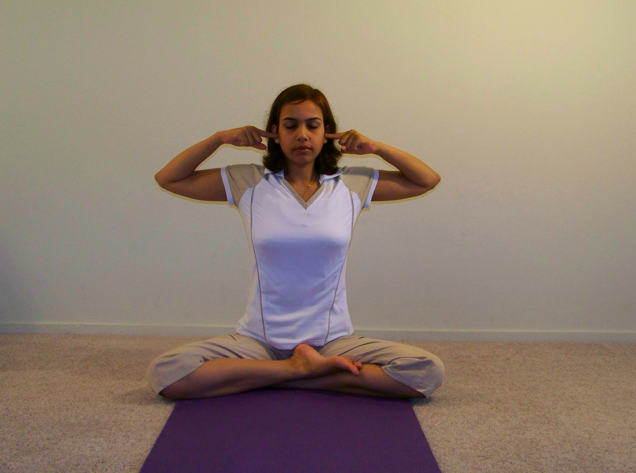
The word "Bhramari" comes from the sanskrit name bhramar which is Humming black bee. The practice of bhramari breathing calms the mind, reduces the stress or fight - flight response. It reduces cerebral tensions, anger, anxiety, insomnia, The blood pressure is also lowered. This pranayama is very effective in speeding up the healing of body tissues and may be practiced after surgeries.

The purpose of the Bhramari breathing is to reduce throat ailments. This may have positive effect on the endocrine glands specially thyroids and nervous system. In ancient text of Hatha Yoga Pradipika, Swami Swatmaram says that person becomes Lord of Yogis and mind gets absorbed in the supreme bliss. It has a calming effect on entire nervous system, especially it stimulates the parasympathetic nervous system, which induces muscular relaxation and is very effective in stress management. So this pranayama is very effective for relaxation of body and mind.

In this pranayama one needs to create a sound while exhaling and inhaling in the throat. The sound is similar to chanting of Om, especially the long mmm.. in Omkar. The sound should be deep, steady and smooth

Technique

Stage 1: Preparation

Sit in a comfortable meditation asana. The spinal cord should be erect, the head straight and the hands resting on the knees in chin or jnana mudra.

The ideal posture for this practice is padmasana or siddha / siddha yoni asana.

The position of nadanusandhana asana, which is used in nada yoga, may also be utilized as follows.

Stage 2: Body Posture

Sit on a rolled blanket with the heels drawn up to the buttocks. Place the feet flat on the floor with knees raised and the elbows resting on the knees.

Close the eyes and relax the whole body for a short time. The lips should remain gently closed with the teeth slightly separated throughout the practice. This allows the sound vibration to be heard and felt more distinctly in the brain. Make sure the jaws are relaxed.

Raise the arms sideways and bend the elbows, bringing the hands to the ears. Use the index or middle finger to plug the ears. The flaps of the ears may be pressed without inserting the fingers.

If the position of nadanusandhana has been assumed, plug the ears with the thumbs, resting the other four fingers on the head.

Bring the awareness to the centre of the head, where ajna chakra is located, and keep the body absolutely still.

Stage 3: Breathe Awareness

Breathe in through the nose. Exhale slowly and in a controlled manner while making a deep, steady humming sound like that of the black bee.

The humming sound should be smooth, even and continuous for the duration of the exhalation.

The sound should be soft and mellow, making the front of the skull reverberate.

This is one round.

At the end of exhalation, breathe in deeply and repeat the process.

Perform 5 rounds.

AWARENESS:

Physical – on the humming sound within the head and on making the breath steady and even.
Spiritual – on ajna chakra.

DURATION:

5 to 10 rounds is sufficient in the beginning, then slowly increase to 10 to 15 minutes. In cases of extreme mental tension or anxiety, or when used to assist the healing process, practice for up to 30 minutes.

TIME OF PRACTICE:

The best time to practice is late at night or in the early morning as there are fewer external noises to interfere with internal perception. Practising at this time awakens psychic sensitivity. However, bhramari may be practiced at any time to relieve mental tension, providing the surroundings are peaceful.

CONTRA-INDICATIONS:

Bhramari should not be performed while lying down. People suffering from severe ear infections should not practice this pranayama until the infection has cleared up. Those with heart disease must practice without breath retention.

BENEFITS:

Bhramari relieves stress and cerebral tension, alleviating anger, anxiety and insomnia, and reducing blood pressure. It speeds up the healing of body tissue and may be practiced after operations. It strengthens and improves the voice and eliminates throat ailments.

ADVANCED PRACTICE:

Once the basic form of bhramari has been mastered, jalandhara and moola bandhas may be incorporated into the practice in conjunction with internal breath retention. Do not strain when performing kumbhaka, one or two seconds is sufficient at first. The duration may be increased gradually as the technique is mastered. When the head has returned to the upright position and the ears are plugged, slowly exhale producing the humming sound. As an alternative practice, only more strongly. In this way, a humming sound can be produced on inhalation as well as exhalation.

PRACTICE NOTE:

Bhramari pranayama induces a meditative state by harmonizing the mind and directing the awareness inwards. The vibrations of the sounds create a soothing effect on the mind and nervous system. It is also an important aspect of nada yoga which uses subtle sound vibrations to attune the practitioners with their true nature.

Note: The word bhramari means ‘bee’ and the practice is so called because a sound is produced which imitates that of the black bee.

Source: Asana Pranayama Mudra Bandha by Swami Satyananda Saraswati.


07 August, 2011

ALONE


All our unhappiness comes from our our inability to be alone. The truth is, even if you can feel one with everybody, you are not a part of anybody. Truly happy is that person who is alone and yet feels complete by himself.

If you have to tread the unknown, you have to go alone. If you want to be a pathfinder, you have to walk alone. If you choose to be a trailblazer, you have to move alone. To be a rebel, a revolutionary, you have to stand alone. If you desire to be a Numero Uno, you have to run alone. If you want to reach where no one has reached, if you want to do what no one else has done, then you have to learn to walk alone in a crowd.

A million incomplete people can come together and they will still be incomplete. And those million incomplete people, in the presence of one complete person, will all feel complete. A million unlit candles and still darkness prevails. All that is needed is that one candle with light. Not only darkness will be dispelled, but also all the million candles will come to light.

It is not that half and half can come together to feel full. They will only make two halves. That’s why when two incomplete people get married believing that they can be each other’s better half, they continue to struggle with perpetual incompleteness in that marriage. That’s why when two incomplete people come together in business in partnership (part ownership) they soon part from ownership. As long as you need the other to complete you, there will be struggle. Only when you become one who can complete the other, there will be flow in your life.

Simply put, you have to rise from being dependent to becoming dependable.

Life is like an eternal train journey


In one of the stations, you get in. That’s your birth. You join the journey and start connecting with others in the compartment. They become your relatives. In some of the future stations a few will depart from the compartment, as well as the journey. You may mourn their exist. In certain other stations a few will join the compartment. You will celebrate their arrival. Some will go away from your compartment to other compartments, and some from the other compartments will come over to your compartment. Relationships will be lost and relationship will be gained. Addition and subtraction are inherent in this journey. And your time will come to leave the compartment, and thus the journey. That will be your death. But the train journey will continue. It was there before you joined the train. The journey is eternal and you being a part of it is ephemeral. You came alone. And, you will leave alone. And in between, you will want them all to be a part of you, and that will be your struggle.

A struggle because, no matter how many you surround yourself with, there is a part in you, which will always be alone. In that aloneness is your completeness. But you don’t want to accept that aloneness. You resist that aloneness. You try to avoid that aloneness. You want to run away from that aloneness and that’s your struggle. By detesting that aloneness you move away from that completeness and feel incomplete.

In the womb you were alone. No matter how loving your mother is, no matter how competent the gynecologist was, no matter how many participated in the process of your birth, still you fought the passage of your birth alone. Many may run to feed you, but in your hunger you are alone.

Everybody would have prompted you from outside and yet you were alone in attempting to articulate the first meaningful sound. Even though everybody around you kept saying, “We are there for you,” in your fears you were alone. When you had dared to face the situation, it didn’t matter who was there and who wasn’t, you were alone in your courage. Even if everybody surrounds you, right now, in reading and comprehending this ‘Awakening’ you are lone. Many would be a source of your joy, but your smile has to emanate from your aloneness. Many will come forward to wipe your tears, but your tears originate from your aloneness. In the womb, in the tomb, and in between you are alone. You resist it, you deny it, you try to avoid it, and you struggle with it; but nothing changes the truth. A part of you is, was and will always be alone.

Life should be a flow. It shouldn’t be a struggle. It needn’t be a struggle. But then, why so many struggle? There must be a way out. There is always a way out. What’s the way?

First step is acceptance.


The truths you resist are the battles you fight. In accepting the truth there is nothing to fight. Accept the truth. Accept the design. Accept the reality. Accept your aloneness. Whether you like it or not, the fact remains the skies are blue, the ocean is deep, there isdeath, there is no rewind to life, that’s your mother, and this is your body in this life time.

These are empirical realities and you cannot wish them to be otherwise. Deep within you are alone. That’s it. Accept it. To start with, it will not be an experiential acceptance, but to begin with, let it be intellectual acceptance.

Second Step is to practice conscious aloneness.


Dalai Lama suggests, “Spend sometime alone every day.” Blaise Pascal declared, “all men’s miseries derive from not being able to sit in a quiet room alone.” And, Franz Kafka prophesied, “It is not necessary that you leave the house. Remain at your table and listen. Do not even listen, only wait. Do not even wait, be wholly still and alone. The world will present itself to you for its unmasking, it can do no other, in ecstasy it will writhe at your feet. Trusts these wise men.

Practice conscious aloneness every day. For some time on a daily basis, withdraw yourself from all external stimulations. Learn to be with yourself, just yourself. Listen to music. Practice gardening. Walk through nature. Gaze at the stars. Sit before the waves. Sit in a park and just observe the dynamics around. Essentially, practice activities, where reciprocation from the other end is not possible, which means you cannot do these activities expecting anything in return.

Third step is to go into relationships looking at what you can give, and not what you can receive.

Start with one relationship. Be an active giver in this one relationship. Do not develop any emotional dependency on this one relationship. Be aware. Never expect any reciprocation from this one relationship. In this one relationship alone, always strive to complete the other and never expect the other to complete you. Whatever be your emotional needs, satiate those needs from the other relationships. This relationship is your aloneness-laboratory. In you serving it, it is serving you a purpose. Eventually you will achieve a transcendental flow in this one relationship. Even instinctively, you will no more seek anything from this one relationship and yet you will find immense fulfiment in being a giver in this relationship. Now take up one more relationship, then another, after that one more. Our relationship at a time, build a small world around you that feels complete with your presence. Be dependable. And, yet, never need that world for you to feel complete. Do not become dependent.

Physically you are the crowd. That’s why you are always lost in the crowd, always feeling incomplete. Rise above that. Psychologically you are a part of the crowd. That’s why you always seek the crowd, craving to feel complete with other’s help. Rise above that. Spiritually you are apart from the crowd. You walk with the crowd, and yet you are above the crowd. Everybody needs the sun. The sun needs none.

And, when you completely get in touch with your aloneness and you are absolutely peaceful in that state of aloneness, for the first time you experientially realize the existential truth: You are never alone. You feel the presence. You have nothing else to atain, for, It has attained you.

------------------------------------------------
Source: Excerpts from the article published in the magazine “FT”.
-------------------------------------------------

31 July, 2011

LORD VISNU


VISNU is one of the gods of the Trinity. Visnu represents the power of sustenance. The other two powers manifest in the world, namely creation and destruction are personified as Brahma and Siva respectively. Visnu is wedded to Laksmi the goddess of wealth. The significance is that sustenance or maintenance involves wealth. In order to maintain anything the maintainer must necessarily possess wealth.

In the Visnu Purana, Sage Vyasa refers to Visnu as the supreme all-pervading Reality, the Reality which is the substratum of the microcosm and macrocosm. The root ‘vis’ means ‘to pervade’. Visnu is the core of the human personality. He is the Atman which manifests Itself through body, mind and intellect as the individual. The same Visnu pervades the entire cosmos as Brahman.

Visnu is said to be lying on a great serpent, Sesa or Ananta, in an ocean of milk, ksirabdhi in heaven, Vaikuntha. He is said to be in yogic sleep, yoganidra. The body of the serpent is coiled to form Visnu’s bed. The serpent has a thousand heads and its hood is turned inward looking at its own coiled body. Visnu’s consort, Lakshmi, sits at his feet serving him.

Visnu represents the supreme within the human body, mind and intellect. The picture of Visnu lying on the serpent-bed in the milky ocean suggests the means of recognizing the Atman, the innermost core of man’s personality. The ocean is the mind with its infinite thoughts. The milky ocean stands for the sattvika mind. A sattvika mind is pure and serene. It is the highest quality of the mind. The other two states of the mind are rajasika, and tamasika. The rajasika mind is ever agitated. Tamasika is dull and stupid. When the mind is in the latter two states man gets involved in the mundane world. Only the sattvika mind lifts man to the higher realm of Divinity. In a sattvika mind alone can man recognize his Godhead.

The serpent is the ego with its many desires. In a sattvika mind the ego is turned inward. An extroverted ego loses sight of the Divinity within. When the same ego turns its attention inward, when its concentration is upon the inner Self instead of the outer objects of the world it recognizes the supreme Self, Atman. The thousand heads of the serpent turning inwards indicates that the thoughts are directed to single-pointed concentration meditation upon the Atman. When man holds his mind thus in deep meditation upon his supreme Self he realizes Visnu, the all pervading Reality.

Visnu is shown to be in yogic sleep—yoganidra. Yoga is derived from its root yuj, to unite. This indicates his perfect union with the infinite Reality. Nidra means sleep. A man who is totally absorbed in the supreme Self is asleep as it were to the happenings of the terrestrial world, reveling in the infinite bliss of Self-realisation. He is disinterested in the experiences of the finite world.

Goddess Lakshmi, the consort of Visnu, sits at his feet, serving him. Lakshmi symbolizes the wealth, power and glory of this world. When man seeks the higher Truth and is disinterested in the world the sense-objects seek him. When Visnu is sought, Lakshmi necessarily follow the seeker. But the trouble in the world today is that people try to seek Lakshmi directly. The moment runs after wealth, starts desiring, craving, asking and begging for it, the object of desires leaves him. That is the law.

Visnu is the one eternal, unmanifest Reality. The manifest world of plurality has emerged from the unmanifest Reality. Brahma, the creator of the world is shown as emerging from the navel of Visnu while he is lying on the serpent-bed. The naval portion represents the psychological centre, cakra from where sound originates in the form of paravak, transcendent speech. This inaudible sound passes through two more stages of developments, namely pasyanti and madhyama, before it becomes audible speech, called vaikhari. This audible sound is the quality of space, akasa. Space is the first of the five elements which constitutes the entire universe. The production of sound therefore symbolizes creation. This idea of the manifested world created from the unmanifested Reality is illustrated by Brahma emerging from the navel of Visnu.

Visnu is known to be blue in colour and clothed in yellow garb. He wears a crown and stands upon a lotus. He has four hands. All these are significant symbols indicating that Visnu is none other than the supreme Self, the changeless Reality around which all the terrestrial changes take place, the imperishable essence in the perishable world.

The blue colour of Vishnu indicates His infinite stature, Blue is associated with the infinite since immeasurable entitites like the sky or ocean appear blue in colour. Yellow is usually attributed to the earth for two reasons: one, the earth (silica) glows with a yellow fire when introduced in a colourless flame; and two, anything that is buried in the earth for a long period of time gathers a yellowish colour. Visnu, blue in colour and clothed in yellow, therefore, represents the descent of the infinite, immeasurable, transcendental Truth to the terrestrial realm i.e. God in a human form.

When the Infinite expresses through a finite form, there is a manifestation of an individual, jiva. The individual comes in contact with and reacts to the world with the help of four subtle instruments in him. They are the four constituents of his subtle body, viz., manas mind, buddhi intellect, ahankara ego and citta conditioned consciousness. The four hands of Visnu represent them.

The crown on Visnu’s head signifies his supreme sovereignty and lordship over the entire world of plurality. He is the one who maintains and protects all things and beings in the entire universe.

The deity stands upon a lotus. The lotus represents Truth. ‘Standing upon the lotus’ therefore, means that the ground or substratum which supports a God-man is the Brahman i.e., a God-man is ever rooted in the supreme Truth.

In his four hands Visnu holds a sankha conch, cakra discus, gada mace and padma lotus. The lotus indicates the final goal of human evolution. By showing the lotus, Visnu invites mankind to reach this goal of perfection by realizing his pure Self within.

The Lord blows his sankha conch, calling the people of the world to lead a pure and noble life so that they may shift their attention and interest from the material world to the supreme Self within. This call is the whispering of the conscience within. The conscience of man tells him to give up sensuous appetites and extrovert living and directs him to the higher life. But man does not heed this sacred voice from within. He continues with his passionate living until he experiences knocks and shocks leading to disappointment and dissatisfaction with life. The mace in the third hand is meant as a warning to draw man’s attention to this stern law of nature. If man, despite the growing sense of restlessness and agitations in his bosom, still persists in his sensual indulgences and does not turn towards the spiritual path, he meets with total disaster. The discus is meant to show man this inevitable end that he would reach if he were totally heedless to the warnings of nature.

On the other hand, a seeker who listens to the call from within and follows the spiritual path leading to the Truth, does not experience the knocks of the mace or the destruction of the discus. He lives a life of contentment and bliss until he reaches the abode of Truth and becomes one with Visnu.

Visnu’s message conveyed by his four hands is true not only with reference to an individual but to a society, community or a nation as well. As long as people do not heed the sacred advice of the scriptures and take to the spiritual values of life, they meet with sorrow and suffering in life. If this warning also is not heeded and the people continue to live extrovertedly fulfilling merely their sense gratifications, they are bound to meet with disaster. This is what history has been recording from generation to generation as evidenced by the rise and fall of nations and empires.

Source: Excerpts from the Book on “The symbolism of Hindu Gods and Rituals”.