Search This Blog

30 July, 2015

Guru: The Journey and the Goal


GURU PURNIMA


       Guru purnima is an Indian festival dedicated to spiritual and academic teachers.  This festival is traditionally celebrated by Hindus, Jains and Buddhists, to pay their respects to their teachers and express their gratitude.  The festival is celebrated on the full moon day of (purnima) in the month of June-July which is the Indian national calendar and the Hindu calendar.

IMPORTANCE OF GURUPURNIMA: 


       The celebration is marked by ritualistic respect to the guru.  The guru principle is said to be thousand times more active on the day of Gurupurnima than on any other day.  The word guru is derived from two words, gu and ru.  The Sanskrit root gu means darkness or ignorance, and ru denotes the remover of that darkness.  Therefore, a guru is one who removes the darkness of our ignorance.  Gurus are believed by many to be the most necessary part of life.   
 
       On this day, disciples offer puja (worship) or pay respect to their guru (spiritual guide).  Guru Purnima is also considered an especially beneficial day to practice yogic sadhana and meditation. In addition to having religious importance, the festival has great importance for Indian academics and scholars  Indian academic celebrate this day by thanking their teachers as well as remembering past teachers and scholars.


       Vedanta declares that our bondage and suffering are caused by lack of right thinking and knowledge.  Therefore, we need to undertake the right inquiry to correct our thinking and become free from all bondage.  Since our bondage is caused by ignorance, it can only be dispelled by knowing arising from inquiry.  Right inquiry depends on the availability of proper tools/means of investigation.  The Upanishads, containing the Vedanta vidya [knowledge], or the Vedanta sastra [scriptures] are the right means for this line of inquiry.


Why a Guru?  The question and the Key


       But how do we understand the meaning of Vedanta sastra?  To unlock that wealth of knowledge, somebody has to give us the key.  Some locks have numbers or combinations, but if we don't know the right combinations, we will not be able to open them!  Even a standard lock requires the right key.  To unlock and gain the right meaning of sastra, we need a guru.  Further, the body of scriptures, with its countless statements, is like an endless forest.  We would get completely lost in a forest without the help of a native of that place who can lead us out.  Similarly, in a maze we won't know the techniques to get out, until a guide help us.  In the same way a guru is required!


Who is the Guru?  The preparation and Search


     First, we have to examine how intense is the longing for that knowledge.  The need for a guru will be determined only by how urgently that knowledge is wanted.  


       Therefore, Shankaracharya has said, "Intensify your desire and longing for knowledge, and when you have that, you will get appropriate guidance, according to your evolution, and according to your need."  At first you may need only some instructions and that will be enough for you.  But as you go deeper and deeper into your inquiry, when there is a real need for someone to guide you, when you need to sit at the feet of a teacher to learn, you will also get that!  So you don't have to go guru hunting.

Kinds of Gurus


       There are many kinds of gurus.  The word, "Guru" is defined by its Sanskrit root as "granti" - the one who teaches you."  We learn so many things from so many teachers.  While we know the teachers in various secular fields, we can also notice of that there are different kinds of teachers through the stages of religious practices [rituals] up to the spiritual search for the highest knowledge.  Let us take a closer look.  Many priests come to Hindu homes and do various rituals.  They guide us to perform special karmas with instructions and methods of worship.  The aim of this is the concentration and purification of our mind.  Such a priest then becomes an "upasana guru".  Thereafter, someone comes as a jnana Guru, one who enlighten you.  He teaches you what is Atma and what is Anatma and he may or may not give you a mantra.  Teaching can come to us in many ways.

How does the Guru Teach?


     It is said in Vivekachudamani that there are three things that are gained only by God's grace and that they are very rare:  One is a human birth, and having gained a human birth, to have the desire for liberation.  But the most difficult thing is to get protection and guidance from an enlightened person.  So a guru is required to guide us on this inner journey, but what does the guru do?


     We may have guru, but how do we gain knowledge?  In our scriptures (sastra) it is said, "A person who has a teacher, that person will know this Truth."  It is also said, "The one who has faith in the teacher and in scripture, that person gains knowledge."  Thus, when you get a teacher, you must have full faith in him, for it is only then that you gain that knowledge.  And you must look upon your teacher as God, he should not be taken as a human being!  In the scriptures, there are very clear instructions.

      "The Upanisad mantras reveal their true hidden meanings to that seeker who has supreme devotion to God and the same devotion for his guru."  A real seeker does not see the difference between God and guru.  But there are people who say, "This is all guru-worship.  These gurus want to be revered and therefore they say all this. There are so many teachers in all walks of life; in the same way guru is also a teacher and a human being.  So gurus are only human!"

What is guru's job?


       Now what is guru's job?  When a seeker, who has already passed through the states of karma and upasana, meet the guru, the guru's job is to give him the higher knowledge.  Karma and Upasana are the primary steps for purifying the mind and making it ready for higher knowledge and as the seeker is now of a higher caliber, he should be given the higher knowledge.  That guru must give him the knowledge by which he will realize the supreme Truth.  There are such beautiful mantras in our Upanishads:

"When a qualified student has reached the teacher, 
then the teacher should give him the highest knowledge."  

      The teacher then will not tell him to do any particular ritual for the student has gone beyond all that.  Receiving this Knowledge, this person reaches Truth.
~~~~~~~~~~~~~~~~~~~~~~~~~~~~~~~~~~~~~~~~~~~~~~~~~~
Source: Article written by Swami Tejomayananda in Mananam Series.
~~~~~~~~~~~~~~~~~~~~~~~~~~~~~~~~~~~~~~~~~~~~~~~~~~

21 June, 2015

In Indian Culture Why do we worship Lord Subramanya?


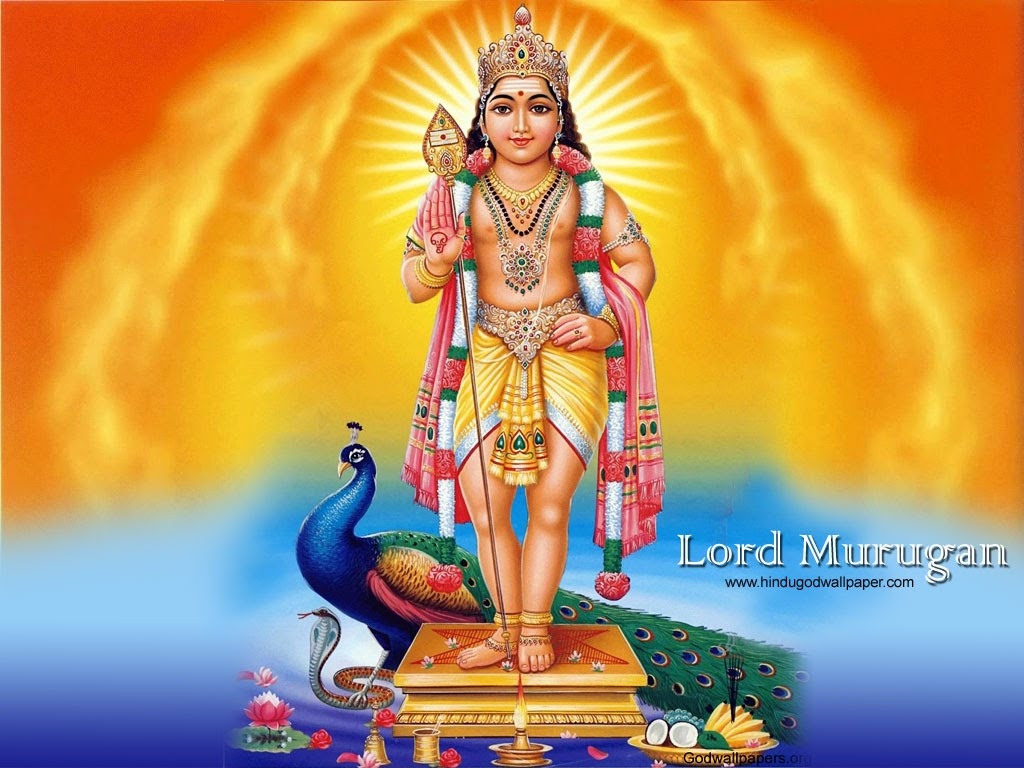
       The second son of Lord Siva is Subramanya.  Subramanya is also known as Kartikeya and Sanmukha. Subramanya holds a spear or javelin, sakti in his hand.  He rides a peacock.  The peacock grips a snake with his feet. Subramanya like other gods is a picture of human perfection.  Through symbolism, he indicates ways and means to reach that Perfection.


Symbolism behind Lord Subramanya


       A normal human being goes through three experiences, waking, dream and deep sleep states of consciousness.  Waking state is the state of consciousness which man experiences when he is awake.  The dream is the state of consciousness which he experiences when he is dreaming.  The deep-sleep is dreamless sleep when he experiences a realm of nothingness.  Beyond these three states is the state of God-consciousness.  That is the fourth state, called turiya.  Man is hardly aware of this state much less does he experience it.  Nevertheless, that is man's original and real state, the man's original and real state, the core of his personality, his essential and infinite being.  When you transcend the limitations of the waking, dream and deep-sleep you reach that state.  This is the state symbolised by Subramanya.


       Subramanya holds a sakti spear in his hand.  Most of the Hindu gods wield weapons of destruction. Siva holds trident, trisula.  Vishu carries a discus, chakra.  Rama carries a bow.  These weapons are meant to attack, to destroy vasanas, desires within oneself.  It is only by the destruction of vasanas, desires that you attain your divine state.  Your vasanas, desires are the impurities covering the Godhead within you.

Man minus desires is God.
God plus vasanas is man.  

       Holding a spear, Subramanya proclaims the destruction of all his vasanas.  You too, by destroying your vasanas, can attain your supreme Stature.


Significance of peacock as vehicle


       The peacock is the vehicle of Subramanya.  The significant characteristic of a peacock is its vanity   The vanity of the peacock is seen during its continuous dancing with its colorful feathers spread out like a fan. The peacock is blue in color   This subtly suggest the means the seeker should adopt to attain the state of Subramanya.


Who is real Subramanya?


       Man is now absorbed in the material layers of his personality.  All his attention and interest are upon the physical body, mind and intellect.  Identifying himself with them he imagines himself to be a perceiver-actor at the physical level, a feeler at the mental level and a thinker at the intellectual level.  He is proud of his physical, mental and intellectual  achievements.  He is lost in the mire of perceptions, emotions and thoughts. Thus, he assumes a limited personality.  He has no glimpse of the supreme Self within him.  He has now to shift his attention and concentration from his body, mind and intellect to the Godhead,  Atman within him. The Godhead is his supreme Self within. The essential nature of man is his Godhood and not his physical-mental-intellectual personality.  He must now lose the false vanity of his physical-mental-intellectual personality, ego and develop he true 'vanity' of his infinite Being.  He must ride on the blue bird representing his infinite Being.  Blue colour is associated with infinity.  The sky is blue, so is the ocean.  He must repeat to himself that he is God - Aham Brahma Asmi; Aham=I, Brahman=God, Asmi=am.  He must constantly remember the Truth - I am God.  If he practises this, concentrates and meditates upon his real Self, he becomes the Atman.  He attains the state of Subramanya.


Symbolism behind Peacock clutching the serpent with its claws


       The peacock is the enemy of the serpent.  It is seen clutching the serpent with its claws.  The serpent is not killed but held in captivity.  This symbolises complete control over he ego.  The serpent represents the ego.  The ego carries the poisonous mind.  It is interesting to note that the poison in the fangs of the snake does not kill the snake.  It is harmful only when it is directed outside.  Similarly, the mind is harmless as long as it is contained within.  The moment it is directed outside, used extrovertedly it assumes the vanity of I-ness and my-ness.  It becomes poisonous.  It generates desires and destroys peace and tranquility.  The infinite Atman becomes the limited individual.  But when the ego is held firm and the desires are kept under perfect control, man gains mastery over the mind and reaches perfection.


Moses holding serpent


       In the Old Testament, Moses is said to have fallen into this state of slavery.  Walking on Mount Sinai, Moses saw a serpent.  He trembled at the sight of it.  Just then he heard a voice saying, "Hold it, hold that hissing serpent, Moses."  It was the voice of God.  Moses hesitated.  He shuddered at the thought of it.  The voice was insistent, "Get hold of it". Moses took a bold step and held the serpent.  Instantly, the serpent turned into a staff.  And that staff worked miracles.  Moses touched a rock with the staff and fresh water gushed forth from it.  When the Israelis were fleeing for safety the Red Sea stood in their way.  Moses again used his staff.  No sooner did his staff touch the sea than the waters divided and dry land appeared before them.  Thus the Israelis passed into safety.


Get hold of the Ego


       Similarly, Reality seems terrifying.  You would keep off from it.  You would prefer to indulge in the pleasures of your senses.  You don't want to stifle your ego and experience your Godhead.  You are afraid to leave the comforts of the known and plunge into the unknown.  You are ignorant of the supreme bliss of Godhood.  Your ignorance is the cause of your fright.  Vedanta, the supreme philosophy of life, offers you knowledge to overcome ignorance, emboldens you to smoother your ego an reveal your Self.  It seems difficult.  The suggestion to annihilate your ego appears frightening.  But you must take the plunge fearlessly.  Get hold of the ego.  Destroy your selfishness.  Assert your divinity.  Embrace your Godhead within.  You will become the monarch of all you survey.  All your worries and anxieties vanish instantly.  You live in perfect peace and bliss.


Sanmukha

       Another form of Subramanya is Sanmukha.  This form has six faces, sat means six, mukha means face. Sanmukha is a deity with six faces.  It is only means that the supreme Self expresses itself in the human being through the five sense organs and mind.  The Self within has no expression but when It functions through the sense organs and mind It manifests as a human being.

~~~~~~~~~~~~~~~~~~~~~~~~~~~~~~~~~~~~~~~~~~~~~~~~~
Source: Excerpts from the book on "The symbolism of Hindu Gods and Rituals
~~~~~~~~~~~~~~~~~~~~~~~~~~~~~~~~~~~~~~~~~~~~~~~~~

03 May, 2015

Jnana Mudra and Chin Mudra


Jnana Mudra (psychic gesture of knowledge)


Assume a comfortable meditation posture.
Fold the index fingers of both hands so that the touch the inside root of their respective thumbs.  
Spread the other other three fingers of each hand so that they are relaxed and slightly apart.
Place the hands on the knees with the palm facing downwards and the three unbent fingers and thumb of each hand pointing towards the floor in front of the knees.
Relax the hands and arms.

Variation


      Some people prefer to practise jnana mudra with the tips of the thumb and index finger touching.  This is also correct.  

Chin Mudra (psychic gesture of consciousness)


Chin mudra is performed in the same way as jnana mudra except that the palms of both hands face upwards, with the backs of the hands resting on the knees.  Relax the hands and arms.

Sequence


       One of these two mudras should be adopted whenever practising meditation, unless otherwise specified.


Benefits


     Jnana mudra and chin mudra are simple but important psycho-neural finger locks which make meditation asanas such as padmasana, siddhasana, siddha yoni asanas, sukhasana, vajrasana and others, complete and more powerful by redirecting the nervous impulses from the hands upwards to the body.  The palms and fingers of the hands have many nerve root endings with constantly emit energy.  When the finger touches the thumb, a circuit is produced which allows the energy that would normally dissipate into the environment to travel back into the body and up to the brain.


       When the fingers and hands are placed on the knees, the knees are sensitised, creating another pranic circuit that maintains and redirects prana within the body.  In adition, placing the hands on the knees stimulates a nadi which runs from the knees, up the inside of the thighs and into the perineum.  This nadi is known as gupta or the hidden nadi.  Sensitising this channel helps stimulate the energies at mooladhara chakra.

       When the palms face upward in chin mudra, the chest area is opened up.  The practitioner may experience this as a sense of lightness and receptivity which is absent in the practice of jnana mudra.

Variation


       Jnana and chin mudras are often performed with the tip of the thumb and index finger touching and forming a circle.  Beginners may find this variation less secure for prolonged periods of meditation as the thumb and index finger tend to separate more easily when body awareness is lost.  Otherwise, this variation is as effective as the basic position.

Practice note:


       The effect of chin or jnana mudras is very suble and it requires great sensitivity on the part of the practitioner to perceive the change in consciousness established.  With the practice, however, the mind becomes conditioned to the mudra and when it is adopted the signal to enter a meditative state is transmitted.


Note:


      The word jnana means 'wisdom' or 'knowledge', thus jnana mudra is the gesture of intuitive knolwedge.  Chin, on the other hand, is derived from the word 'chit' or 'chitta' which means 'consciousness'.  Chin mudra, therefore, is the psychic gesture of consciousness.


     Symbolically, the small, ring and middle fingers represent the three gunas or qualities of nature: tamas, inertia; rajas, activity and creativity; and sattwa, luminosity and harmony.  In order for consciousness to pass from ignorance to knowledge, these three states must be transcended.  The index finger represent individual consciousness, the jivatma, while the thumb symbolises supreme consciousness.  In jnana and chin mudras the individual (index finger) is bowing down to the supreme consciousness (the thumb), acknowledging its unsurpassed power.  The index finger, however, is touching the thumb, symbolising the ultimate unity of the two experiences and the culmination of yoga.

~~~~~~~~~~~~~~~~~~~~~~~~~~~~~~~~~~~~~~~~~~~~~~~~~~
Sources:
1) Excerpts from the book on "Asana Pranayama Mudra Bandha" by Swami Satyananda Saraswati.
2) Excerpts from the book on "Meditations from the Tantras" by Swami Satyananda Saraswati.
~~~~~~~~~~~~~~~~~~~~~~~~~~~~~~~~~~~~~~~~~~~~~~~~~~~

06 April, 2015

16 Step Puja Worship in Hindusim or Shodasa – Upachara Puja


Preparatory Steps to the Sixten-step Puja

1.  Light a Lamp.


2.  Offer flowers chanting:


      dipajyotih param brahma dipajyotir janardana
      dipo me haratu papam dipajyotir namo'stu te


       The light of the lamp stands for Brahman, the unmanifest truth as well as for Lord Vishnu (in his manifest form).  Let that light of lamp remove my papas, results of omissions and commissions.

3. a)  Acamanam


       Take a sip of water after chanting each of the following mantras:

       Om acyutaya namah
       Salutation unto the Lord who is imperishable.

       om anantaya namah
       Salutation unto the Lord who is limitless.

       om govindaya namah
       Salutation unto  Lord Govinda.

      b) Guru Dhyanam - Visualisation of one's Guru.


       gurubrahma gururvishnuh gururdevo mahesvarah
      gurusaaksat param brahma tasmai srigurave namah

       The Guru is Brahma, the guru is Vishnu, the guru is Mahesvara.  The guru is ultimate truth.  Unto that guru my prostration.

       c)  Vignesvara Dhyanam -  Visualisation of Lord Ganesa.


         Lightly tap the temples with the knuckles, chanting the following mantra


         suklambaradharam vishnum sasivarnam caturbhujam
         prasannavadanam dhyayet sarvavighnopasantaye


       May one meditate upon Lord Vignesvara, who wears the white garment, who is all pervasive, who has bright complexion (like the full moon), who has four hands (representing all power), who has an ever-smiling face (or an elephant face), for the removal of all obstacles.

       d) Pranayamah - Breath Control


       While closing the right nostril with the right thumb, inhale through left nostril chanting mentally:

       Om bhuh om bhuvah om suvah om mahah om janah om tapah om satyam


       Hold the breath inside by closing the right nostril with the right thumb and left nostril with ring finger, while chanting mentally:

       om tatsaviturvarenyam bhargo devasya dhimahi dhiyo yo nah pracodayat


       Close the left nostril with the ring finger and exhale through the right nostril chanting mentally:

       om apo jyotiraso mrtam brahma bhurbhuvassuvarom


       The seven worlds are pervaded by the Lord the creator.  Om is the basis of everything.  That Lord is the one who is the most worshipful.  We meditate on that all-knowing Lord.  May he set our intellects in the right direction.  The Lord is the waters in the rivers and oceans, the light in the luminaries, the taste in food, the essence of everything, the body of the vedas, the threefold worlds and om.

4.       Sankalpah - Statement of the purpose of the puja.


       Clasp your right palm over the left palm holding a flower; place them on your right thigh.  Offer the flower at the altar, after chanting:

       mamopatta - samasta duritaksayadvara sriparamesvara - prityartham devapujam karisye.

       I do the puja to Lord Deva* to obtain the grace of Lord through the removal of all afflictions resulting from my omissions and commissions.

* Deva may be substituted by any other deity, such as Mahaganapati, Mahavisnu, Mahasarasvati, Mahalakshmi.

5.   Asana Puja - Worship of the Earth to Purify the Seat.


      Sprinkle water on your seat while chanting:

       prthvi tvaya dhirta lokah devi tvam visnuna dhrta
      tvam ca dharaya mam devi pavitam kuri casanam

       O Mother Earth, all the worlds are held by you.  You are held by Visnu.  May you hold me, O Goddess, and purify my seat.


6.  Ghanta Puja - Worship of the Bell to Purify the Atmosphere.


       Ring the bell while chanting:

       agamartham tu devanam gamanartham tu raksasam
      kurve ghantaravam tatra devatahvanalanchanam

       For the arrival of the deities and for the departure of destructive forces, I ring the bell, marking the invocation of the deity.

7.     Kalasa Puja - Worship of Pot of Water to Purify all Puja materials


       Offer flowers in the pancapatram, small pot, which has been filled with water and decorated with sandal paste and vermilion.  Cover the pancapatram with the right palm and chant:

       gange ca yamune caiva godavari sarasvati
      narmade sindhu  kaveri jalesmin sannidhim kuru

       O Rivers Ganga, Yamuna, Godavari, Sarasvati, Narmada, Sindhu, Kaveri, may you all be present in this water!

       Sprinkle the water from the pancapatram on all the puja materials and on oneself.

8.    Atma Puja - Worship of the Self.


      Fold hands and chant:

       deho devalayah proktah jivo devassanatanah
       tyajedajannanirmalayam so ham bhavena pujavet

       The body is the temple.  The jiva is the deity of this temple since the beginningless time.  May one remove wilted flowers that are looked upon as ignorance and worship the Lord with an understanding that he is non-separate from oneself.

The Sixteen step Puja:


1.  Avahanam - Invocation


       Visualise the form of the deity and chant a sloka addressed to the deity.  Take flowers and aksatas, rice, in hand and after chanting, offer at the feet of the Lord.

     असमिन बिम्बे देवं ध्यायामि   (or the chosen deity)  ध्यायामि
          asmin bimbe sri devam           (or the chosen deity)   dhyayami
     असमिन बिम्बे देवं ध्यायामि  (or the chosen deity)  आवाहयामि
          asmin bimbe sri devam           (or the chosen deity)  avahayami

          I visualise Lord Deva, I invoke his form in this image.

2.  Asanam - Seat


       Offer flowers at the feet of the Lord, chanting:

    आसनं सामर्पयामि
        asanam samarpayami
        O Lord! I offer you a seat.

3.  Padyam - Water for Washing the Feet


       Offer water in a cup, chanting:

    पपद्यम् समर्पयामि
        padyam smarpayami
       O Lord! I offer you water for washing the feet.

4.  Arghyam - Water for Washing the Hands


       Offer water in a cup, chanting:
   
   अर्घ्यं समर्पयामि
       arghyam samarpayami
       O Lord! I offer you water for washing the hands.

5.  Acamaniyam - Water for Inner Purification


       Offer water in a cup, chanting:

   अचामनियं समर्पयामि
       acamaniyam samarpayami
       O Lord! I offer you water for inner purification.

6.  Madhuparkam - Sweet


       Offer water (or any offering such as ghee, curds, honey or sugar) in a cup, chanting:

   मधुपर्कं समर्पयामि
       madhuparkam samarpayami
       O Lord! I offer you the sweet.

7.  Snanam - Bath


      Offer water in a cup, chanting:

   स्नानं समर्पयामि
      snanam samarpayami
      O Lord! I offer you a bath.

      Offer water in a cup, chanting:

      स्नानान्तरम् अचामनित्यं समर्पयामि
   snanantaram acamaniyam samarpayami
    After the bath, I offer you water for inner purification.


8.  Vastram - Cloth


     वस्त्रं समर्पयामि   
          vastram samarpayami
          O Lord! I offer you cloth.

          Offer flowers or aksatas, chanting:


       उपवीतं समर्पयामि     
              upavitam samarpayami
             O Lord! I offer you the sacred thread.

9.  Abharanam - Ornaments


      Offer flowers or aksatas, chanting:

       आभरणं समर्पयामि
       abharanam samarpayami
       O Lord!  I offer you ornaments.

10. Gandham and Kumkum - Sandal paste and vermilion


      Offer flowers, aksatas or sandal paste, chanting:

       गन्धान् धारयामि
       gandhan dharayami

       O Lord!  I offer you sandal paste.

    गन्धस्योपरि हरिद्र्कुन्कुमं समर्पयामि
       gandhasyopari haridrakunkumam samarpayami
       O Lord! I offer you vermilion over the sandal paste.

11. Puspam - Flowers


       Offer flowers, chanting:

       पुष्पाणि समर्पयामि
       puspani samarpayami
       O Lord! I offer you flowers.

       One may chant    अषतोत्तरसतनमवलिः "astottarasantanamavalih", the one hundred and eight names of the Lord.  With each name offer flowers.

12.  Dhupam - Incense


      Show the incense to the Lord with circular clockwise motion three times; simultaneously ring the bell with the left hand, and chant:

धूपमाघ्रापयामि
       dhypamaghrapayami
       O Lord!  I offer you incense.

13.  Dipam - Lamp


       Show the lamp held in the right hand with a circular clockwise motion three times; simultaneously ring the bell with the left hand, and chant:

       दीपं संनदर्शयामि
       dipam sandarsayami
       O Lord! I offer you this light.

       Offer a spoon full of water in the cup, chanting:

       dhupadipanantaram acamaniyam samarpayami
       O Lord! After dhupa and dipa, I offer you water.

14.  Naivedyam - Food


a)  Sprinkle water on the food while chanting:

ॐ भुर्भुवसुवस्सुवः ॐ तत्सवितुर्वरेण्यम् भर्गो देवस्य धीमहि धियोयोनः प्रचोदयात
       om bhurbhuvassuvah om tatsaviturvarenyam bhargo devasya dhimahi dhiyoyonah pracodayat.

       The three worlds are pervaded by the Lord, the creator.  Om is the basis of everything.  That Lord is the one who is the most worshipful.  We meditate on that all-knowing Lord.  May he set our intellects in the right direction.

b)  Ring the bell and offer the sanctified food with a flower in hand, with a sweeping motion from the food up towards the altar, for each of these six chants:

रॐ प्रणय स्वाहा   ॐ अपानाय स्वाहा    ॐ व्यानाय स्वाहा
     Om pranaya svaha.  Om apanaya svaha.      Om vyanaya svaha.


ॐ उदानाय स्वाहा. ॐ समानाय स्वाहा.   ॐ ब्रह्मणे स्वाहा
      Om udanaya svaha.  Om samanaya svaha.  Om brahmane svaha.

       I offer to this prana.  I offer this to apana.  I offer this to vyana.
       I offer this to udana.  I offer this to samana.  I offer this to the Lord.

c)  Offer food at the feet of the Lord while chanting:

       naivedyam nivedayami
       O Lord!  I offer you food.

d)  Offer water while chanting:

   नैवेध्यन्तरम् अचामनियं समर्पयामि
       naivedyanantaram acamaniyam samarpayami
       O Lord! I offer you water after the food.

e)  Offer betel leaves and nuts, chanting:

ताम्बूलं समर्पयामि
       tambulam samarpayami
       O Lord!  I offer you betel leaves and nuts.

*(If you don't have tambulam you may chant tambulartham aksatan samarpayami and offer aksatas instead).

15.  Karpura-niranjanam - Lighted Camphor


a)  Standing, show the camphor with circular clockwise motion three times; simultaneously ring the bell with the left hand and chant:


      na tatra suryo bhati na chandratarakam
      name vidyuto bhanti kuto yamagnih
      tamevabhantamanubhati sarvam
      tasya bhasya sarvamidam vibhati

       There the sun does not shine, nor do the moon or stars.  There this lightning does not shine;  what to talk of this fire:  That (awareness) shining, everything shines after it; by the light of that awareness, all this shines in various forms.

       Offer lighted camphor, chanting

    कर्पुरनिरन्जनं संटर्शयामि
        karpuranirajanam sandarsyami
        O Lord! I show you lighted camphor.

b)  Offer a spoonful of water into the cup while chanting.

   अचामनियं समर्पयामि
       acamaniyam samarpayami
       O Lord!  I offer you water for inner purification.

16.  Vandanam - Salutation


a)   Continue standing and offer flowers, chanting:

   मन्त्रपुष्पं समर्पयामि
      mantrapushpam samarpayami
      O Lord!  I offer you flowers with sacred chants.

b)  Turn around oneself three times clockwise while chanting the mantras given below:


       yani kani ca papani janmantarakrtani ca
      tani tani vinasyanti pradaksinapade pade

       May those omissions and commissions done in this life and also in the previous births and the resulting afflictions perish with every pradaksina.

       tava tattvam na janami kidrso si mahesvara
       yadrso si mahadeva tadrsaya namo namah

       O Lord!  What is your nature?  I do not know your nature.  Whatever be your nature, I offer salutations to you who are of that nature.

      Offer salutations, chanting:

   प्रदक्षिणनमस्करान् समर्पयामि
       prakasinanamaskaran samarpayami
       O Lord!  I offer you circumambulation and prostration.

c) To seek forgiveness, one may chant:

       mantrahinam kriyahinam bhatihinam mahesvara
       yatpujitam maya deva paripuranam tadastu te

       O Lord!  may the puja done by me, even though devoid of proper mantras, wanting in the steps and in devotion, be received by you as complete.

       Release the deity by offering flowers and aksatas at the altar and chant:

       asmad bimbad avahitam sridevam yathasthanam pratisthapayami

       The Lord Deva (or the chosen deity) invoked at this atltar is placed again in his own glory.

       Samarpanam - Dedication to the Lord.

       Take water int he right hand and pour the water in front of the deity while chanting:

       kayena vaca manasendriyairva buddhayatmana va prakrtessvabhavat
       karomi yadyat sakalam parasmai narayanayeti samarpayami

       Unto Lord Narayana, I dedicate all the acts that I perform with my body, speech, mind, senses and intellect which are born of deliberation or natural tendencies.

       Complete the puja with salutation.

       Take the water, flowers and naivedya as prasada from the Lord.


~~~~~~~~~~~~~~~~~~~~~~~~~~~~~~~~~~~~~~~~~~~~~~~~
Source:  Excerpts from the book on Purna Vidya - Puja & Prayers by Swamini Pramananda Saraswati and Shri Dhira chaitanya.
~~~~~~~~~~~~~~~~~~~~~~~~~~~~~~~~~~~~~~~~~~~~~~~~