Search This Blog

Showing posts with label Self Improvement. Show all posts

31 May, 2016

Self-Belief


       When your past results are good and favourable, then this feeling that 'I know I can do it' or self-belief would become so strong that it may even begin to affect your faith.  If a few results are unfavourable in the past for certain decisions that you have indulged in, then you take refuge in faith so much that there is no more self-belief in you.


       Faith is in knowing that there is a cosmic system that is acting between your choices and consequences. Choices are the steps that you take that is born out of human intelligence and consequences are born out of the infinite intelligence.  For every choice executed we invite a consequence.  While we can have control over our choices, we can only have expectations over consequences. which are,

1] I get more than what I expected, [>]
2] I get what I expected [=].
3] I get less than what I expected. [<]

       For example, when I execute the choice of starting a business on my own, the four possible consequences are, [>] The business might turn out to be roaring success, [=] The business return might be up to my expectations, [<] It might go through slump. [X] It can turn out to be an utter failure.  Whichever may be the consequence, I can take it as a feedback and still execute another choice.

       So there is a  cosmic intervention between the choice and consequences, by whatever name you may want to call it, god or law of karma, which determines the consequences of your life.

       When every choice that you execute expecting something in life, turns out consequences that you expected, or more than what you expected, you start feeling 'Whatever I want is happening'.  When this happens repeatedly, it results in a self-belief which is shadowing your faith.  You may fail to realize that the cosmic intervention is right now happening in your favour because of certain alignments in your life. Knowingly or unknowingly that karmic actor is working in your favour right now.  The favourable results can make the 'I' in you very loud, muffling your faith.


       This happened to even Arjuna and Krishna had to remind him saying, 'Arjuna, from where are you getting this feeling, that you are doing all these things?  The truth is, not a single arrow from that other side has touched you and every arrow from you is producing the results you wanted on the other end.  Because of this happening, Arjuna you have started feeling that only you are producing all these results; you are not realizing that, this thumb of yours cannot move without my providential sanction.'


       The other extreme is, if every choice that you have executed has somehow resulted in consequences less than what you expected or completely opposite of what you had expected, you feel like a victim in life. When nothing seems to be working as planned, you understand the helplessness of your finite intelligence and begin to understand the power and the potency of that cosmic intervention.  At that point most will run towards faith, hoping that it will alter the circumstances for you.  If Krishna could do everything, then Arjuna need not have fired those arrows, isn't it?


       When belief is delivered from the womb of faith, neither self-belief becomes arrogance nor spirituality becomes a refuge.  When you realize "Without me God will not, Without God I cannot, God plus me miracles are possible' neither the desperate running towards spirituality will be there nor will there be a haughty tone in your activities.  You will understand that 'Divine energy' plus 'my intelligent effort' plus 'my faith in that energy' - a threefold combination produces the desired results.


       Sri Ramakrishna, by himself, wouldn't have cared to take his wisdom to the world.  Swami Vivekananda, by himself, couldn't have enlightened the world.  Yet, the energy of Shri Ramakrishna plus the efforts of Swami Vivekananda plus the faith Swami Vivekananda had in his Master Shri Ramakrishna - caused a renaissance in the world.


       Rama, by himself, could not have traced Sita.  Hanuman, by himself, could not have crossed the seas in search of Sita.  Yet, the energy of Rama plus the efforts of Hanuman plus the faith Hanuman had in his Lord Rama - caused miraculous possibilities.


       Krishna, by himself would not have fought the war.  Arjuna, by himself, could not have fought the war. Yet, the energy of Krishna plus the efforts of Arjuna plus Arjuna's faith in his Bhagwan Krishna - was an absolute winning combination.


       The energy of Jesus Christ plus the efforts of Mother Teresa plus her faith n her Good Shepherd - made a difference to millions of lives.

       Even from an organisational parlance, the energy of a visionary plus the effort of the team plus the faith of the team in the vision of their visionary - builds a legendary organisation.

       But the intelligent effort is still dependent on you; this effort is the human manifestation in all the providential plans and it has to be executed only through you.  There has to be tremendous amount of self belief to put in the intelligent effort and f the self-belief is born out of your unshakable faith then your life becomes a series of win.

       Energy is the spiritual aspect of life and intelligent effort is the material aspect of life.  The formless by itself has no way to manifest and the form by itself is still a spiritual orphan.  The bridge between these two ends is the faith, it bridges spirituality and the material reality.  


         The energy of Ramakrishna, Rama, Krishna and Jesus didn't work for all those who put in their efforts, but it did work for Vivekananda, Hanuman, Arjuna, Teresa and the likes who worked with faith in their sources of energy.  It is Faith that connects the object of your effort with the source of  energy.  However, remember, faith does not free man from the responsibility of his efforts.  For the effort to be consistent and wholehearted you need self-belief.  Faith without effort is expecting God to do man's work, which is mere foolishness.


       'Energy plus Effort plus Faith' is a miraculous combination.  Explore the infinite possibilities with self-belief rooted in Faith.

~~~~~~~~~~~~~~~~~~~~~~~~~~~~~~~~~~~~~~~~~~~~~~~~~~~~~
Source: Excerpts from the Article published in Infinithoughts magazine.
~~~~~~~~~~~~~~~~~~~~~~~~~~~~~~~~~~~~~~~~~~~~~~~~~~~~~~

27 October, 2015

Subconscious Mind and Habits


We are what we repeatedly do.
Excellence is not an act, but a habit.
~ Aristottle


Subconscious Mind and Habits forming positive habits and character


       We are all born to lead successful lives, but our conditioning leads us to failure.  We are born to win but are conditioned to lose.  We often hear comments like, "this person is is just lucky, he touches dirt and it turns to gold" or, "he is unlucky; no matter what he touches, it turns to dirt."  These comments are not true of anyone.

       If you were to analyze the lives of the lucky and unlucky individuals being commented on, you would find that the successful person is doing something right in each transaction, and the failure is repeating the same mistake time and again.  Practice does not make perfect - only perfect  practice makes perfect.  Practice makes permanent whatever you do repeatedly.  Some people keep practicing their mistakes and they become perfect in them.  Their mistakes become perfect and automatic.

       Cultivating a habit is like plowing the field.  It takes time.  Habits generate other habits. Inspiration is what gets us started, motivation is what keeps us on track, and habit is what makes it automatic.  


       The ability to show courage in the face of adversity; show self-restraint in the face of temptation, choose happiness in the face of hurt, show character in the face of despair, and see opportunity in the face of obstacles are all valuable traits to possess.  But these traits do not just appear; they are the result of constant and consistent training, both mental and physical.  In the face of adversity, our behaviour, whether positive or negative can only be what we have practiced.  When we practice negative traits such as cowardice or dishonesty in small events, and hope to handle major events in a positive way, it won't happen because that's not what we have practiced.

       If we permit ourselves to tell a lie once, it s a lot easier to do it a second and third time until it becomes a habit.  Success lies in the philosophy of "sustain and abstain."  Sustain what needs to be done and abstain from what is detrimental until this becomes habitual.  Human beings are more emotional than rational.  Honesty and integrity are the result of both our belief system and practice.  Anything we practice long enough becomes ingrained into our system and becomes a habit.  A person who is  honest most of the time gets caught the first time he tells a lie, whereas a person who is dishonest most of the time gets caught the first time he tells the truth.

       Honesty - or dishonesty to self and others becomes a habit:  The choice is ours as to which we practice.  Whatever response we choose, our thinking pattern becomes habitual.  We form habits, and habits form character.  Before, we realize that we have got the habit, the habit has got us!

       Someone once said, "Our thoughts lead to actions, actions lead to habits, and habits form character."  Character leads to destiny.  Form the habit of thinking right.


FORM GOOD HABITS


       Most of our behaviour is habitual - comes automatically without thinking.  Our character is the sum total of our habits.  If we have positive habits, then we have good character.  Conversely, if we have negative habits, others will find our character lacking.  Habits are a lot stronger than logic and reasoning.  In the life cycle of habit formation, a habit starts by being too weak to be felt, and ends up becoming too strong to get out of.  Habits can be developed by default or determination.  If we don;t decide what habits to form, by default we may end up with bad habits.

HOW DO WE FORM HABITS?


       Anything we do repeatedly becomes a habit.  We learn by doing.  By behaving courageously, we learn courage.  By practicing honesty and fairness, we learn these traits.  By practicing these traits, we master them.  Similarly if we practice negative traits such as dishonesty, unjust behavior, or lack of discipline, that is what we become good at.  Attitudes are habits.  They lead to behavior patterns.  They become a state of mind and dictate our responses.

CONDITIONING


       Conditioning is the psychological process whereby we get used to (or become conditioned to) specific events occurring in association with each other.  The most famous example of conditioning is Pavlov's dogs.  


       The Russian scientist Pavlov would ring a bell each time he fed his dogs.  Of course, the dog would salivate at the sight of their meal.  Pavlov did this for some time.  Then Pavlov rang the bell and did not produce the food.  The dogs still salivated because they had been conditioned to expect the bell with their food.

       Most of our behaviour comes as a result of conditioning.  We are all being conditioned continuously by the environment and the media, and we start behaving like robots.  It is our responsibility to condition ourselves in a positive manner.

       If we want to do anything well, it must become automatic.  If we have to consciously think about doing the right thing, we will never be able to do it really well.  That means we must make it a habit.

       When I was a student of martial arts, I observed that even the black belts were practicing block/punch, the basics, because if they needed to use these skills, they had to come automatically.

       Professionals make things look easy because they have mastered the fundamentals of whatever they do.  Many people do good work with promotions in mind,  But the one to whom good work becomes a habit is deserving.

       Good habits are hard to come but easy to live with.  Bad habits come easy but are hard to live with.

HOW DO WE GET CONDITIONED?


       Think of the mighty elephant that can lift in excess of a ton of weight with just its trunk.  How does an elephant get conditioned to stay in one place, tied with a weak rope and a stake, when it could easily uproot the stake and move wherever it wants?  The answer is that when the elephant was a baby, it had been tied by a strong chain to a strong tree.  The baby is not used to being tied, so it keeps tugging and pulling the chain, all in vain.  A day comes when it realizes that tugging and pulling will not help.  It stops and stands still.  Now it is conditioned.


       And when the baby elephant becomes the mighty full grown elephant, it is tied with weak rope and a small stake .  The elephant could, with one tug, walk away free but it goes nowhere, because it has been conditioned.

       We are constantly being conditioned, consciously or unconsciously, by exposure to:


  • The kind of books we read;
  • The kind of movies and TV programmes we watch;
  • The kind of music we listen to;
  • The kind of company we keep.

        While driving to work, if you listen to the same music every day for several days and if the tape deck breaks down, guess what tune you will be humming?

       Insanity is defined as doing the same thing over and over and expecting different results.  If you keep doing what you have been doing, you will keep getting what you have gotten.  The most difficult thing about changing a habit is unlearning what is not working and learning positive habits.

THE GIGO PRINCIPLE


       The computer phrase GIGO (Garbage in, garbage out) is very sound.


  • Negativity in; negativity out.
  • Positivity in; positivity out.
  • Good in; good out.


       Our  input equals our output.  Our subconscious mind does not discriminate.  Whatever we choose to put into our mind, our subconscious will accept and our behavior will reflect accordingly.

       Television has a considerable impact on influencing our morals, thinking and culture.

       While bringing us lots of useful information, television has also contributed heavily to degrading our tastes, corrupting our morals and increasing juvenile delinquency.  By the age of 18, a child sees more than 200,000 violent acts in TV.

       Advertisers are good at conditioning their audience.  Companies spend close to a million dollars for a 30 second and during a major event.  Obviously, they are getting results.  We see an ad for a particular brand of soft drink or toothpaste and we go to the supermarket and buy that brand.  We don't want just any soft drink b ut only that brand.  Why?  Because we are programmed and act accordingly.

       When we watch TV or listen to a radio advertisement, our conscious mind is not listening, but our subconscious is open and we receive whatever is being dumped in.  Have you ever argued with a TV?  Of course not.

       When we go to the movies, we laugh and we cry because the emotional input has an immediate emotional output.  Change the input and output changes.

YOUR CONSCIOUS AND SUBCONSCIOUS MIND


       The conscious mind has the ability to think.  It can accept or reject.  But the subconscious only accepts.  It makes no distinction regarding input.  If we feed our mind with thoughts of fear, doubt and hate, the auto-suggestions will activate and translate those things into reality.  The subconscious is like a data bank.  The subconscious is like the automobile while the conscious is like the driver.  Of the two, the subconscious mind is more powerful.  The power is in the automobile but eh control is with the driver.

       The subconscious mind can work for us or against us.  It is not rational.  If we are not successful, we need to reprogram the subconscious.  


       The subconscious mind is like a garden, it does not care what we plant.  It is neutral; it has no preferences.  If we plant good seeds, we will have a good garden, otherwise we will have a wild growth of weeds.  I would go a step further to stay, even when we plant good seeds, weeds still grow and the weeding process must continue constantly.

       The human mind is no different.  Positive and negative thoughts cannot occupy the mind simultaneously.

       In order to succeed, we need to get programmed in a positive way.

HOW DO WE GET PROGRAMMED?


       Remember how we learnt to ride a bike.  There are four stages:  The first stage called unconscious incompetence.  At this stage, we don't know that we don't know.  The young child does not know what it is to ride a bike (unconscious) nor can he ride a bike (incompetence).  This is the stage of unconscious incompetence.

       During the second stage, conscious incompetence, the child becomes conscious of what it is to ride a bike but cannot ride one himself, so he is consciously incompetent.

       But then he starts learning g and is at the third stage of conscious competence.  Now he can ride a bike, but has to concentrate on the mechanics of the process.  So with conscious thought and effort, the child is competent to ride a bike.

       The fourth stage unconscious competence comes when the child has practiced consciously riding the bike so much that he does not have to think.  It becomes an automatic process.  He can talk to people and wave to others while riding.  He has reached the stage of unconscious competence.  At this level, he doesn't need the concentration and thinking because the behavior pattern has become automatic.

       This is the level that we want all your positive habits to reach.  Unfortunately, we probably also have some negative habits that are at the unconscious competence stage and are detrimental to your progress.

NATURE ABHORS A VACUUM


       I have two nephews who are tennis buffs.  One day their father said to me, "This game is getting very expensive.  There is the rackets, balls, lawn fees and now they have a coach.  It all costs money."  I asked him, "It is getting expensive compared with what?"  He could have them stop playing tennis and save some money.  But if they stopped, and came home from school with all their time and energy at hand, what would they do?  He stopped to think quietly for some time and then said, "I think I will have them continue.  It is cheaper this way."  He realized the importance of keeping them involved in positive activities.  Otherwise they would be attracted to the negative because nature abhors a vacuum.  There is either a positive or negative; there is no neutral ground here.

       Character building becomes a habit.  If we want to build a pleasing personality, we have to examine our habits closely.  What begins as an occasional indulgence turns into a permanent flaw.  Ask yourself the following questions:

1.  Do you let the quality of your work deteriorate?
2.  Do you indulge in gossip?
3.  Are envy and ego constant companions?
4.  Is empathy in short supply?

       We are creatures of habit.  That is good because if we have to constantly think before doing anything, we would never get anything done.

       We can control our habits b y exercising self-discipline over your thoughts.  We need to harness the power of our subconscious mind.  We need to cultivate positive habits its during childhood which builds character in adulthood.  But it is never too late to start.  Every exposure to a positive or negative makes a difference.  Learning new habits takes time but positive habits, once mastered give new meaning to life.

       Having an optimistic or pessimistic outlooks is a habit.  Habits are a matter of the pain and pleasure principle.  We do things either to avoid pain or to gain pleasure.  So long as the gain is more than the pain, we continue with the habit.  But if the pain exceeds the gain, we drop it.  For example, when the doctor tells the smoker to stop he replies, "I cannot stop!  It is a habit that I enjoy!"  and he goes on smoking.  The pleasure is greater than the pain.  One day he is faced with a major medical problem and the doctor says, "You better stop smoking immediately if you want to live."  Most would stop.  Why?  Now the pain is greater than the pleasure.

RESISTANCE TO CHANGE


       When people recognize or become aware of their negative habits, why don't they change?

       The reason they don't change is because they refuse to accept responsibility.  The pleasure of continuing is greater than the pain.  They may:

  • Lack the desire to change
  • Lack the discipline to change
  • Lack the belief that they can change
  • Lack the awareness for the need to change

       All of those factors prevent us from getting rid of our negative habits.  We all have a voice.  We can ignore negative behavior and hope it will go away - the ostrich approach - or face up to it and overcome it for life.  Behavior modification comes from overcoming irrational fears and getting out of the comfort zone.  Remember,  fear is a learned behavior and can be unlearned.

       The following excuses are the most common explanations for not changing negative habits:
  1. I have always done it that way.
  2. I have never done it that way.
  3. That is not my job.
  4. I don't think it will make any difference.
  5. I'm too busy.

FORMING POSITIVE HABITS


       It is never too late to change, regardless of your age and how old the habit is.  We can change by being aware of what needs to be changed and using techniques that modify behavior.  The old adage that you can't teach an old dog new tricks is wrong.  We are human beings, not dogs.  Nor are we performing tricks.  We can unlearn self- destructive behavior and learn positive behavior.

       An Earl Nightingale said, the secret of successful people is that they form the habit of doing things that failures don't like to do and won't do.  Just think about the things that failures don't do.  They are the same things that successful people don't like to do, but they do them anyway.  For example, failures don't like discipline, hard work, or keeping commitments.  Successful people also dislike discipline, hard work (an athelete doesn't like and want the discipline to get up and train every day but he does it regardless), but they do these things anyway because they have formed good habits.

       All habits start small but end up eventually being very difficult to break.  Attitudes are habits and can be changed.  It is a question of breaking and replacing old negative habits with new and positive ones.

       It is easier to prevent bad habits than to overcome them.  Good habits come from overcoming temptation.

       Happiness and unhappiness are a habit.  Excellence is the result of repeated conscious effort until the behavior or the attitude becomes a habit.

AUTO-SUGGESTION


       What is auto-suggestion?  An auto-suggestion is a statement made in the present tense, of the kind of person you want to be.  Auto-suggestions are like writing a commercial about yourself, for yourself.  They influence both your conscious and subconscious mind that, in turn, influence attitude and behavior.

       Auto-suggestions are a way to program your subconscious mind.  They can be either positive or negative.

       Examples of negative auto-suggestions are:

  • I am tired.
  • I am not an athlete.
  • I have a poor memory.
  • I am not good at math.

       When you give yourself a negative auto-suggestion, your subconscious mind believes it and it becomes a self-fulfilling prophecy and starts reflecting in your behavior.  For example, when a person who gives himself the auto-suggestion, "I have a poor memory," is introduced to a new person, he will not make the effort to remember the name because he tells himself, "I have a poor memory, so there's no point in even trying to remember."  Of course, he won't remember the person's name the next time they meet, and will again tell himself, "I have a poor memory."  It's a never-ending cycle - a self fulfilling prophecy.

       When a person repeats a belief often enough, it sinks into the subconscious and becomes reality.  A lie that is repeated often enough becomes accepted as the truth.

Why make positive statements?


       Because you want to create a picture in your mind of what you want to have rather than what you don't want.  Any picture that you hold in your mind becomes reality.  Auto-suggestions are a process of repetition.  If you repeat a statement often enough, it sinks into your subconscious mind.  For example, if you tell yourself, "I am relaxed.  I am cool, calm and collected," you will start responding to situations in a cool, calm and collected manner.


       Auto-suggestions should not be phrased in a negative way.  Don't say, "I am so disorganized."  Instead say, "I am organized person."  When a negative word comes in the auto-suggestion, it forms a negative picture that we want to avoid.  If I tell you, "don't think of the blue elephants."  it's like that the image of a blue elephant immediately propped into your mind.


       Auto-suggestions should be positive statements because we think in pictures, not in words. If I say "mother", what comes to your mind?  Most likely a picture of your mother comes to your mind, and not the word "mother".

       Make your auto-suggestions in the present tense.  Why?  Because your mind tell the difference between a real experience and an imagined one.  For example parents are expecting their child to come home at 9.30 p.m. but the kid is not home and it is now I am.  What is going through the parents' mind?  They are probably hoping everything's okey.  "I hope that kid didn't get into an accident."  What is happening to their blood pressure?  It is going up!  This is an imagined experience.  The reality could be that the kid is having fun at a party and is plain irresponsible.

       Supposing the kid was actually coming home at 9.30 p.m. but got into an accident.  What is happening to the parent's blood pressure?  It is still going up!  In the first scenario the imagined experience was not true.  In the second scenario it was true.  The body's response in both cases was identical.  Our subconscious mind cannot tell the difference between a real and an imagined experience.

Prepare the Subconscious


       Auto-suggestions can be used to eliminate negative habits and develop positive ones.  We have all used auto-suggestions unconsciously.  For example when we have to catch an early morning flight, when we get into bed we tell ourself that we have to wake up at six.  And invariably, we do (often , even without an alarm clock).  A prepared subconscious mind works for us.

       Auto-suggestion is a way to program and condition our mind to make a statement into a self-fulfilling prophecy.

       Auto-suggestion is a repetitive process through which you feed our subconscious with positive statements that translates into reality.  Repetition alone is not enough, unless it is accompanied by emotions and feelings.

       Auto-suggestions without visualization will not produce results.  The first time our mind receives an auto-suggestion, it rejects it.  Why?  It is an alien thought, contrary to our belief system.  Success depends on our ability to concentrate and repeat the process.

VISUALIZATION


       Visualization is the process for creating and seeing a mental picture of what we want to have or do, or the kind of person we want to be.  visualization goes hand in hand with auto-suggestion.  Auto-suggestion without vizualisation is mechanical repetition and will be ineffective.  In order to see results, feelings and emotions - visualization must accompany auto-suggestions.

CAUTION!


       Auto-suggestion may not be acceptable to our mind the first time we do it because it is an alien thought.  For example, if for the past few decades I have believed that I have a poor memory and now all of a sudden, I tell myself that I have a good memory, my mind will reject it, saying, "You liar!  You have a bad memory!" - because that is what I have believed up to this point.  It will take 21 days to dispel this notion.  Why 21 days?  Because it takes a minimum of 21 consecutive days of conscious, continuous practice to make or break a habit.  If you listen to an audio tape in 21 days and your player break down - guess what tune you are humming.

       The big question is:  Is 21 days of conscious effort a heavy price to pay to change a lifetime for the better?  Not really but only the committed do i.  The auto-suggestion process sounds simple, but it is not easy.  But you can do it.  Follow the steps in the next section to turn your auto-suggestions into reality.

21-DAY FORMULA TO FOR POSITIVE HABITS


Translating Auto-Suggestion into Reality

1.  Go to a spot where you won't be disturbed,

2.  Make a list of your auto-suggestions. Make sure they are positive and in the pesent tense.

3.  Repeat auto-suggestions at least twice a day; first thing in the morning and at the end of the day.
In the morning, your mind is fresh and receptive; at night you deposit the positive picture into your subconscious to be working for you overnight.  You can also write each auto-suggestion on a few small sticky notes.  Place them in places you will see them throughout the day (on your bathroom mirror; on your car's dash-board, inside your daily planner, inside your desk drawer).  Seeing the notes throughout the day will cause you to repeat the auto-suggestions again.

4.  Auto-suggestions alone will not work.,  Use visualization as well.

5.  Do this for atleast 21 days until it becomes a habit.

ACTION PLAN


An ounce of action is worth ton of theory. ~ Friedrich Engels

IMPORTANT:
AUTO SUGGESTIONS AND VISUALIZATIONS WILL ONLY WORK AS A SUPPLEMENT (NOT A SUBSTITUTE) TO A TIME BOUND, GOAL-ORIENTED ACTION PLAN.

1.  We all have some negative habits that are pulling us down.  Take 15 minutes alone and undisturbed to make a list of all the negative habits that are pulling you down.

2.  Take 14 minutes alone and undisturbed to make a list of all positive habits you want to develop,

3.  Make a list of auto-suggestions you can give yourself to develop the positive habits listed above.

3.  Follow the 21 day programme with visualizations.

~~~~~~~~~~~~~~~~~~~~~~~~~~~~~~~~~~~~~~~~~~~~~~~~~~~~~~
Source: Exceprts from the book on "YOU CAN WIN" by Shiv Khera
~~~~~~~~~~~~~~~~~~~~~~~~~~~~~~~~~~~~~~~~~~~~~~~~~~~~


08 July, 2012

Destiny Designing


Introduction

          If life is a puzzle, Destiny Designing is a solution.  If life is simple, Destiny Designing makes it even simpler.  Each Destiny Designing analyses a certain aspects of life and delves into the depths of it.  The most striking feature of it is its simplicity.  It explains the “WHY” behind things.  Destiny Designing is an answer to all your unanswered questions of life.  Clarity is power.  Read Destiny Designing to gain clarity and the power that comes with it.

            A bunch of plastic flowers lived inside a flower vase, obviously sheltered and protected from the winds, the rains and even the sun’s rays.  One day a bouquet of rose flowers was placed next to them.  The presence and the fragrance of those gorgeous roses made one of the plastic flowers feel ashamed of its existence.  So it prayed to God, “I do not want to live as a faceless flower; please turn into a rose.”

            God replied, “Why do you want to get into unnecessary trouble?  The life of a rose is very arduous.  Someone will always pluck it.  The sun will burn the petals.  It has a very limited lifespan.  You are living a well-protected life, Do not forsake it.”

            The plastic flower insisted, “I have long lived a sheltered life.  Now, I want to feel real.  I want to feel the life of LIFE.  I want to fight death.  Please transform me into a rose.”  God finally yielded and it became a rose.  Almost immediately, its saga of trials and tribulations began.  A young boy plucked a few of its petals.  The midday sun followed and it burned the remaining petals.  As the day progressed it was feeling dehydrated and was beginning to dry down.  The other plastic flowers gathered around the rose and said, “We knew this would happen.  Don’t you see how secure you were in your old life?  Granted, even as plastic flowers we had our problem but they were old and familiar problems.  We were used to them.  Do you see what a mess you have made of your life?”

            To this the rose replied, “You are all fools.  It is far better to live as rose, even if it is for just twenty-four hours than to live in lifelong security as mere plastic flowers.  It was great to breathe, to feel the warmth of the sun and to be in communion with life.  I might wither away in twenty-four hours, but before I die I would have emitted fragrance.  I have achieved my soul’s fulfiment.  I lived fully and I am going to die fully.  As far as you are concerned, you live a life of living death.  To have been a flower and not to have known fragrance at all… is not to have lived at all.  I am real.”

            Life itself isn’t secure.  Then, where is the question of security within life?  Then why choose to be a plastic flower?  Why not be the real rose?  In searching for security, we resist change, and in resisting change, we stagnate.  We build our own comfort zones and become prisoners in our own comfort zones.  That which does not change, does not grow.  And, that which does not grow, dies.  And growth is your willingness to give up who you are, in order to become, what you can be.

            A seed is very well protected as long as it remains a seed.  There is a security in remaining a seed whereas a plant is always vulnerable.  To sprout into a plant makes the seed susceptible; but then, what else is the purpose of the seed?  It contains a thousand forests within itself and it is only when the seed transforms into a plant that those possibilities are opened.  If the seed resists change and remains a kernel, it is no better than a pebble on the beach.

            The most important quality of great people is in their willingness to change.  It is in the willingness to give up the life of a caterpillar that it becomes a butterfly.  That which does not change does not grow.  That which does not grow, dies.  Grow, we must.  So, change, we must.  Growth and the willingness to change are inseparable.

            If changes are the way to growth and growth is the way to greatness, then why is change always resisted?  Let us take an example.  See, when you were a just-born you were comfortable because you were completely dependent on your environment.  To learn to crawl was an uncomfortable transition because you would have bruised your knees so many times.  But this transition to learn to crawl was a needed one for you to grow.  Once you learnt to crawl, you were completely comfortable once again.  Now learning to walk was another uncomfortable transition because you would have fallen down and hurt yourself so many times.  But, again this transition to learn to walk was a needed one for you to grow.  Once you learnt to walk, you were completely comfortable once again.  So it was from blabbering to talking to communicating.  Therefore, it was from scribbling to writing to drawing.  So it was from school to college to work.

            Comfort zone – uncomfortable transition – again a new comfort zone – another uncomfortable transition – another new comfort zone – and one more uncomfortable transition – This is the cycle of growth.  Grow, we must.  So, change, we must.  So, we cannot avoid uncomfortable transitions.  Change is the willingness to give up an existing comfort zone and the willingness to take up an uncomfortable transition.  Giving up an existing comfort zone is never easy.  Uncomfortable transitions are never easy.  But grow, we must.  So change, we must.  So we cannot avoid uncomfortable transitions.

            The cycle of change is such that before change you are comfortable, after change you will again be comfortable; but the transition is never comfortable.  However, the comfort you experience after change is always of a higher degree than the comfort you experienced before change.  So, legends permanently keep their life in transition, for that’s the only way to grow up.  The alternative is mere stagnation.

            To sweep issues in a relationship under the carpet is comfortable; to talk and resolve the issue is never comfortable, but once the issue is sorted out, that’s where the higher comfort is. To sleep those extra hours is comfortable; to get up and exercise is never comfortable; to get up and exercise is never comfortable, but once the body is fit after adhering to the exercise routines, that’s where the higher comfort is.  To smoke is comfortable; to give up that craving for nicotine is never comfortable, but once you have transcended the desire for nicotine, that’s where the higher comfort is.

            So people who made it to the top in life had the vision to see the higher realities of life at the end of those uncomfortable transitions.  The willingness of a woman to go through the transition of labour gives birth to a new life.  Similarly, your willingness to through the transition of change will give a new life.

            On the bottom of a quiet pond lived a little colony of water bugs.  They did notice that every once in a while one from their colony clinging to the stem of a pond lily and gradually moved out of sight and was seen no more.  They wondered, “Why would anybody give up this comfortable life, great friends, and move up in search of a new life?”  One more found himself climbing up the lily stalk, and before he knew what was happening, he had broken through the surface of the water and fallen onto the broad, green lily pond above.  When he awoke, a startling change had come to his old body.  His movement revealed four silver wings and a long tail.  He moved his wings and found himself up above the water.  He had become a dragonfly!!  Swooping and dipping in great curves, flying through the air, experiencing the freedom of space, he truly felt on ‘Top of the World’. 

            Now, if this water bug had not given up the comfort of remaining a water bug, it would have never become a dragonfly.  This is where all great people stood out from the rest.  They were willing to change and grow.  They never sought comfort zones.  They never thought what is ‘Easy’ for me.  They always thought what is ‘Good’ for me.  So, do not settle.  Keep changing.  Do not settle.  Keep growing.  Do not look at the transition.  Look at the possibilities beyond the transition.

            People do not dare to give up their certainty for uncertainty.  They are afraid to push ahead.  It is not that they cannot.  Just that they don’t.  They wait and wait, hoping that some mysterious power may liberate them.  These people finally die still waiting.

            It is astonishing as to how the world makes way for a resolute soul and how obstacles get out of the pathof a determined man, who believes in the power of change and growth.  Transcendence is like taking the lantern in the hand knowing that you will always have light, just enough for your ext step, no matter how dark, for the light will move along with you.  Take oe step, then take another step and then another.. till your reach the top. 

Design your Destiny

            If you keep doing the same stuff, you will keep getting the same results.  If you have to achieve what you have not achieved before, then you must be willing to do what you have never done before.  That simply means, you must change.

            Mahatma Gandhi said, “Become the change you wish to see.”  You first have to “Become the change you wish to be,” much before you “Beome the change you wish to see.”  Give up who you are, and become what  you can be.  Sometimes, you need to give up, in order to go up.
------------------------------------------------------------
Source: Excerpts from the articles published in FT.

10 June, 2012

Why Do We Complain?


You can complain because roses have thorns, or you can rejoice because thorns have roses.-- Ziggy.

       Many of us pass through certain phases of life, 'rough patches' as they are called, when everything seems to go wrong for us.  In such circumstances, people do tend to become negative, and at such times, we need to offer them help and support to carry them through, and the inspiration and incentive to cultivate faith and repose their trust in God.

       But, there are some people who complain no matter what happens to them!  It seems that complaining has become a way of life with them, that they simply cannot stop cribbing!  It seems to have nothing to do with pessimism or optimism, pain or suffering: it just seems that complaining has become second nature to them!.

       I must say that some of the people who suffer from pain and illness, some of the patients I have met in hospitals are not always of this type.  They discover a lot to be grateful for in the midst of their pain and affliction; they enjoy what little respite they get from pain; they discover that such and such movements of their limbs can be accomplished without strain, and are very happy about it.  They are happy to have visitors; they are grateful to the nursing staff; they thank their doctors for the relief they feel.

       But some of us simply cannot stop complaining.  Regardless of where they are, what they are doing, or what is happening to them, they keep on complaining!  The traffic is too bad; the telephone lines are congested; the weather is too hot or too cold; people are rude or indifferent; servants are lazy and inefficient; the subordinates are insubordinate!  And I could go on and on nobody understand me; nobody appreciates me; nobody knows what I am going through; nobody cares; nobody helps, nobody knows...

       Of course I feel sorry for such miserable people: but when I offer them a remedy for their misery, they refuse to take it!  I say to them, "You try to be what others are not; you must try and appreciate others; you must care; you must understand; you must help others..."

       They look at me as if I have suddenly switched over  to Latin or Greek.  They simply cannot register what I am saying to them.  They want only to be at the receiving end of care, compassion, understanding, help, appreciation and sympathy.  They do not want to give away any of those beautiful feelings to others!.

       Selfish people are born complainers.  Nothing will ever convince them that a lot of people are far worse off than they are; nothing will persuade them that they have a lot to be grateful for; they prefer the martyr's syndrome:  I am the most misunderstood, unappreciated creature in the entire world!

       Complaints stem from a sense of unhappiness and dissatisfaction with life.  But the way to meet this dissatisfaction is to set things right.  Complaining constantly will only make things worse; and let us not forget -- when we complain constantly, we become difficult and unpleasant to deal with and people would definitely like to keep their distance from us.  Thus, we are cutting off the source of help and support that we feel we need so desperately!

       All of us complain at one time or another: we are fed up with waiting interminably in a traffic jam or in a doctor's waiting room; we are angry when flight schedules are disrupted and our carefully laid travel plans are messed up completely; we react with indignation when government offers treat us with disrespect and callousness.  This is but natural:  in such situations, complaining, even loud complaining becomes a way of letting off steam, as we say.  But the trouble starts when we make complaining a habit, and that that complaining is the best way to deal with life and its problems.  Compulsive complainers make it their way of reacting to life.  No  matters what happens, they complain; they cry; they express their unhappiness volubly; they protest; they feel very sorry for themselves; they leave very little room for anyone else to step in and do anything for them!

       People start complaining when they are unhappy; but complaining sometimes becomes a bad habit which they cannot get rid of.  It is like those little children who get into the habit of sucking their thumb, and cannot thereafter give it up when they are scolded or pulled up.  The worst thing is that many of them actually begin to feel better when they complain persistently:  let me hasten to add, this is an entirely illusory feeling.  They have managed to make the others miserable with their cribbing; they have unburdened themselves of all their negativity, and are entirely satisfied with their session:  but the trouble is, their problems are no nearer to being solved.

       People who complain constantly do not wish to take the responsibility for themselves and their actions.  Ask  them why their goals are not accomplished, and they will come up with excuses.  What they don't realise is their energy and intellect is so focused on finding faults with others that they cannot concentrate on achieving their goals.  They do not realise how tedious and futile their constant complaints are: they have effectively undermined their own power and efficiency, and have retained control only by constant complaining.

       Constant complainers also suffer from a false sense of superiority because they are finding fault with everyone except themselves.  They think  others love listening to their complaints; they do not realise that they are actually driving away their friends, and will soon have only themselves left as their sole audience!

       Just look at some of their complaints:

1.   I am overworked and it is the fault of my boss.  (What about your time management?)

2.  I am late, and it is the fault of the public transport system.  (Why don't you try leaving home early?)

3.   My targets have not been met and it is the fault of my subordinates.  (Why don't you lead from the front?)

4.   My job is the most difficult and unpleasant.  (Why don't you make way for someone who can handle it?)

5.   I have been overlooked for promotion because the system is corrupt.  (Have you looked at your own performance record?)

       I said, all of us complain at one time or another.  Dynamic complainers find a way to solve their problems; they give vent to their negativity through complaints and then go on to find a way out of their difficulties.  Cribbers are far from dynamic; they are in fact defeatists who are more interested in making excuses and shifting the blame on to others.  They are happy and satisfied just complaining: they do not want to lose control over their pet excuses.

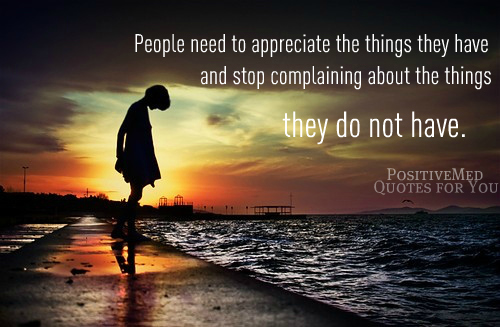
       Let's stop focusing on all that is wrong and focus instead on all that's right; let's stop cribbing about what we don't have and look stead what's there for us; let's take the time to appreciate people for what they are and what they can do, instead of focusing on their defects.  When we complain and criticise constantly, we are drawing negativities into our lives.  Each time we utter something negative about your life, we actually begin to believe it more and more, and make it come true in our lives.  Our imagined ills become our reality.  Needless to say, the reverse is also true.  When we believe things are going good, they become better, actually.  When we visualise success and talk about all that is positive, success actually begins to take shape for us.

       So, let us stop complaining, start thinking, appreciating and feeling good about ourselves.

-------------------------------------------------------------------------------------------
Source: Excerpts from the Book on "Stop Complaining:  Start Thanking!" by J.P. Vaswani.
--------------------------------------------------------------------------------------------

29 April, 2012

Is desire an evil?


       Among all living beings, human beings are considered the most superior and the most powerful.  Our sastras or scriptures give the reason for our superiority:  human beings alone are endowed with the three fold power known as icchasakti, jnanasakti and kriyasaktiIcchasakti means the power to desire; Jnanasakti is the power to know and kriyasakti is the power to do.

       It is because of jnanasakti that we have so many educational institutions and research centers.  The body of knowledge is forever expanding.  And it is because of kriyasakti that the face of the earth has undergone such tremendous transformation, changes that we see all around us touching our lives every day -- from using the ATM to surfing the Internet.  Thus, science alone is not enough; science must be converted into technology.

       Equally important is icchasakti.  The power to desire is the driving force behind jnanasakti and kriyasakti.  Let us suppose we have the power to know (a keen mind and a sharp intellect) but not the desire to know.  The power to know is of no use if there is no desire to know.  Similarly we can have the power to do (the stamina and strength) but this power is useless if we have no desire to do anything.  The power to know and do is made meaningful by the power to desire. 

       In our tradition we respect all three powers equally.  In fact, we worship these powers considering them a blessing from God.  One of the names in Lalitha-sahasranama (verse 130, nama 658) is 'icchasakti-jnanasakti-kriyasakti-svarupini, - The One who is the power of will, power of knowledge and power of action'.

       Here we face a problem.  While we look upon desire as a blessing, our scriptures - despite glorifying the desire on one hand - strongly condemn kama or desire which is looked upon as an internal enemy.  In the Bhagavad-Gita (3.37) Lord Krishna calls kami (a person with desires) a great papi or sinner -  'It is desire, it is wrath begotten by rajoguna: all consuming, all sinful, know this as the foe on earth'. 

       Katha Upanisad (2.3.14) states - 'When a man has all his heart's desires destroyed, he attains immortality and becomes one with Brahman in this very life'. 

       Again, in the Bhagavad-Gita (2.25), Lord Krishna defines liberation as the destruction of all desires - 'when a man abandons, O Partha, all the desires of the heart and is satisfied in the Self by the Self, then he is said to be stable in wisdom'

       To the above scriptural references, we can also add the well known English saying 'Desire is the root cause of all evil'.

       Are the scriptures confusing us?  Is desire a blessing or a curse?  On every new year day we make resolutions which are nothing but expressions of our desire.  Should we continue to make these resolutions - considering desire a blessing - or do we refrain from doing so - considering desire a curse?  What should we do?  What is the scriptural stand?

       Scriptures cannot afford to condemn desires.  The very existence of the scriptures is only to fulfill desires.  Our scriptures prescribes four purusarthas or goals of life: dharma (values), artha (wealth), kama (desire), and moksa (liberation). 

       To achieve the above goals or purusarthas we must first have a desire for them.  A doubt can arise.  Desire itself is one of the purusarthas.  Does it mean we must have a desire for desire just as we hve a desire for the other three?  When desire is mentioned as a purusartha, it must be understood to mean desired objectives such as a successful career, winning a competition etc.  Veda-purva-bhaga (the earlier portion of the Vedas) contains elaborate procedures like homa and yajna for fulfilling our desires like getting progeny, acquiring cattle, property, etc.  Even God has desire. 

       Taittirya-upanisad (2.6) says, 'He, the Atman desired:  May I become many:  Let me procreate Myself.'  Bhagavan desired and created the world.  The incarnations of the Lord are manifestations of Bhagavan's desire.  If desire is to be condemned sastra itself becomes irrelevant.  Desire is the starting point, the basis, the foundation of for all our activities, endeavours, pursuits.  Desire is indispensable for every being.  Thus desire and desiring power are a blessing in the form of icchasakti because of which alone we are able to make use of our jnanasakti and kriyasakti and progress in life.  Hence, we look upon desire not as an evil or course, but a blessing.

       Then why do our scriptures condemn desire?  Why do scripture define liberation as giving up desire as we have quoted earlier?  When our scriptures condemn desire, we must understand it to mean abnormal desire.  To understand what abnormal desire is, we first understand what is 'abnormal' and for this let us consider an example.

       A friend says, "I have a sugar problem.'  Does this mean that the sugar in our system is a problem?  Sugar is essential for a healthy life, but the doctors have prescribed a limit on consumption of it.  It is only when this norm is exceeded or violated that a person has a diabetes.  Thus, it is not sugar per se, but abnormal sugar which is the problem.  Similarly, cholesterol is necessary for good health.  Yet we hear of people having 'cholesterol problem'.  Again, what is meant by abnormal cholesterol in the system.  In the same way, when our scriptures condemn desire, it means abnormal desire.

       Thus, what is abnormal desire?  It is a desire which exceed the limit, violates the norm.  A desire which is within limits, conforms to norm, is a normal or healthy desire.  Just as there are prescribed norms for sugar and cholesterol, there are certain norms (three in number) for normal or healthy desires.


1.  Appropriate desire:

       Krishna says in the Bhgavad-Gita (7.11), "In beings I am desire, not contrary to dharma, O chief of the Bharatas"Lord Krishna defines an appropriate desire as dharmic desire.  Any desire that does not violate the norms of ethics, morality and justice is appropriate.  In fact, Lord Krishna says a dharmic desire is an expression of his vibhuti (glory).

       When adharmic desires arise in our mind we need not feel bad because we have no control over the their appearance.  But we do have control over their continuity.  And so, when an adharmic desire pops up in our mind, we simply nip it in the bud.  A desire is like a visitor - both welcome and unwelcome - who appears at our door unannounced.  While we have no control over who knocks at our door, we entertain and spend time only with the welcome visitor while turning away the unwelcome one.

       What is wrong, if we entertain adharmic desires?  We are likely to think 'nobody will know'.  But we know.  We lose respect for ourselves and our self-esteem is affected.  In our heart of hearts, we will not accept such behavior.  Such a person cannot be a happy in life.


2.    Balanced desire:

       There must be a balance in our desires.  All this is a two-fold balance.  The first balance is in getting and giving.  We all have the desire for acquisition and hoarding.  But, how many have the desire for giving and sharing?  The desire for acquisition should be balanced with the desire for contribution.  Desire for acquisition is natural; desire for contribution has to be cultivated.

       How can we contribute?  We can contribute time, energy, effort, knowledge and money.  Scriptures looks upon the entire universe as a gigantic, cosmic infrastructure.  We tap this infrastructure to fulfill our wants, needs and desires.  Scriptures call upon us to give back to the infrastructure which sastra describes as having five components.

a.  Nature: 

       Sastras or scriptures refers to nature as a panchabhuta or five elements: space, air, fire, water and earth.  These are a source of energy and our very sustenance.  In our tradition we look upon Lord as the panchabhutas or five elements.  And what have we done?  Rather than give back to nature (by planting trees, etc.,) we have polluted the air, land and water.  Global warming is the result of us going against nature.  We have to contribute to preserve nature.

b.  Living beings: 

       This includes all living beings, flora and fauna.  We contribute to their well being.

c.  Society:  

       We contribute to social welfare schemes that benefit the less privileged sections of the society.

d.  Educational Institutions:

       Scriptures attach great importance to eduction and teachers.  The role of educational institutions is to turn out responsible human beings who know what normal and abnormal desires are, healthy and unhealthy desires and more importantly have self control over abnormal desires.

e.  Family:

       Our scriptures consider family to be the most important infrastructure for a healthy mind.  We can enjoy a healthy mind only if we have the cushioning support of a family.  This especially applies to children and elderly people.  Institutions such as schools cannot give the love and care as effectively as a family.

       This five fold contribution - nature, living beings, society, educational institutions and family - is known as pancamaha-yajna and is referred to in sastras as devayajna, bhutayajna, manusyayajna, brahmayajna and pitryajna respectively.

       The second of the two-fold balance is balancing material pursuits and spiritual pursuits.  According to our scriptures, the entire universe is a combination of matter and spirit - prakriti and purusa.  We ourselves are a mixture of matter and spirit.  A spiritualistic person chasing money, entertainment, pleasure will feel a hollowness or emptiness in the heart, an inner sense of vacuum and incompleteness.  We must spend at least an hour a day for spirituality.  At a minimum we can study a few verses of Bhagavad Gita daily.  A spiritual person who neglects basic comforts - nutritious food, a comfortable place to stay - with a wish to eschew materialism would face needless and unnecessary hardships which actually hinder spiritual growth.  Hence, we must have a balanced mixture of both material and spiritual pursuits.


3.  Clean desire:

       Our scriptures say desire has certain byproducts which are harmful.  These toxic byproducts are krodha (anger), lobha (greed), moha (delusion), mada (arrogance) and matsaryam (jealousy), fear, anxiety, worry, rivalry etc.  A successful businessman desirous of being even more successful, plots to eliminate his competitors.  We should not entertain such unethical desires.  In other words, we cultivate 'clean' desires.

       Thus, we follow the above principle - we have Appropriate, Balanced, Clean Desires.  We can have any number of desires.  We need not feel guilty.  On the contrary, we can feel proud and privileged.  Swami Vidyaranya says in Pancadasi (6.262) that we can even have a cross desires - "When a person can dis-identify the Self from egoism and realize that the Self is in no way connected with egoism, then though he may have crores of desires, they will not bind him because he has cut the knot of the conscious with the unconscious."

       Let there be plenty of healthy desires!

---------------------------------------------------------------------------------------------------
Source: Excerpts from the Talks given on new year day January 1, 2007 by Swamy Paramarthananda at 'Asthika Samaj', Venus Colony, Alwarpet, Chennai.
---------------------------------------------------------------------------------------------------