Search This Blog

Showing posts with label Why do we. Show all posts

02 September, 2018

In Indian culture..Why do we celebrate Krishna Janmashtami?


In Indian culture..Why do we celebrate Krishna Janmashtami?


      Bhagwan Shri Krishna incarnated five thousand years ago, at the end of cosmic phase, known as Dwapar-yug.


Purpose of Incarnation


      In the Gita [4/7.8], Shri Krishna proclaims:

     "Yada yada hi dharmasya glanir bhavati Bharat...
     ... Dharma sansthapanarthaya sambhavami yuge yuge."

      i.e., I incarnate whenever Dharma declines and evil predominates, to establish Dharma Dharma and vanquish evil.
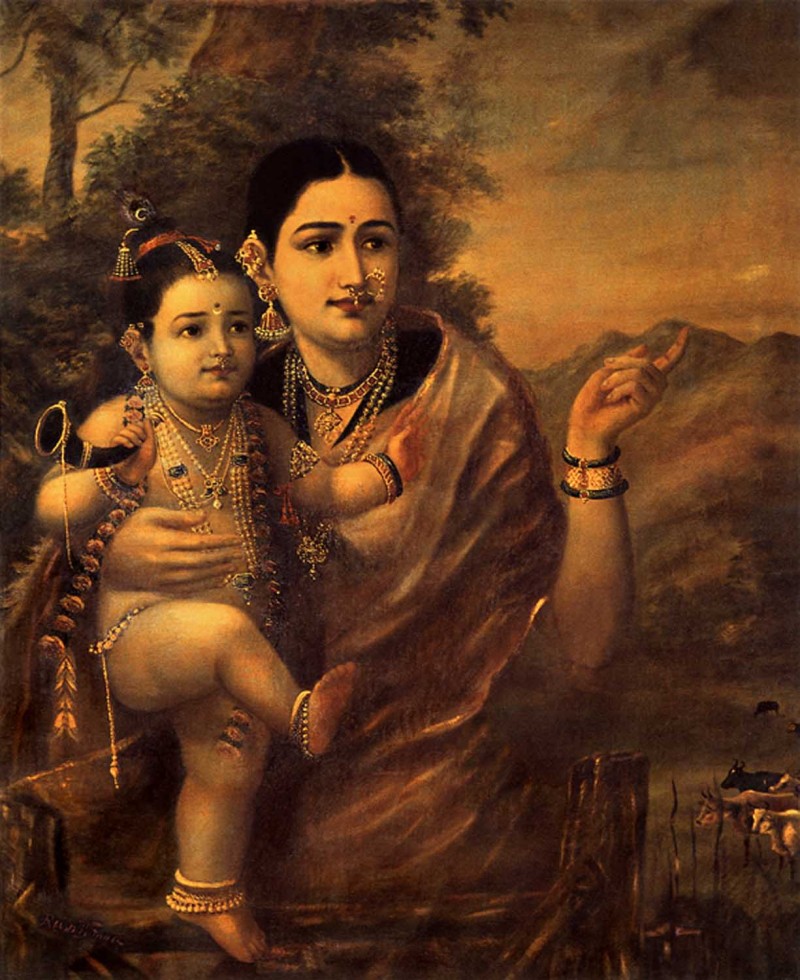

       In the Bhavishyottar Puran Shri Krishna himself extols the celebration of Janmashtami to Yudhishtir, the eldest of the five Pandavas.


       He incarnated in Mathura (Uttar Pradesh) to vanquish evil elements who were harassing pious people.  His second reason was to fulfill the pledge he gave to Vasudev and Devki.  When they married, Kamsa heard a divine proclamation that the couple's eighth son would be his nemesis.  To obviate this, Kamsa imprisoned the couple and killed the first seven sons born to Devki.  When Shri Krishna was born, Vasudev placed him in a cradle.  The prison's doors opened miraculously and he forded the river Yamuna with the divine child.  Thus, Shri Krishna survived.  


       During childhood he eradicated evil elements such as Bakasur, Aghasur, Putna, Kaliyanag and Kamsa.  Later he removed mighty evil kings from all over Bharat who were causing anarchy and inflicting needles misery on people.  By this mission, he fulfilled Paramatma's prophecy to remove evil and established dharma and peace in the whole of Bharat and reunified it.


Sentiments


       The first important sentiment of Janmashtami is to observe dharma.  Since humans are all imprisoned in samsar, Paramatma incarnates in this 'prison' with man, establishes dharma and redeems him from maya.  Man can transend maya only if he seeks Paramatma's aid, as did Arjun during the battle of Mahabharat.  As Bhagawan Ved Vyas proclaims:

       'Yato Krishnastato dharmaha, yato dharmastato jayaha."
       - Mahabharat Critical edition 13/153/39, 6/62/34

      i.e., Where there is Krishna, there is dhama,  where there is dharma, there is victory.  


       Since Duryodhan, leader of the Kauravas, did not observe dharma, he did not have Krishna.  No Krishna, no victory.


Sharanagati [Refuge]

   
      During the battle, Shri Krishna imparted divine knowledge to convince the relucatant Arjuna to fight.  This divine knowledge is known as Bhagavad Gita.  In the Bhagavad Gita 18/66 the following slok [18/66] as its essence:

       Sarva dharman parityajya maekam sharanam vraja,
       aham twa sarvapapebhyo mokshishyami ma shuchaha.

       i.e., O Arjun!  Forsake all your personal beliefs and surrender to me.  Do not lament for I shall deliver you free from all sins.

       Therefore, the true spirit of Janmashtami is for devotees to implicitly surrender at Paramatma's lotus - feet, while staunchly observing dharma.


Ideal Devotee


       Shri Krishna stipulates:
       "Brahma bhutaha prasannatma na shochati na kankshati,
       Samaha sarveshu bhuteshu madbhaktim labhate param." - Bhagavad Gita 18/54

       i.e., One who becomes brahma-rup and offers devotion to Parabrahma, forever remains blissful and attains the highest glory of Paramatma.  'Brahma-rup' simply means to become an ideal devotee, like Arjun, who represents Nar, and to then worship Krishna - Narayan.  Hence, the murtis of Nar-Narayan.


       Similarly, Shri Krishna played the Maha Ras (divine stick dance) with the Gopis of Vrundavan because of their unalloyed devotion to him.  Radha was the foremost among them.  Therefore, devotees should develop Gopi-bhav, to become Radha-rup (like Radha) to worship Shri Krishna.  Hence, the murtis of Radha-Krishna are consecrated in mandirs.  This establishes the eternal principle of worshipping Paramatma, by becoming Radha-rup, like His ideal devotee; to become Akshar-rup to worship Purushottam.  Hence to become Akshar-rup or gunatit, Shri Krishna has given two chapters in the Bhagavad Gita, aksharbrahma Yoga [Chapter 8] and Purushottam Yoga [Chapter 15].


       In addition to such surrenderance, how should an aspirant strive to attain the exalted state of the Gopis - Gopi-bhav - to please Paramatma?  Shri Krishna himelf provides the answer in the Bhagavatam.


Interesting age-related figures about Shri Krishna.

  • Shri Krishna was only a child of about 12 when he played Maha Ras with the Gopis, prior to leaving for Mathura at the age of 13.
  • He first met Pandavas prior to the battle, at the age of 83.
  • He always did pranams to Yudhishthir [aged 87] and Bhim [aged 86] since they were older than him.
  • When he attended Draupadi's svayamvar, he brought along with him, his son Samb and Pradyumna, and the latter's son Anirudh, from Dwarka.
  • He was 125 years old at his demise [Bhagavatam 11/625].

Such longevity was common then.  Even 2.5 millennia later, when the Greeks arrived around 300-200 BCE, a chronicler [Arian] noted "many Hindus aged 140 years olds and many more who are 100!"


~~~~~~~~~~~~~~~~~~~~~~~~~~~~~~~~~~~~~~~~~~~~~~~~~~~~~~~
Source: Excerpts from the book Hindu Festivals written by Sadhu Mukundcharandas
~~~~~~~~~~~~~~~~~~~~~~~~~~~~~~~~~~~~~~~~~~~~

14 January, 2015

Why do we celebrate Pongal or Makar Sankranti - Harvest Festival?


In Indian Culture Why do we celebrate Pongal or Makar Sankranti -  Harvest Festival?


        Celebrations at the time of the winter solstice have been universal in almost every culture on the planet. It is seen as the rising of the new sun.  In ancient Rome, this was celebrated as Saturnalia, which means it was about Saturn, the god of agriculture and food.  

Makar Sankranti - Harvest Festival


     The Makar Sankranti festival is also known and referred to as the "harvest festival" because this is the time when harvesting is complete and there are big celebrations.  This is the day we acknowledge all those who assisted in making the harvest.  The farm animals play a huge role in harvesting, so the following day is for them and is called "Mattu Pongal".


       The first day is for the earth, the second day is for us and the third is for the animals and livestocks.  See, they are placed a little higher than us because we exist because of them, they do not exist because of us.  If we were not here, they would all be free and happy.  But if they were not here, we could not live.


       In Southern India, even today, the celebration of Makar Sankranti is one of the most important festivals in a year for the agricultural communities.  In Rome, Saturnalia was a holiday -- people gave gifts, no war could be declared on this day, and masters and slaves swapped their positions.  In India, even today, men and women swap their positions at that time - men will be singing, women will be drawing complex geometric patterns in the form of Rangoli.


       In lands like Central Asia and China, such celebrations were also prevalent.  These traditions were destroyed in Europe and other parts of the world with the advent of Christianity.  The ancient Egyptians always saw that during this month, the line between the physical and the spiritual is thin or the two are brought close together.

Pongal or Makar Sankranti - Harvest Festival


       Between the 14th and 17th of January are the festivals of Makar Sankranti or Pongal, as it is called in Tamilnadu, South India.  There are different aspects to this festival, which falls in the month of Thai in the Tamil Calendar.

First Day - Bhogi


     The first day is celebrated as Bhogi festival in honour of Lord Indra, the supreme ruler of clouds that give rains.  Homage is paid to Lord Indra for the abundance of harvest, thereby bringing plenty and prosperity to the land.      


     Another ritual observed on this day is Bhogi Mantalu, when useless household articles are thrown into a fire made of wood and cow-dung cakes.  Girls dance around the bonfire, singing songs in praise of gods, the spring and the harvest.  The significance of the bonfire, in which is burnt the agricultural wastes and firewood is to keep warm during the last lap of winter.


    During Bhogi houses are cleaned, decorated, and in a way re-consecrated for the new year, using materials like mango leaves and the first cut of paddy to enhance the vibrance in the house.  All the unnecessary things in one's home are disposed of.


       In this season, you should get rid of all the unnecessary things in your life and begin life afresh.  You should make this clean-up an annual event.  Even if some cleaning up is done on a daily basis, a few things pile up here and there without you being conscious about it.


      This piling up is not only of material things in our homes.  Also in our minds, in our emotions, in our bodies, and in our consciousness, things pile up.  This is the time to clean that up and start afresh in the coming spring, as spring is the best time to start life in every way.


Second Day - Pongal or Makar Sankranti - Harvest Festival


      On the second day of Pongal, the puja or act of ceremonial worship is performed when rice is boiled in milk outdoors in earthenware pot and is then symbolically offered to the sub-god along with other oblations.  All people wear traditional dress and markings and their is an interesting ritual were husband and wife dispose off elegant ritual utensils specially used for the puja.


       In the village, the Pongal ceremony is carried out more simply but wit the same devotion.  In accordance with the appointed ritual a turmeric plant is tied around the pot in which the rice will be boiled.  The offerings include the two sticks of sugar-cane in background and coconut and bananas in the dish.  A common feature of the puja, in addition to the offerings, is the kolam, the auspicious design which is traditionally traced in white lime powder before the house in the early morning after bathing.


Third Day - Mattu Pongal


       The third day is known as Mattu Pongal, the day of Pongal for cows.  Multi-colored beads, tinkling bells, sheaves of corn and flower garlands are tied around the neck of the cattle and then are worshipped. They are fed with Pongal and taken to the village centers.  


The resounding of their bells attract the villagers as the young men race each other's cattle.  The entire atmosphere becomes festive and full of fun and revelry. Arati is performed on them, so as to ward-off the evil eyes.


       Apart from Bhogi, the Pongal celebrations also include Mattu Pongal, which honors all the animals that traditionally play an important role in agriculture. 


   On this day, the bulls and cows that are the center of pastoral communities are decorated, pampered, and worshipped, as an expression of gratitude.  In Karnataka and Andhra Pradesh, they make these animals cross a small fire made of hay. This is because during winter, when the animals stay inside more, their hooves tend to get worm-infested.  So as a part of the celebration, they are made to walk over the fire.  This cleans up their hooves and removes any worm infestation.  Children and adults also run over the fire, just for the fun of it.


     Today machines have come in but you cannot grow food out of just machines.  If you do not put animal waste into the land there will be no question of any agricultural produce.  So animals which work in the farms have always been very important part and on this day the bulls and cows which made the life of pastoral communities are worshipped and decorated.  They are pampering in so many different ways.  The idea is to recognize how important a role they have in the making of our lives.  It is an expression of gratitude.


Fourth Day - Kaanum Pongal


        The Fourth day is known as Kanu or Kaanum Pongal day, which is a community affair - this means going and seeing people.


On this day, a turmeric leaf is washed and is then placed on the ground.  On this leaf are placed, the left over of sweet Pongal and Venn Pongal, ordinary rice as well as rice coloured red and yellow, betel leaves, betel nuts, two pieces of sugarcane, turmeric leaves and plantains. 


 In Tamilnadu woman perform this ritual before bathing in the morning.  All the women, young and old, of the house assemble in the courtyard.  The rice is placed in the centre of the leaf while the woman ask that the house and family of their brothers should prosper.  Arati is performed for the brothers with turmeric water, limestone and rice, and this water is sprinkled on the kolam or Rangoli infront of the house.


        The Makar Sankranti or Pongal festivities have various ingredients of cleansing, of appreciating and expressing gratitude to all the creatures that are involved in our lives.  It is also about getting involved with the community, which means it also has a social connotation.  It is a time of festivity.


      These festivals are a reminder that we need to craft our present and our future in a conscious manner.  Right now, we have harvested the previous year's crop.  How to create the next one is being consciously planned by taking the animals also into consultative process.  

~~~~~~~~~~~~~~~~~~~~~~~~~~~~~~~~~~~~~~~~~~~~~
Source: Article by Sadguru - "Isha Yoga Blog"
~~~~~~~~~~~~~~~~~~~~~~~~~~~~~~~~~~~~~~~~~~~~~

15 September, 2014

In Indian Culture Why do we worship Tulasi?


In Indian Culture Why do we worship tulasi?

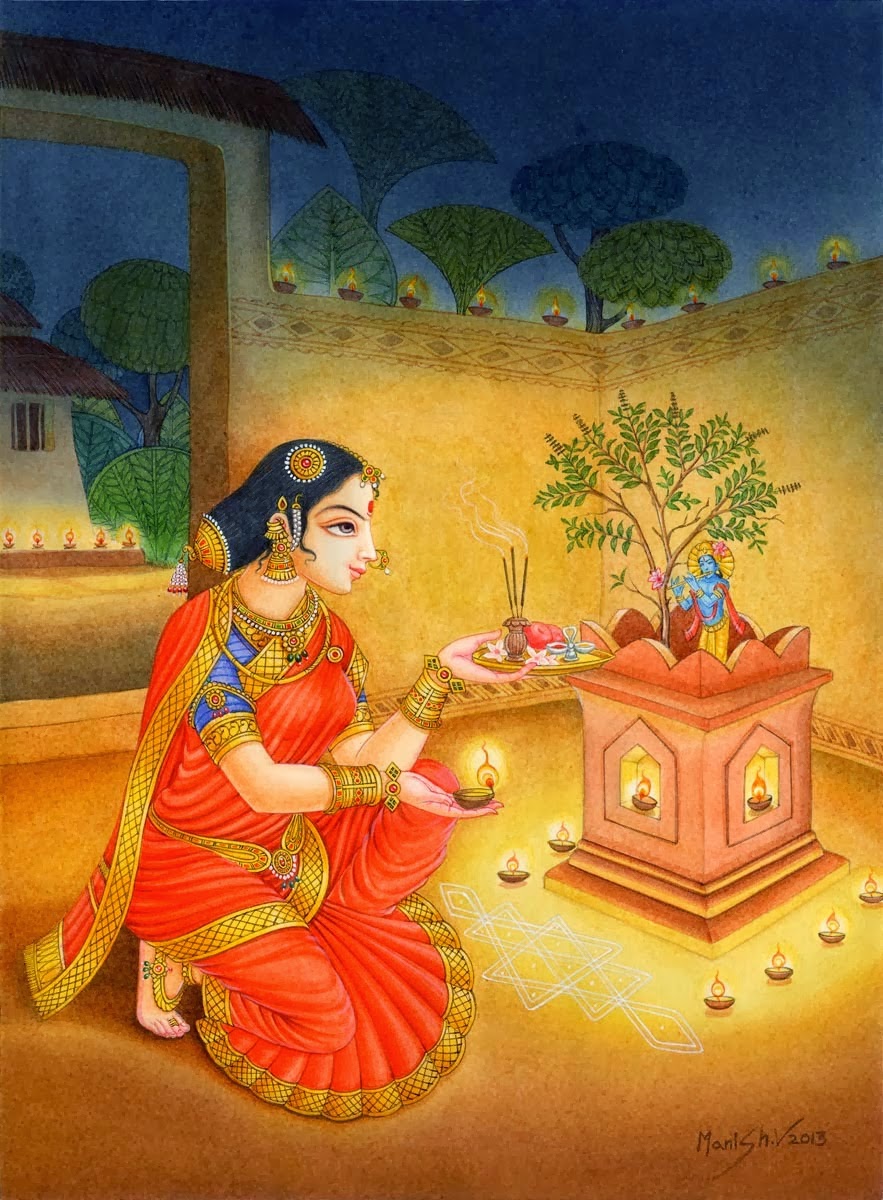
      Either in the front, back or central court yard of most Indian homes there is a tulasi-matham - an altar being tulasi plant.  In the present day apartments too, many maintain a potted tulasi plant.  The lady of the house lights a lamp, waters the plant, worships and circumambulates it.  The stem, leaves, seeds and even the soil, which provides it a base, are considered holy.  A tulasi leaf is always placed in the food offered to the Lord.  It is also offered to the Lord during poojas, especially to Lord Vishnu and His incarnations.


Why do we worship the tulasi?


       In Sanskrit, tulanaa naasti athaiva tulasi - that which is incomparable (in its qualities) is the tulasi.  For Indians it is one of the most sacred plants.  In fact, it is known to be the only thing used in worship which, once used, can be washed and reused in pooja - as it is regarded so self-purifying.


Why is tulsi sacred?


       As one story goes, Tulasi was the devoted wife of Shankhachuda, a celestial being.  She believed that Lord Krishna tricked her into sinning.  So she cursed Him to become a stone (shaaligraaama).  Seeing her devotion and adherence to righteousness, the Lord blessed her saying that she would become the worshipped plant, tulasi that would adorn His head.  Also that all offerings would be incomplete without the tulasi leaf - hence the worship of tulasi.


       She also symbolises Goddess Lakshmi, the consort of Lord Vishnu.  Those who wish to be righteous and have a happy family life worship the tulasi.  Tulasi is married to the Lord with all pomp and show as in any wedding.  This is because according to another legend, the Lord blessed her to be His consort.

       Satyabhama once weighed Lord Krishna against all her legendary wealth.  The scales did not balance till a single tulasi leaf was placed along with the wealth on the scale by Rukmini with devotion.  Thus the tulasi played the vital role of demonstrating to the world that even a small object offered with devotion means more to the Lord than all the wealth in the world.

     Shri Hari adorns wreaths of Tulsi leaves and also greately adores its fragrance.  Seeing this, flowers such as mandar, parijat, jasmine, champak, karavir, punnaga, nagkesar, bakul, lotus, though themselves fragrant, highly regard tulasi; that she performed greater penance (n her previous birth) than any of them. [Bhagavatam 3/15/19]


A Sanskrit sloka describes tulasi's sancrtity:


Yanmule sarvatirthaani
  yannagre sarvadevataa
Yanmadhye sarvavedaasche
  tulasi taam namaamyaham.

I bow down to the tulasi,
at whose base are all the holy places,
at whose top reside all the deities and
in whose middle are all the Vedas.


The Brahmavaivart Puran (Prakritikhand 21/40) lauds tulasi's glory:


Sudhaghatasahasrena sa tushitrna bhavedwarehe,
ya cha, tushtirbhanevennrunam tulasipatra danatah.

- He (Bhagwan) is not so pleased after bathing with a thousand pots of amrut, as he is when he is offered even a single tulsi leaf.


In Vaishnavisim, it is obligatory to place a tulasi leaf when offering food and donation.

A special utsav - The Tulsi Vivah, is also observed in all Vaishnav mandirs, when Tulasi is married to Vishnu, with pomp and bhakti.

It is also a ritual to place a tulasi leaf in the mouth of a person, as the first antyeshti rite at the time of death. This ensures his transmigration to Vishnu's abode.


Medicinal value

   
    In Ayurveda, tulasi is considered a divya aushadhi - divine herb.  The Tulasi leaf has great medicinal value and is used to cure various ailments, including the common cold.

~~~~~~~~~~~~~~~~~~~~~~~~~~~~~~~~~~~~~~~~~~~~~~~~~~~~~~~
Sources 
1] Excerpts from the book on"In Indian Culture why do we .. written by Swamini Vimalananda & Radhika Krishnakumar.
2] Excertps from the book on "Hindu rites and rituals [Sentiments, sacraments & symbol] written by Sadhu Mukundecharandas, Swaminarayan Aksharpith.
~~~~~~~~~~~~~~~~~~~~~~~~~~~~~~~~~~~~~~~~~~~~~~~~~~~~~~~