Search This Blog

Showing posts with label Symbolism of Hindu Gods and Rituals. Show all posts

05 January, 2017

In Indian Culture..Why do we worship Lord SASTHA (HARIHAR)?


      On the peak of Sabari Hill at the southern tip of the Sahyadri ranges stretching southward into Kerala, there is an ancient temple dedicated to Lord Ayyappan, who is popularly known as Sabari Mala Sastha.  This temple can be reached only by foot through the jungles which is infested with wild animals.

       In Hinduism, the transcendental message of the Vedas has been conveyed to man through the technique of Mysticism.  This technique is employed in all religions, but in the Hindu scriptures it has been developed to artistic perfection.  Saastha is one of the Hindu deities which has a deep mystic significance.


       Lord Ayyappan is the son of Lord Siva and Mohini (Lord Vishnu) in a delusory enchanting form.  Ayyappan stands for constructive destruction which is combination of Vishnu (construction) and Siva (destruction).  He is considered the 'Protector' of the weak.  He saves mankind from sickness, diseases and miseries of the world and endows them with Gnana [knowledge] leading to spiritual liberation.


       The Vishnu Purana describes that in heaven the gods and the demons - the devas and the asuras - decided to sink their differences temporarily, to come to a mutual understanding for a joint endeavour to churn and draw the nectar (amrutam) from the milky ocean, on which Lord Vishnu is described as ever reclining in yoga nidra(yogic sleep).  The gods and the demons stood on either side, used the Manthara mountain as the churn, and Vasuki, the mighty serpent, served them as the rope.  The great churning of the milky ocean started.

Neelakanda


       The churning first produced a deadly poison called Halahala.  Seeing this poison spreading in all quarters, the living beings flew for protection to Lord Siva.  Siva, in His divine compassion for them, received the poison in His palm and not knowing what to do with it, decided to drink it Himself. When He swallowed thus the poison to save the universe from disaster, Mother Divine, the consort of the Lord, strangled the neck to prevent the poison from going down the neck.  The poison spread over the neck region and hence it is that Siva's neck is blue in colour.  He is called Neelakanta (Blue-necked).  The churning continued after the removal of the poison and several beautiful and powerful things issued forth from the ocean.  They were all given away and the gods and the demons pursued in their churning until the last of the products - the nectar (amruta) - emerged.  As soon as the nectar appeared, the demons snatched it from the gods and ran away with it.

Mohini


       The gods prayed to Lord Vishnu to retrieve their loss.  The Lord answered their prayers and agreed to bring back the nectar (amruta) to them.  Meanwhile, the demons quarreled among themselves as they could not agree upon who should distribute the nectar and how much each should get.  In such a state of confusion, Lord Vishnu appeared in the enchanting form of a maiden named Mohini.  Fascinated by the seducing beauty of Mohini, the asuras (demons) stopped their quarrel and stood passionately gazing at her divine beauty.  Having attracted them thus, Mohini offered to distribute the nectar justly.  The demons accepted her suggestion and sat down to receive their share. Before the actual distribution started, however, she objected to their lustful looks, which were offending her modesty, and laid down a condition that they should keep their eyes closed until the distribution was over.  Whoever opened his eyes would lose his share.  Obediently, they all shut their eyes and waited for their share.  While they were thus sitting and waiting with their eyes shut, the maiden ran away with the pot of nectar (amruta-kalasa).  The demons learnt it too late that the maiden and the nectar had disappeared.

Saastha


       Upon the request of Lord Siva this episode was narrated by Lord Vishnu.  Siva wished to see that enchanting form of Mohini who tricked the demons.  He was warned that the Maya form was too irresistible.  Siva insisted, being proud of His continuous tapas (austerity) in Kailas.  But lust is the last weakness to leave one's bosom.  Vishnu conceded to the request and once again took the maidenly form - the Mohini, one who deludes all.  Parameswara was charmed by that divine maiden, and a child was born of the contact of Siva and Vishnu, Saastha was that child. 

Mystic significance


       This simple story has a deep mystic significance.  It is an objective representation of a subjective phenomenon.  It explains the spiritual path leading to the Goal of perfection; the state of Immortality symbolised by the gaining of amrutam.  Amrutam means deathlessness or immortality.

Symbolism


       The milky ocean represents the Pure (sattwic) mind.  The gods (devas) stand for the higher nature/tendencies and the demons (asuras) for the lower nature/tendencies in man.  The individual (ego) who desires to spiritually evolve and obtain Immortality (amruta) must first cleanse his mind of its impurities and maintain it in a relatively pure sattwic state (milky ocean).  Such a mind is churned by the process of Assertion and Negation.  The seeker asserts that he is the divine Self and negates the perceiver feeler thinker and the material equipments as 'not-self'.  The whole process of such subtle discrimination and analysis between the good and the bad, the Spirit and the matter, the Real and the unreal is accomplished by the great churn, the subtle-intellect (Manthara).

       As a result of such discriminative analysis and contemplation, man evolves spiritually.  The evolution is first marked by the purging of low passionate animalistic tendencies (vasanas), which are symbolised by the issuing of the poison from the ocean.  These vasanas are detrimental to the well-being of mankind.  They pollute the head (discrimination) and the heart (feelings).  Hence, the consort of Siva, Parvati (representing sattwic mind) - arrested the poison in the throat of the Lord, i.e. kept it in between the head and the heart, not allowing it to poison either the feeling of the heart or the clear thinking of the intellect.


       As one evolves further in the spiritual path, one develops higher faculties and powers, siddhis, including the capacity to perform miracles.  These are represented by the attractive gifts that arose out of the churning.  The gifts were however not meant for self-aggrandisement but for distribution to others.  Similarly, if the powers obtaining by spiritual sadhana (practice) are not dissipated in selfish and ego-centric pursuits, and the seeker continues in his spiritual path, he gains the final reward of Immortality (amrutam) - the state of God Realisation.


       The bad tendencies in man trade even on the spiritual treasure gained by him.  In other words, they make use of his newly-gained spiritual distinction for self aggrandisement and low purposes. Such men are easily tempted by the enchanting sense-objects (Mohini).  'Moha' means delusion. Mohini, therefore, is 'delusion personified'.  Those who have low animal impulses and passions are deluded by the enchantment of the sensual world and they are blind to their own spiritual beauty. When they are thus led away by the senses, whatever spiritual unfoldment they have gained is lost. this idea is indicated in the demons (asuras) losing the nectar (amrutam).  


       Lord Ayyappan is the son of Siva and Vishnu.  Siva is the God of Destruction while Vishnu is the God of Sustenance.  These two powers are combined in Ayyappan, since he helps to destroy all low negative tendencies and maintains the pure sattwic nature in the seeker.  The Lord is considered the God of Constructive-Destructivion-the 'Protector'.  He protects our spiritual wealth and powers by maintaining the thought of godliness and destroys all other thoughts pertaining to the worldy infatuations.

Hari Hara Sutha


       This power of maintaining a single thought of the great Reality is invoked from Lord Harihara Sutha, as He is also known, meaning the son of Hari (Vishnu) and Hara (Siva).  Without that great powers no meditation is is possible.  Hence all vedantins invoke His grace for maintaining a consistency in their meditation.

Ayyappa temple on Sabari Hill


       The Ayyappa temple on Sabari Hill, in Kerala, is one of the most popular pilgrim centres in South India.  Devotee from all over the country, belonging to all creeds and classes visit this sacred shrine .  Unlike other temples, the pilgrims visiting this temple have very strict and rigorous preparations to go through before reaching the divine altar.  The usual custom is to observe strict austerities and self control for forty-one days preceding the visit to the temple.  By such tapas (austerities) the mind is made to withdraw from the enchantments of the worldly objects and possessions and it is slowly directed to the thought of the Reality: Ayyappa Swami Saranam,

       During this period of tapas, the devotee is allowed to wear only black or saffron clothes and a mala and he has strictly to perform the daily rituals.  The special clothes indicate that he is dead to the world of peceptions, emotions and thoughts. m He remains in constant prayer immersed in the thought of Ayyappan, the Self in him.  'Swami Saranam' is his watchword: "the Lord alone is my protection, my safety".  


       The way to the temple is through jungle and the pilgrimage is undertaken by foot.  The idea is to further develop the concentration of the mind, which has been already prepared by strict austerities. All along the ascent to the shrine, the devotee tries to maintain the one thought of the Lord in his multiple experiences.  When such single pointed concentration and meditation is maintained, the Truth reveals itself to the seeker, which is symbolised by the darshan (vision) of the Lord in the temple.  The eighteen steps which lead the pilgrim to the plateau where the Lord is 'seen' have their endless mystic meaning in the number eighteen.

~~~~~~~~~~~~~~~~~~~~~~~~~~~~~~~~~~~~~~~~~~~~~~~~~~~~
Source: Excerpts from the book on "The Symbolism of Hindu Gods and Rituals
by Swamy A Parthasarathy.
~~~~~~~~~~~~~~~~~~~~~~~~~~~~~~~~~~~~~~~~~~~~~~~~~~~~

01 April, 2016

Lighting lamp in these ways can change your life and attract Goddess Lakshmi


Lighting lamp in these days will attract Goddess Lakshmi and keep away the evil from your house.


1.  This simple trick can attract Goddess Lakshmi without much effort


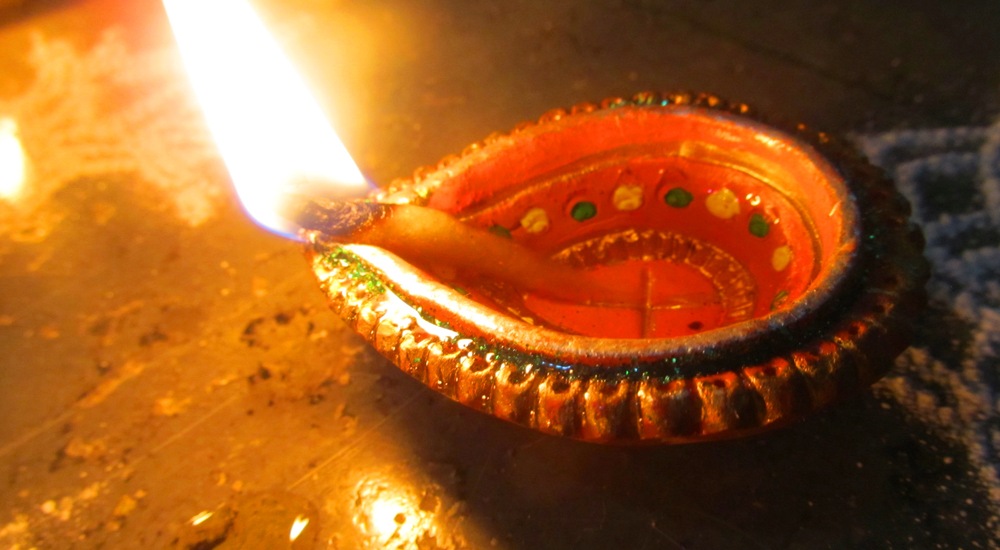
       The light symbolizes knowledge, positivity and tranquility, and lighting lamps [diyas] or earthen lamps on daily basis is considered highly auspicious.  It is said that regular lighting of lamps removes darkness, ignorance and evil.

2.  Lamps and Puja Room


       Since the light of a ghee lamp is believed to bring in prosperity, knowledge and wisdom, it is customary rule in India to start all the auspicious religious events or social functions by lighting the lamp.  By doing so it is believed that we invite the divine to come and bless us.

3.  What is Aarti?


       In Hindu temples an elaborate "Aarti" prayer ceremony is performed with 5 days burning at once, and waved gently in a circular motion - in a clockwise manner, in front of the picture or statue or a deity.  This aarti ritual literally purifies the atmospheric air.  It symbolizes our dedication and oneness with the Lord.

4.  Lamp Shlokam


       This sloka is to be recited while lighting lamp -

'Subham Karoti Kalyanam Arogyam Dhana Sampadah, Shatru Buddhi Vinashaya Dipa Jyotir Namostute.  Deepajothi Parabrahma Deepajyothi Janardhana, Deepo me hara to paapam Deepaa Jyothir Namostute.'

5.  Lighting Lamp can change your life


       Do you know the oil; the wick and the direction in which you light lamp can make a huge difference in your life?"  

       Lighting lamp with a different wick or using a different oil can change your luck without much effort.  Take a look at different kinds of wicks and their benefits.

6.  Banana wick


       Lighting a wick made of banana stem fiber helps seek forgiveness for the mistakes you made unknowingly, it also cures you from ancestral curses.

7.  Cotton wick


       A cotton wick is the most common and easiest available wick.  If you use cotton wick, you obtain good fortune.

8.  Rose water wick


       It is one of the easiest trick to attract abundance by pleasing goddess Lakshmi.  Take a white cloth immersed in rose water, dry it and use the same to create a wick.  By using this wick for lightening lamp on a regular basis, you will not only attract Goddess Lakshmi but also attract peace in life.
       

9.  Yellow Sari wick


       If you are suffering from any problem in your marital or love life, then this is the solution.  Wick made from yellow sari cloth helps in eradicating problem between husband and wife and solve all love related problems.

10.  Wicks from Lotus stem


       If you want to remove all your previous birth karma and are willing to establish a happy and prosperous life, this wick can help you.

11.  A new yellow cotton cloth


       If you use yellow cotton cloth as a wick to light the lamp, you can please Goddess Parvati.

12.  Red cotton cloth


       The regular use of red cotton cloth as wick removes al marriage obstacles and child related problems.

13.  Different types of Oil used in diyas


       The ghee and the flame signifies Goddess Lakshmi who blesses us with wealth, the brightness of the flame resemble Goddess Saraswati who blesses us with education and knowledge and the heat from the flame signifies Goddess Durga who burns away and destroys all evil.  Here are the different types of oils one can use for lighting divya and their respective benefits.

14.  Pure Ghee


       It is considered as the best for lighting the diyas.  It ensures prosperity, health and happiness.

15.  Coconut Oil


       If you want to please Lord Ganapati, use coconut oil for lighting diyas.

16.  Sesame Oil


       Regular use of Sesame oil ensures removal of obstacles and evil effects that haunt you.  Lighting diya during Shani Mahadasha, Antardasha and in Sade-Sati period with sesame oil helps you please Lord Saturn.

17.  Neem Oil


       Lighting neem oil diyas helps in bringing prosperity in the house.

18.  Castor Oil


       Castor oil diyas ensures fame, happiness and gives you a devotional mind set.

19.  Panchadeepa Oil


       It is highly recommended oil for lighting earthen lamps.  Mix coconut oil, sesame oil, neem oil, Iluppai (mahua tree) oil and ghee in the ratio of 3:2:1:2:2 respectively or you can directly buy it from the market.  A Panchadeepa Oil lamp keeps the home and its inmates protected from evil, illness and bad thoughts.  It ensures prosperity and all forms of wealth.  The granaries in the house are full and the home is brimming with joy and laughter.  Children will be healthy and obedient.

20.  Say no to Sunflower oil while lighting lamp


       It is strictly forbidden to use groundnut or sunflower oil to light lamps. Our elders always said that lighting groundnut oil creates debts in the home.  The people living in the home are always bickering for money.

21.  Important rules to follow


       Here is some more information related to lighting lamp.  Always use minimum 2 and maximum 3 wicks for lighting the lamp.  It symbolizes the trinity-Durga, Lakshmi and Saraswati.  After lighting the lamp do not rub the excess oil on your hair, it will make you lose your wealth.  Also rubbing in your own dress is also not good.  So keep a piece of cloth in your pooja room and rub the excess oil on it.  After head bath, one should remove the head towel before lighting the lamp.

22.  Lighting lamp in particular direction ..... North


       Lighting lamp in North direction brings wealth and prosperity.  One is blessed with 8 kinds of wealth or Ashtaishwaryas of Goddess Lakshmi who empowers her devotees, giving them luxuries in the form of wealth.

23.  East


       Lighting lamp in East will bring good health and peace of mind.

24.  West


       Lighting lamp in West makes you free from debts and ensures victory over foes.

25.  South


       We should never light a lamp in the South direction.  It brings bad luck.

~~~~~~~~~~~~~~~~~~~~~~~~~~
Source: Article from Speaking Tree
~~~~~~~~~~~~~~~~~~~~~~~~~~~

19 March, 2016

Ganesha Stories

Image 1

       Image 1 looks like a family photograph: father, mother and two sons.  But this is no normal portrait.  This is the image of a God called Shiva, a mountain mendicant, his wife, the Goddess Parvati, who is a mountain princes, and their two children, Ganesha, who has the head of an elephant, and Kartikeya, who holds a spear.

       One day, when this family was sitting together, they were paid a visit by a sage called Narad, who loved to stir trouble wherever he went.


       'I have a mango,' said Narad, 'for your better son.'

       'How can I decide which one is better?' asked Shiva, turning to to his wife, Parvati.

       'Let them go on a race,' said Parvati.  'He who first goes around the world thrice shall get the mango.' 

       'Let it be so,' said Shiva.

Image 2

Image 2

       Kartikeya, shown in Image 2 immediately mounted his peacock and rose to the sky, determined to be the first to go around the world thrice.  Ganesha, however, did not  move.  He continued to sit beside his parents, playing with his rat.  Kartikeya went around the world once, then twice, wondering what Ganesha was up to.  Ganesha still showed no signs of moving.  As Kartikeya was about to complete his third and final round, ganesha got up, and as shown in Image 3, quickly ran around his parents thrice and declared, 'I have won!.

       'What do you mean, you won?' asked Kartikeya.  'It was I who went around the world thrice. You just went around our parents'.  'That's not true. You went around the world.  I went around my world.  Tell me, which world matters more?


       "How come?" asked Kartikeya and Ganesha replied, "You went around the world while I went around my world.  You went around the objective world while I went around my subjective world.  You went around the physical world around us while I went around an emotional world within me.  What matters more?"

       For Kartikeya the measurable rational logical world mattered more than the unmeasurable emotional world that mattered to Ganesha.  There are two aspects of Life.  Narada gave the mango to Ganesha.  Kartikeya did not agree with this decision, and moved to South.

       Every culture views the world through different lenses.  For some, there is one formless divine; for others, the divine has many forms.  Who is right?  For some, there is only one life with no rebirth; for others, this is just one of many lives.  Who is right?  Answers to these questions are never universal.  They are cultural.  They spawn beliefs.  From beliefs comes behavior that can make us either less tolerant or more accommodating.  That is why my world does matter.


2.  Valli's Marriage


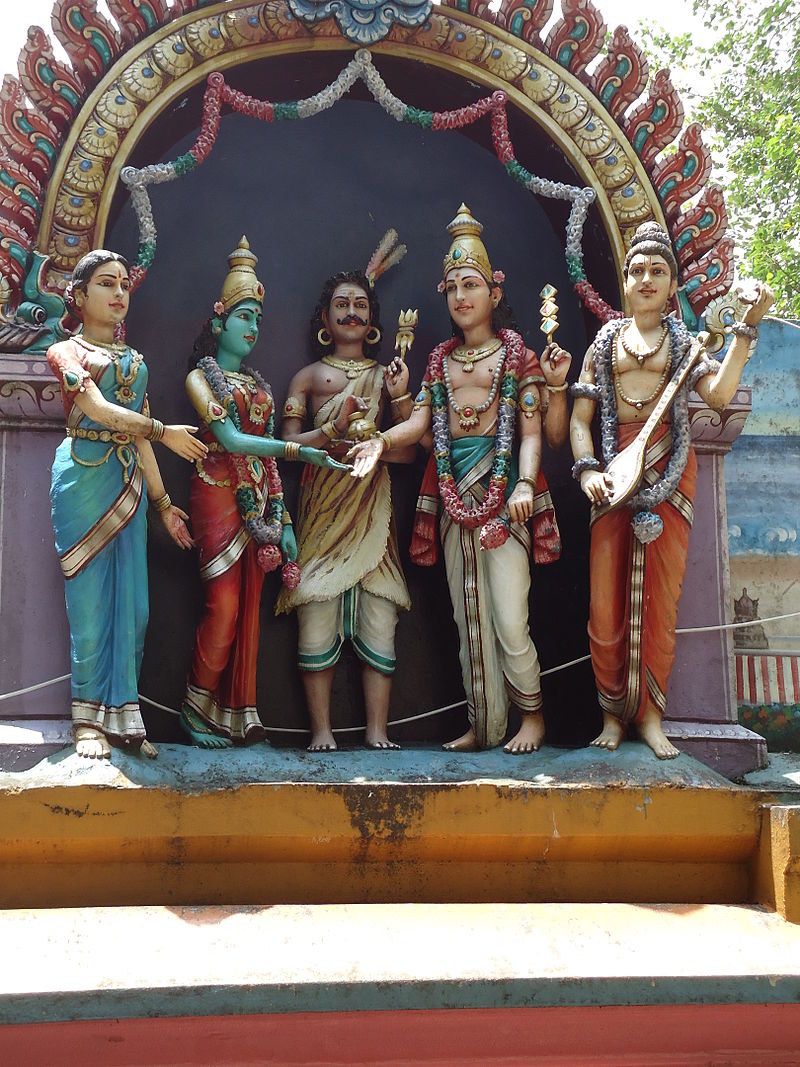
       Kartikeya, the brother of Ganesha is also known as Muruga, especially in Tamil Nadu.  He lives in the mountains of Tamil Nadu and in one of the valleys, in the middle of a millet field, he saw a beautiful tribal girl called Valli.  He fell in love with her but no matter how hard he tried she refused to respond to his attentions.


       So finally he prayed to his brother, Ganesha, who took the form of a wild elephant and stormed into the millet field frightening Valli who ran into the arms of the handsome-god Muruga.  Muruga immediately offered protection to Valli and drove the elephant away much to her delight.  Thus with the help of his brother, Muruga was finally able to get the girl of his dreams.


3.  The Moon


       One day Lord Ganesha was travelling happily through the world on his vehicle, the rat.  He had eaten lots and lots of Modakas [his favourite sweet, made up of rice flour, buts, jaggery and coconut.]  His stomach was full and he was enjoying the ride.  Suddenly the rat saw a snake and stumbled.

       Lord Ganesha toppled and fell flat on the ground.  His stomach burst open and all the Modaks scattered around.  Lord Ganesha gathered all the Modaks and stuffed them back into his stomach.


       In the gust of anger and frustration he caught the snake that caused his rat to stumble and tied it around his belly.  Seeing this sight, the moon started laughing and made fun of Lord Ganesha's big belly.  The otherwise calm and cool Ganesha became furious and pulled out one of his tusks and threw it towards the moon with great force.

       Lord Ganesha cursed the moon and said that.  Your beauty is the cause of your arrogance and now your beauty will become the cause of your suffering.  Whoever sees you on the fourth day of Bhaadrapada month i.e., Ganesh chaturthi [the birthday of Lord Ganesha]  would receive bad repute and suffer bad luck.  That is why no one looks at the moon on Ganesh Chaturthi.


       Lisening to this curse the moon realized his mistake and begged for forgiveness.  Lord Ganesha calmed down and told the moon that the curse cannot be taken back.

       The moon that was proud of his appearance and laughed at Lord Ganesha just because of his big belly and his appearance also had to bow down to the Lord Ganesha.


4.  Parashuram


       Whenever there are problems on earth, Lord Vishnu descends from his heaven, Vaikuntha, and takes an appropriate animal or human form to set things right.  The sixth such form of Lord Vishnu is that of Parashurama who killed many unrighteous kings with his axe.

       According to Brahmananda Purna and Brahmavaivarata Purana, towards the end of his stay on earth, Parashurama decided to give his blood soaked axe to Shiva.  Ganesha stood guard at the foothills of Mount Kailas and would not let Parashurama in until he introduced himself.  But Parashurama was in too much of a hurry to do so.  So he pushed Ganesha away.  Ganesha refused to budge.  Irritated, Parashurama swung his axe and struck one of Ganesha's tusks.


       That is how it is said to have broken.  Ganesh's mother, Parvati was so angry when she saw this that she transformed into Durga, the fierce warrior goddess, and challenged Parashurama to a duel.  Parashurama realized he had acted harshly and apologized to the goddess.  She calmed down, but on condition that Parashurama give up his axe.  Parashurama did as instructed and gave the axe to Ganesha in whose hand it can still be seen in images today.  With the axe gonbe, Parashurama was no longer the angry warrior priest.  He became a sage and meditated on the foothills of Mount Kailas.

5.  Lord of Obstacles


       The gods once churned the ocean of milk for the nectar of immortality known as amrita. However, they forgot to propitiate Ganesha before this undertaking.  To teach them a lesson, Ganesha caused the serpent-king Vasugi who was being used as the churning rope to vomit venom. As the gods choked on the poison, they invoked Ganesha and begged him to remove this obstacle to their success.  Pleased with their worship, Ganesha requested his father Shiva to drink and digest the poison, thus clearing the air and enabling the gods to continue churning until the pot of elixir emerged from the ocean.


       Since then, every one worships Ganesha.  Without propitiating him, they say, Krishna could not have married Rukmini, Ram could not have killed Ravan, Kartikeya could not have killed Taraka, Shiva could not have killed the Tripura demons, Durga could not have killed Mahisha, and Rishis could not have attained wisdom.

       Ganesha name is chanted before any activity is started.  Those who forget to do so, do so at their own peril.

~~~~~~~~~~~~~~~~~~~~~~~~~~~~~~~~~~~~~~~~~~~~~~~~~~~~~~~~
Sources: 
1] Exceprts from the book on "7 Secrets from Hindu Calendar Art" by Devdutt Pattanaik
2] Excerpts from the book on "99 Thoughts on GANESHA" by Devdutt Pattnaik 
~~~~~~~~~~~~~~~~~~~~~~~~~~~~~~~~~~~~~~~~~~~~~~~~~~~~~~~~