Search This Blog

30 June, 2012

In Indian Culture..Why do we celebrate Ganesh chaturthi?


In Indian Cutlure...

Why do we celebrate Ganesh chaturthi?


As Indians, we are often asked how we worship an elephant-headed, pot-bellied, broken-tusked god who travels on a mouse. But as strange as it seems, every little peculiarity of Lord Ganesha's has a deep spiritual significance. As we go along in this article, we will look at the meaning of this symbolic representation of Lord Ganesha. Before we do, however, let's take a look at Lord Ganesha's mythological origin.


Mythological  anecdotes  of Lord Ganesha


Desiring to take a bath, Mother Parvati, Lord Shiva's consort, created a boy from dirt to guard Her home when She was bathing. As it happened, Lord Shiva returned while Mother Parvati was away. Surprised to see a stranger outside the home, the Lord demanded that He be allowed to enter His home. Much to His dismay, the boy refused to allow Him in. Infuriated at being barred from entering His home, the Lord cut off the boy's head. On returning, Mother Parvati was inconsolable when she found out what the Lord had done. To alleviate her suffering, Lord Shiva commanded his troops to get the head of the first living being they came across. The first living being they chanced upon happened to be an elephant calf. Finally, Lord Shiva, on receiving the head of the calf, placed it on the boy's body and restored life to him. Thus Lord Ganesha was created.

Lord Shiva represents the divine Self. Lord Ganesha, being His son, is symbolic of a person who has attained that state of Divinity. While representing the Divinity, Lord Ganesha also represents the way to attain that exalted state.


Elephant head


Lord Ganesha's elephant head symbolises the immense wisdom of a person of Perfection. Wisdom is something that comes out of manana, independent thinking and reflection. This manana can happen only when one has taken in spiritual knowledge i.e. the process of shravana has taken place. This process of shravana or intake of spiritual knowledge is portrayed as Lord Ganesha's large ears where one listens to a teacher. It also symbolises that even the wisest people are always open to hearing fresh ideas and opinions. In other words, the wise are those who always keep an open mind.

Broken tusk


Emerging from the Lord's head is the elephant trunk. This trunk visually depicts a well-developed intellect that arises out of wisdom, the elephant head. Our intellect is of two kinds, gross and subtle. The gross intellect is used to discriminate between pairs of opposites in the world; black and white, hard and soft, easy and difficult. The subtle intellect, on the other hand, discriminates between right and wrong; permanent and impermanent and is colloquially called the conscience.


In a person who has realised the Self, this intellect is extremely well-developed; both gross and subtle. Such people have clarity of thinking and a clear sense of right and wrong. At a relative level, even people who have made progress on the spiritual path experience this. Choices become clear and life becomes a lot simpler. Without clarity of thought, our worldview is bound to be confused and coloured by our own prejudices and preconceptions. Lord Ganesha's well-shaped trunk depicts a crystal clear intellect that a person of Perfection develops.

One of the key attributes of people who are Self-Realised is that they rise above their likes and dislikes and the pairs of opposites that world presents before them. Established in the permanent Divinity, they remain unperturbed by what the world has to offer; the joys and sorrows, the victories and losses. They understand the ways of the world and take to life as a sportsperson takes to sport. Giving their best at every juncture, yet understanding that, in the ultimate analysis, it is only a game. Relatively speaking, genuine seekers on the spiritual path also achieve this sense of peace to the extent that they have identified with the Self.


Two tusks


This transcendence over the pairs of opposites (two tusks) in a person of Perfection is indicated beautifully by Lord Ganesha's broken tusk. For it is only when we have risen above the play of opposites in the world that we can stomach the challenges that life throws at us. This idea is depicted by Lord Ganesha's large stomach. People who attained the supreme state have tremendous mental strength to brush aside the greatest setbacks while keeping their heads in the midst of immensely joyous experience.

Lord Ganesha's posture


The Lord's posture with one foot on the ground and the other folded up conveys to us that while we must operate in the world there must also be a constant alignment with Atman in and through all our experiences. In the relative, whatever we do, there must be an unwavering focus on our higher spiritual goal. Without this focus, it is impossible to make spiritual progress.


Food at the feet of Lord Ganesha


The food at the feet of Lord Ganesha symbolise material wealth and power. Through this, the Lord subtly indicates that the world rewards those live a life of truth. Those who turn spiritual acquire merit in their respective fields of activity and those with merit seldom go unacknowledged. They command respect and wealth even though they may not desire it.


Four arms which hold:-


ankush   - symbol for control over the mind.
ladu       - for happiness
pash      - axe to punish the indriyas and antakaran
ashirvad mudra - blessings for the well being of humanity.


Ganesha riding on his mount, mouse.

Mouse


The mouse as the Lord's mode of transport magnifies the challenge that a spiritual person faces when trying to communicate the knowledge of the infinite Self through the finite equipments of body, mind and intellect. Atman cannot be touched with the body, felt through emotion or understood with the intellect. One can only become It through spiritual practice.


Common four-armed form of Ganesha.
Miniature of 
Nurpur school (circa 1810).
 Museum of 
Chandigarh.


Symbolism behind Lord Ganesha's four hands


In his four hands, Lord Ganesha holds an axe, a rope, a modak (sweetened rice ball) and a lotus. The axe represents the annihilation of desire with the axe of spirituality. The rope is spiritual knowledge which helps us to remove ourselves from the samsara , material world, that we are entrenched in. The modak symbolises the happiness and joy a seeker derives from the spiritual pursuit. And the lotus stands for that Divine state of Self-Realisation that every human being aspires for, consciously or unconsciously. The lotus sustains itself in dirty ponds but yet is above it all. Similarly, a person of Perfection can live in the world, enjoy life and yet be above it all by identifying with the Self.


The occasion of Ganesh Chaturthi gives us, as spiritual aspirants, an opportunity to remember what Lord Ganesha stands for. A chance to reignite ourselves in our search for Divinity.


Ganapati vivah (Marriage)


      When Shiva and Parvati decided to have their sons, Kartikeya and Ganesh, married, they stipulated that he who circumambulated the earth first would be considered the best deity and would be married first. Kartikeya flew off on his vehicle - a peacock.  Poor Ganesh's vehicle was a mouse; no match for a peacock!

       Being a matrubhakta, Ganeshji performed pradakshina of his parents.  He then stated: 'One who offers pujan and performs pradakshina of his parents, receives the same merit as performing pradakshina of the earth.  Thus he was married first, and boosted the glory of the principle that by venerating Bhagwan and one's parents, one also becomes venerable in the world.

       Ganesh is invoked first in all auscipious events, rites and rituals, such as marriage, opening ceremonies, ground-breaking rituals and yagnas.  (Shiv Puran, Rudra Samhita, Kumarkhand - 19).  The phrase "Shri Ganesh" itself is a synonym for "auspicious beginning".


       The Shiv Puran cites another story.  Prajapati had two daughters, Siddhi (wealth) and Riddhi (intellect).  He approached Parvati and Shiva for the girls' marriage to Kartikeya and Ganesha.  However, both girls wished to marry only the latter.  Thus, they married him.  Siddhi gave birth to a son named Shubh (auspiciousness) and Riddhi to Labh (merit).  


      Therefore, when businessmen and merchants offer pujan to Ganeshji and Lakshmiji, they write Shubh and Labh inside their ledgers to invoke the two deities (Shiv Puran, Rudra Samhita, Kumarkhand -20).


--------------------------------------------------
Source: 1]An Article by Smt. Jaya Rao.
2] Excerpts from the book "Hindu Festivals" by Sadhu Mukundcharandas
---------------------------------------------------

24 June, 2012

Why Do we celebrate Guru Purnima Day?


In Indian Culture

Why do we celebrate Gurupurnima Day?


Gurupurnima

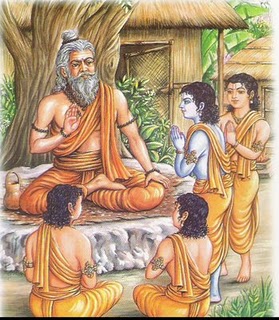
       Just as you have Father's Day and Mother's Day, Gurupurnima is Guru's Day.  This is also called vyasa-purnima, the anniversary of Bhagavan Vyasa who occupies an exalted place in the hierarchy of teachers.  Although there were gurus for Veda Vyasa, we look upon Veda Vyasa as the link between teachers we know and teachers we do not know.

Caturmasya-vrata

       On this particulr day, the sannyasins take a vrata, a vow, to any in one place for two months and teach.  Gurupurnima occurs at the beginning of the rainy season in India when there are many small insects on the ground.  At the time of taking sanyyasa, one takes a vow of not hurting any living being.  In order to avoid killing even small insects on their path, the sanyyasins do not travel during these two months, starting from Gurupurnima day.  Even though they usually travel from place to place, they stay in one place during this period and teach.  Traditionally, the place they choose is located in a river and a stream.  They move within the area, without crossing the river or streams.

       The vow is called caturmasya-vrata.  A masa is a month or a fortnight, pakso vai masah iti.  So, a vow for two months is called caturmasyam, four fortnights.

       On this day of Gurupurnima, the start of the caturmasyam, they invoke the lineage of teachers, guru-parampara.  All the gurus in the parampara, tradition, especially in mathas, traditional monastic places of learning, are invoked.

       There are many mathas, including the sankara-mathas.  The head of each matha is like a pontiff, and has a certain following.  Each one of these heads performs a daily puja to invoke the gurus in the hierarchy.  There are at least 16 gurus in the parampara, and the grace of each is invoked in a vessel containing water.  That is the ritual aspect. 

      Guru Purnima is a day when we pay obeisance to the lifeline of this great, unbroken civilization of India -the guru-sisya-parampara or mentor-protege lineage.

       India achieved excellence in every field of endeavor because of the Science of Self Management kept alive by the unbroken chain of teacher and student. The word 'guru' means 'one who dispels darkness'. The guru removes the pandemic ignorance that is prevalent and gives us the light of knowledge. Knowledge of who we are, how to relate with the world and achieve true success. Most importantly, how to transcend the world and reach the abode of infinite Bliss which is the hallmark of excellence.
gurukul

       On this day we re-dedicate ourselves to human Perfection. To study, assimilate and live Vedanta so that we may be able to pass it on to future generations as our forefathers did. It is an acknowledgement of the importance of Vedanta in our lives. Vedanta makes us rajarishis – kingly without, sagely within. Minus the rishihood even material success eludes us.
       The combination of the teacher’s wisdom and the energy of the student go towards making a vibrant, progressive society. Today students tend to undervalue the teacher and this day helps restore the balance. It stresses on the importance of the guru in every walk of life. A sportsperson’s natural gift and skill acquire direction under the expertise of the coach. A musician’s talent is honed by the dedication of the mentor. In the spiritual path it is the enlightenment of the guru that removes the ignorance in the seeker’s mind.

       The teacher-student relationship is accorded paramount importance in Indian culture. The guru occupies the same pedestal given to God. Spiritual growth is impossible without the help of a guru who is Brahma it and Brahmajna – established in the state of God Realization and has the teaching skills to impart the subtle spiritual concepts. Rare is the person who meets with these stringent qualifications. Yet India has been blessed with outstanding sages who have appeared in every generation to keep this unique tradition alive. It is to this singular endowment that we pay our respects. And as a mark of gratitude we offer ourselves as guru daksina and pledge to continue the tradition for generations to come.

       For this pranipata or total surrender to the guru is one of the foremost qualifications of a student. This does not imply blind following. The seeker must question, probe and analyze the truths taught so as to understand, absorb and transform his personality to the higher realms – prasna. And finally an attitude of service or seva is the hallmark of an outstanding student.


We invoke the Lord in Guru.

       The guru is a human being.  When the guru is praised, however, as in the following verse, the human element is not taken into account.


gururbrahma gururvishnuh
gururdevo mahesvarahh,

gurureva param brahma
tasmai srigurave namah

The guru is Brahma, the guru is Vishnu,
the guru is Maheswara (Siva), the guru
is the self-revealing limitless Brahman.
Salutations to that revered guru.

       Only the truth element is taken into account because the guru teaches that you are Brahman, you are limitless.  When he teaches, 'you are limitless,' he does not mean, "I am limited; you are limitless."  In fact, you are limitless and he is limitless.  The limitless is Brahma, the limitless is Visnu; the limitless is Rudra, or Siva, and the limitless is you.

       Everything is this limitless Brahman.  So, when you praise the guru, the human element is just completely absorbed in the total.  You either relegate the human element to the background, or you absorb it into the total.  It is the total that is worshipped.  In that way, the guru, the person with a human body who teaches, becomes a kind of an altar of worship, but what is being invoked is the Lord.

       When you worship the form of Sri Daksinamurthy in the temple, it is not the form you are worshipping, but the Lord.  You invoke and worship the Lord in a particular form.  Similarly, when you praise the person who teaches you and for whom you have sraddha, it is not the individual person you praise, but the teaching itself, for what he teaches is not separate from him.

       Praise of the guru is praise for the truth of the teaching.

akhandamandalakaram vyaptam yena caracaram,
tatpadam darsitam yena tasmai srigurave namah.

My salutations to that guru who showed me
the abode of the one who is to be known,
whose form is the entire universe and who
pervades all that moves and all that does not move.

       Tasmai srigurave namah, unto that guru; my namaskara, my salutation; tatpadam darsitam yena, by whom that pada, that end or abode, was shown very clearly darsitam.  And what is that pada?  Yena padena caracaram vypatam, by which pada the whole universe is pervaded.  Here, pada is BrahmaYena, by which Brahman, this entire universe, akhanda-mandalakaram, of living beings and inert things, caracaram, is pervaded, vypatam.  My salutations to the teacher who has shown me the Lord (the vastu, the reality) in the form of the great universe.

       The gaining of any knowledge is the greatest miracle.  How is the mind able to grasp a new fact or concept?  If you are ignorant by nature, you cannot know and if you know by nature, you need not be taught.  The fact is that you cannot see more than you know, yet you keep increasing your existing knowledge; you keep on shedding ignorance.  It is because under certain conditions you are able to see.  The teacher is the one who creates those conditions.  He does so by using reason and by citing your own experiences.  In that way, he helps you see.  In fact, the teacher creates an inner environment in which you cannot but see.  That is what teaching is about.  It is a miracle, an impossibility that happens.  You cannot see more than you already know; yet you always do.  That is how you know more and more.  How can that happen?  The answer is very simple: you are all-knowledge.

       We say that the Lord is all-knowledge; that all-knowledge is in the Lord.  Yet, who is this Lord?  If the Lord were to say, "I am the Lord," that 'I am' is not going to be any different from the meaning of your statement, 'I am.'  When you say, 'I am,' it is exactly the same as the 'I am' of the Lord.  There is one limitless consciousness.  Consciousness cannot be limited because it is one, and it is formless.  The Lord is a conscious being, and the limitless consciousness is the same for the Lord and for you.  I am limited only with reference to my body, mind and sense organs.  As consciousness, I am limitless.  The  Lord is also limitless consciousness.  Being limitless, there s only one consciousness.  If the Lord is all-knowledge, that all-knowledge rests in the consciousness that is one, that is limitless, that is you.  This means that all-knowledge rests in you.

--------------------------------------------------------------------------------------------
Sources: (1) Eassay on "Gurupurnima" by Swamy Dayananda Saraswati &
              (2) Article by Smt. Jaya Rao.
-------------------------------------------------------------------------------------------
10 June, 2012

Why Do We Complain?


You can complain because roses have thorns, or you can rejoice because thorns have roses.-- Ziggy.

       Many of us pass through certain phases of life, 'rough patches' as they are called, when everything seems to go wrong for us.  In such circumstances, people do tend to become negative, and at such times, we need to offer them help and support to carry them through, and the inspiration and incentive to cultivate faith and repose their trust in God.

       But, there are some people who complain no matter what happens to them!  It seems that complaining has become a way of life with them, that they simply cannot stop cribbing!  It seems to have nothing to do with pessimism or optimism, pain or suffering: it just seems that complaining has become second nature to them!.

       I must say that some of the people who suffer from pain and illness, some of the patients I have met in hospitals are not always of this type.  They discover a lot to be grateful for in the midst of their pain and affliction; they enjoy what little respite they get from pain; they discover that such and such movements of their limbs can be accomplished without strain, and are very happy about it.  They are happy to have visitors; they are grateful to the nursing staff; they thank their doctors for the relief they feel.

       But some of us simply cannot stop complaining.  Regardless of where they are, what they are doing, or what is happening to them, they keep on complaining!  The traffic is too bad; the telephone lines are congested; the weather is too hot or too cold; people are rude or indifferent; servants are lazy and inefficient; the subordinates are insubordinate!  And I could go on and on nobody understand me; nobody appreciates me; nobody knows what I am going through; nobody cares; nobody helps, nobody knows...

       Of course I feel sorry for such miserable people: but when I offer them a remedy for their misery, they refuse to take it!  I say to them, "You try to be what others are not; you must try and appreciate others; you must care; you must understand; you must help others..."

       They look at me as if I have suddenly switched over  to Latin or Greek.  They simply cannot register what I am saying to them.  They want only to be at the receiving end of care, compassion, understanding, help, appreciation and sympathy.  They do not want to give away any of those beautiful feelings to others!.

       Selfish people are born complainers.  Nothing will ever convince them that a lot of people are far worse off than they are; nothing will persuade them that they have a lot to be grateful for; they prefer the martyr's syndrome:  I am the most misunderstood, unappreciated creature in the entire world!

       Complaints stem from a sense of unhappiness and dissatisfaction with life.  But the way to meet this dissatisfaction is to set things right.  Complaining constantly will only make things worse; and let us not forget -- when we complain constantly, we become difficult and unpleasant to deal with and people would definitely like to keep their distance from us.  Thus, we are cutting off the source of help and support that we feel we need so desperately!

       All of us complain at one time or another: we are fed up with waiting interminably in a traffic jam or in a doctor's waiting room; we are angry when flight schedules are disrupted and our carefully laid travel plans are messed up completely; we react with indignation when government offers treat us with disrespect and callousness.  This is but natural:  in such situations, complaining, even loud complaining becomes a way of letting off steam, as we say.  But the trouble starts when we make complaining a habit, and that that complaining is the best way to deal with life and its problems.  Compulsive complainers make it their way of reacting to life.  No  matters what happens, they complain; they cry; they express their unhappiness volubly; they protest; they feel very sorry for themselves; they leave very little room for anyone else to step in and do anything for them!

       People start complaining when they are unhappy; but complaining sometimes becomes a bad habit which they cannot get rid of.  It is like those little children who get into the habit of sucking their thumb, and cannot thereafter give it up when they are scolded or pulled up.  The worst thing is that many of them actually begin to feel better when they complain persistently:  let me hasten to add, this is an entirely illusory feeling.  They have managed to make the others miserable with their cribbing; they have unburdened themselves of all their negativity, and are entirely satisfied with their session:  but the trouble is, their problems are no nearer to being solved.

       People who complain constantly do not wish to take the responsibility for themselves and their actions.  Ask  them why their goals are not accomplished, and they will come up with excuses.  What they don't realise is their energy and intellect is so focused on finding faults with others that they cannot concentrate on achieving their goals.  They do not realise how tedious and futile their constant complaints are: they have effectively undermined their own power and efficiency, and have retained control only by constant complaining.

       Constant complainers also suffer from a false sense of superiority because they are finding fault with everyone except themselves.  They think  others love listening to their complaints; they do not realise that they are actually driving away their friends, and will soon have only themselves left as their sole audience!

       Just look at some of their complaints:

1.   I am overworked and it is the fault of my boss.  (What about your time management?)

2.  I am late, and it is the fault of the public transport system.  (Why don't you try leaving home early?)

3.   My targets have not been met and it is the fault of my subordinates.  (Why don't you lead from the front?)

4.   My job is the most difficult and unpleasant.  (Why don't you make way for someone who can handle it?)

5.   I have been overlooked for promotion because the system is corrupt.  (Have you looked at your own performance record?)

       I said, all of us complain at one time or another.  Dynamic complainers find a way to solve their problems; they give vent to their negativity through complaints and then go on to find a way out of their difficulties.  Cribbers are far from dynamic; they are in fact defeatists who are more interested in making excuses and shifting the blame on to others.  They are happy and satisfied just complaining: they do not want to lose control over their pet excuses.

       Let's stop focusing on all that is wrong and focus instead on all that's right; let's stop cribbing about what we don't have and look stead what's there for us; let's take the time to appreciate people for what they are and what they can do, instead of focusing on their defects.  When we complain and criticise constantly, we are drawing negativities into our lives.  Each time we utter something negative about your life, we actually begin to believe it more and more, and make it come true in our lives.  Our imagined ills become our reality.  Needless to say, the reverse is also true.  When we believe things are going good, they become better, actually.  When we visualise success and talk about all that is positive, success actually begins to take shape for us.

       So, let us stop complaining, start thinking, appreciating and feeling good about ourselves.

-------------------------------------------------------------------------------------------

Source: Excerpts from the Book on "Stop Complaining:  Start Thanking!" by J.P. Vaswani.
--------------------------------------------------------------------------------------------

01 June, 2012

Dassera : The Triumph of Good over Evil


Celebrated in the month of Ashvin (September/October) according to the Hindu calendar. Dassera is an important festival that is celebrated across the length and breadth of India.

Also known as Vijayadashami, Dassera marks Goddess Durga’s victory in battle over the mighty asura demon, Mahishasura who was part animal. The holy trinity comprising Brahma, Vishnu and Maheshwara had created goddess Durga to kill the powerful Mahishasura who had been harassing the devas (gods). Dassera has immense mythological significance. As per the Ramayana, Lord Rama invoked the blessings of Goddess Durga by performing ‘chandi puja’ to kill the ten-headed king of Lanka, Ravana, who had abducted his wife, Sita. Dassera marks the day on which Lord Ram vanquished Ravana. This is why effigies of Ravana are burnt at various places across India on Dassera.


In the stories above, Mahishasura and Ravana represent people who have taken the unrighteous path. They represent those who do not listen to the voice of their conscience. Lord Rama and Goddess Durga, on the other hand, represent those who live by truth. Follow the voice of their conscience. The victory of Goddess Durga and Lord Rama over Mahishasura and Ravana respectively reinforces our belief that those who live by truth acquire the strength to overcome corrupt and unrighteous forces that come in their way.

At a subtler level, Mahishasura and Ravana represent our lower, base instincts, our vasanas (desires). Goddess Durga and Lord Rama represent the nobler, divine tendencies, the immortal Spirit in each one of us. Their victories epitomise the triumph of good over evil, the destruction of vasanas and the realisation of the Self.

The nine days of worship, Navaratri, preceding Vijayadashami are divided into three days of worship for each of the three goddesses Durga, Lakshmi and Saraswati. These signify that the spiritual journey needs to be undertaken at all three levels of the personality - physical, emotional and intellectual. At the physical level, we must dedicate our actions to a higher purpose. At the emotional level, the yearning and feeling for our spiritual goal must be kindled. And finally, at the intellectual level, we must strive to acquire spiritual knowledge to take us closer to the Goal.

The celebration on Dassera signifies the complete sublimation of desires and the re-discovery of the Divinity within. Thus Dassera is not simply about feasting and catering to the frailties of the senses. It is a reminder to each one of us to commit ourselves to the spiritual pursuit. The ten-day festival is symbolic of the lifelong search for the Divinity within each one of us, of the battle that we fight everyday against our own lower tendencies. If we haven’t yet embarked on the pursuit, the festival serves as an inspiration to take that first step. And for those of us already on the path, it is an opportunity to take stock of the situation and maintain focus on our sadhana (spiritual pursuit).

-------------------------------------------------------------
Source: From the article by Smt. Jaya Rao.
--------------------------------------------------------------

12 May, 2012

Ajapa japa Meditation Techniques


Techniques


       Ajapa japa can be practised in any meditational posture, or if it this not possible the preliminary methods can be practised while lying in shavasana.  The best time for ajapa japa practice is early morning between 4 and 6 a.m. or at night just before sleep.  Ajapa japa can be practised with or without a mala or rosary.

       There are many different stages in ajapa japa and the techniques for each stage progressively require a little more concentration and awareness.  Anyone wishing to practise ajapa japa should commence with stage one of preliminary ajapa japa and progressively work through and perfect each stage.  Little can be gained by randomly selecting any technique for practice.  It is also advisable to be acquainted with the practices of japa before proceeding to ajapa japa.


Preliminary ajapa japa - frontal passage rotation


       When practising preliminary ajapa japa the practitioner should try to feel the prana flowing in the fronal psychic passage between the navel and throat.  A little imagination may be necessary in the early stages.  You can imagine that the psychic passage is like a glass tube filed with water.  As you inhale, the water level rises from the navel to the throat and as you exhale, the water level drops back to the navel, or you can imagine that when you inhale, the breath comes from the navel and return to it when you exhale.

Stage 1:  Awareness of frontal passage and Soham


Feel the breath moving through the frontal psychic passage between the navel and throat.  Do not let one breath pass without your awareness.  Continue for a few minutes.

Now mentally synchronize the mantra Soham with the breath.  So sounds during inhalation and the rising of the prana in the psychic passage.  Ham sounds during exhalation and the descending of the prana in the psychic passage.

Continue in this way with total awareness of both the movement of prana and the mantra.

Practice this stage for a week or so, then go on to stage 2.

Stage 2:  Rotation of Hamso


The method is the same as stage one, but reverse the sequence of the mantra with the breath.  Each breath will start with exhalation on the mantra Ham followed by So on inhalation.  The mantra will now be Hamso.  After each Hamso pause briefly.

Practise this daily for a week or so, then proceed to stage 3.

Stage 3:  Rotation of Soham-Hamso


Merge the mantra So with the ingoing breath and Ham with the outgoing breath.  Thus, there is an endless circle of Soham-Soham-Soham.  Prolong the vibrations of Ham and join them with the ingoing vibrations of So.  Prolong the vibrations of So and join them with those of Ham.  Continuous repetition of Soham and Hamso without any intermission.

Practice this daily for a week or so, then proceed to stage 4.

Stage 4:  Spontaneous alternation of Soham-Hamso


In this stage,  you practise the techniques of stages one, two and three in a spontaneous alternation.

First be aware of he breath forming the cycle of Soham.
 
Practice this for a few minutes and then let your awareness shift to the continuation of Hamso.  After sometime, you will find that So and Ham have become connected on both ends.

Keep breathing with a continuous cycle of a Soham-Soham-Soham.

After some time you may spontaneously feel a change take place to Soham or Hamso.  Let it follow on its own course, spontaneously.  Be only a witness as your awareness shifts between the three mantras of is own accord.

Practice this daily for at least five days before proceeding to stage 5.

Stage 5:  With ujjayi and khechari


This stage involves the techniques of stages 1 to 4, but they are practised with ujjayi pranayama and khechar mudra.  After you have fully mastered this technique in all stages, go on to the intermediate practice of ajapa japa.

Ujjayi pranayama and khechari mudra


       Ujjayi pranayama helps induce a meditative state.  It is practised by contracting the glottis.  When performed correctly, a soft sound is produced like a cat purring or like light, gentle snoring.  One should feel he is breathing through he throat rather than the nose.  When a healthy child sleep, he always breathes by contracting his glottis and his breath can be heard in the throat.

       Khechari mudra is practised by rolling he tongue backwards so that the normal lower surface touches the upper palate.  Try to bring the tip back as far as possible.  If khechari mudra is practised correctly, in conjunction with ujjayi over a long period of time, the tongue will eventually go into the upper nasal orifice.

-----------------------------------------------------------------------------------------------------

Source: Excerpts from the Book on Sure Ways to Self-Realization' by Swami Satyananda Saraswati.
-----------------------------------------------------------------------------------------------------

Ajapa Japa Meditation practice


Introduction

       Ajapa japa is an important meditation practice by which we can plough our psyche, making it fertile and receptive.  Another name of ajapa japa is 'spontaneous awareness'.  Its translation is 'to see, to look within, to watch, to observe'.

       Japa is the constant repetition of a mantra.  Japa becomes ajapa (spontaneous) japa when the mantra automatically repeats itself without conscious effort.  It is said that ajapa japa comes from the heart, whereas japa comes from the mouth.

       Ajapa japa is particularly recommended for rajasic people with tension and problems.  The practices will help to divert one's attention from worries to higher spiritual ideals.  People who do a lot of study and mental work will benefit greatly from ajapa japa.  It provides a balance between mental and physical activity.  Whereas, study and mental work introvert the mind, ajapa japa requires one to be aware of his mental activities, while maintaining awareness of the movement of the breath and repetition of the mantra.  As well as these purely mental and physical activities, the practitioner begins to explore the more subtle regions of the psychic body - the psychic centres (chakras) and psychic passages.

       Ajapa japa is also a good practice for those people who have reasonable control over the mind and for those who want to develop greater concentration.  Ajapa japa is a combination of pranayama and meditation and it is said that through pranayama you enter the land of meditation.

Breath Awareness

       The first thing one must be aware of in ajapa japa is one's own natural breath.  You breathe 15 times per minute, 900 times per hour and 21,600 times in 24 hours, but you are never aware of this most vital process which is the key to life.  During practice of ajapa japa, the practitioners should watch the changing dimensions of breath.  Throughout meditation there are likely to be four dimensions of breath; natural, deeper than natural, relaxed and suspended.

       The second and most important point in ajapa japa is awareness of the movement of breath as it flows through the body.  This can be practised in many ways, but the most important is awareness of the breath in the spinal cord.  When the breath has assumed the relaxed third dimension it becomes ujjayi pranayama (psychic breathing) long, deep and soft, like the gentle snoring of a baby.  This relaxed breath is rotated up and down the spinal cord.

       In the preliminary practices of ajapa japa, the practitioner watches the breath flow through the frontal psychic passage between the navel and throat.  In the intermediate practices the breath is felt flowing through sushumna nadi and the practitioner feels the prana passing through each chakra from mooladhara to ajna and back down to mooladhara.  Advancd ajapa japa is similar to intermediate, with the breath becoming longer and slower, and the psychic passage extends all the way from mooladhara to sahasra chakra.

Mantra

     The third point in ajapa japa is the sound or mantra.  In the physical and psychic body there is a sound.  Some hear it as Soham or Om, others hear it as a different mantra.  Actually, any mantra can be used for the practice of ajapa japa although traditionally the mantra Soham is utilized since it correspond with the natural sound of inhalation and exhalation.  The mantra should be integrated with the breath.  When you inhale, the breath spontaneously makes the sound of So and when you exhale it makes the sound of Ham.  The most important thing is that the breath and the mantra should become one.  While you are inhaling through sushumna from mooladhara to ajna and exhaling from ajna to mooladhara, be aware of the movement of the breath combined with the movement of the powerful sound -- Soham.  This practice purifies the nadis, the pranic channels in the body.

       When mantra is awakened in the breath the whole body is recharged.  Psychic toxins are eliminated and blocks in the nadis, which are the main source of physical and mental disturbances, are removed.  The mantra should awaken sushmna nadi and permeate each and every particle of the body.  When sushumna nadi begins to vibrate, self-awareness becomes active.  When ida nadi starts vibrating, the mind becomes active.  When pingala nadi starts vibrating the prana becomes active and energy flows through one's whole system, extending even outside the physical body.

       When the awakening of sushumna nadi takes place with the help of mantra shakti, the elimination of karma takes place symbolically.  This results in the arising of inner sounds and fantastic experiences.  Whatever you experience is rising from your deeper consciousness.  It is mental shankhalprakshalana, part of the purging process.

       Ajapa japa is the basis for kriya yoga.  With its mastery pratyahara is achieved and the real practice of dharana begins.  When ajapa japa is perfected and fully realized, the samskaras are totally exhausted and the mind becomes one-pointed.  In this way dhyana yoga blossom forth.

-----------------------------------------------------------------------------------------------------
Source: Excerpts from the Book on Sure Ways to Self-Realization' by Swami Satyananda Saraswati.
-----------------------------------------------------------------------------------------------------

29 April, 2012

Is desire an evil?


       Among all living beings, human beings are considered the most superior and the most powerful.  Our sastras or scriptures give the reason for our superiority:  human beings alone are endowed with the three fold power known as icchasakti, jnanasakti and kriyasaktiIcchasakti means the power to desire; Jnanasakti is the power to know and kriyasakti is the power to do.

       It is because of jnanasakti that we have so many educational institutions and research centers.  The body of knowledge is forever expanding.  And it is because of kriyasakti that the face of the earth has undergone such tremendous transformation, changes that we see all around us touching our lives every day -- from using the ATM to surfing the Internet.  Thus, science alone is not enough; science must be converted into technology.

       Equally important is icchasakti.  The power to desire is the driving force behind jnanasakti and kriyasakti.  Let us suppose we have the power to know (a keen mind and a sharp intellect) but not the desire to know.  The power to know is of no use if there is no desire to know.  Similarly we can have the power to do (the stamina and strength) but this power is useless if we have no desire to do anything.  The power to know and do is made meaningful by the power to desire. 

       In our tradition we respect all three powers equally.  In fact, we worship these powers considering them a blessing from God.  One of the names in Lalitha-sahasranama (verse 130, nama 658) is 'icchasakti-jnanasakti-kriyasakti-svarupini, - The One who is the power of will, power of knowledge and power of action'.

       Here we face a problem.  While we look upon desire as a blessing, our scriptures - despite glorifying the desire on one hand - strongly condemn kama or desire which is looked upon as an internal enemy.  In the Bhagavad-Gita (3.37) Lord Krishna calls kami (a person with desires) a great papi or sinner -  'It is desire, it is wrath begotten by rajoguna: all consuming, all sinful, know this as the foe on earth'. 

       Katha Upanisad (2.3.14) states - 'When a man has all his heart's desires destroyed, he attains immortality and becomes one with Brahman in this very life'. 

       Again, in the Bhagavad-Gita (2.25), Lord Krishna defines liberation as the destruction of all desires - 'when a man abandons, O Partha, all the desires of the heart and is satisfied in the Self by the Self, then he is said to be stable in wisdom'

       To the above scriptural references, we can also add the well known English saying 'Desire is the root cause of all evil'.

       Are the scriptures confusing us?  Is desire a blessing or a curse?  On every new year day we make resolutions which are nothing but expressions of our desire.  Should we continue to make these resolutions - considering desire a blessing - or do we refrain from doing so - considering desire a curse?  What should we do?  What is the scriptural stand?

       Scriptures cannot afford to condemn desires.  The very existence of the scriptures is only to fulfill desires.  Our scriptures prescribes four purusarthas or goals of life: dharma (values), artha (wealth), kama (desire), and moksa (liberation). 

       To achieve the above goals or purusarthas we must first have a desire for them.  A doubt can arise.  Desire itself is one of the purusarthas.  Does it mean we must have a desire for desire just as we hve a desire for the other three?  When desire is mentioned as a purusartha, it must be understood to mean desired objectives such as a successful career, winning a competition etc.  Veda-purva-bhaga (the earlier portion of the Vedas) contains elaborate procedures like homa and yajna for fulfilling our desires like getting progeny, acquiring cattle, property, etc.  Even God has desire. 

       Taittirya-upanisad (2.6) says, 'He, the Atman desired:  May I become many:  Let me procreate Myself.'  Bhagavan desired and created the world.  The incarnations of the Lord are manifestations of Bhagavan's desire.  If desire is to be condemned sastra itself becomes irrelevant.  Desire is the starting point, the basis, the foundation of for all our activities, endeavours, pursuits.  Desire is indispensable for every being.  Thus desire and desiring power are a blessing in the form of icchasakti because of which alone we are able to make use of our jnanasakti and kriyasakti and progress in life.  Hence, we look upon desire not as an evil or course, but a blessing.

       Then why do our scriptures condemn desire?  Why do scripture define liberation as giving up desire as we have quoted earlier?  When our scriptures condemn desire, we must understand it to mean abnormal desire.  To understand what abnormal desire is, we first understand what is 'abnormal' and for this let us consider an example.

       A friend says, "I have a sugar problem.'  Does this mean that the sugar in our system is a problem?  Sugar is essential for a healthy life, but the doctors have prescribed a limit on consumption of it.  It is only when this norm is exceeded or violated that a person has a diabetes.  Thus, it is not sugar per se, but abnormal sugar which is the problem.  Similarly, cholesterol is necessary for good health.  Yet we hear of people having 'cholesterol problem'.  Again, what is meant by abnormal cholesterol in the system.  In the same way, when our scriptures condemn desire, it means abnormal desire.

       Thus, what is abnormal desire?  It is a desire which exceed the limit, violates the norm.  A desire which is within limits, conforms to norm, is a normal or healthy desire.  Just as there are prescribed norms for sugar and cholesterol, there are certain norms (three in number) for normal or healthy desires.


1.  Appropriate desire:

       Krishna says in the Bhgavad-Gita (7.11), "In beings I am desire, not contrary to dharma, O chief of the Bharatas"Lord Krishna defines an appropriate desire as dharmic desire.  Any desire that does not violate the norms of ethics, morality and justice is appropriate.  In fact, Lord Krishna says a dharmic desire is an expression of his vibhuti (glory).

       When adharmic desires arise in our mind we need not feel bad because we have no control over the their appearance.  But we do have control over their continuity.  And so, when an adharmic desire pops up in our mind, we simply nip it in the bud.  A desire is like a visitor - both welcome and unwelcome - who appears at our door unannounced.  While we have no control over who knocks at our door, we entertain and spend time only with the welcome visitor while turning away the unwelcome one.

       What is wrong, if we entertain adharmic desires?  We are likely to think 'nobody will know'.  But we know.  We lose respect for ourselves and our self-esteem is affected.  In our heart of hearts, we will not accept such behavior.  Such a person cannot be a happy in life.


2.    Balanced desire:

       There must be a balance in our desires.  All this is a two-fold balance.  The first balance is in getting and giving.  We all have the desire for acquisition and hoarding.  But, how many have the desire for giving and sharing?  The desire for acquisition should be balanced with the desire for contribution.  Desire for acquisition is natural; desire for contribution has to be cultivated.

       How can we contribute?  We can contribute time, energy, effort, knowledge and money.  Scriptures looks upon the entire universe as a gigantic, cosmic infrastructure.  We tap this infrastructure to fulfill our wants, needs and desires.  Scriptures call upon us to give back to the infrastructure which sastra describes as having five components.

a.  Nature: 

       Sastras or scriptures refers to nature as a panchabhuta or five elements: space, air, fire, water and earth.  These are a source of energy and our very sustenance.  In our tradition we look upon Lord as the panchabhutas or five elements.  And what have we done?  Rather than give back to nature (by planting trees, etc.,) we have polluted the air, land and water.  Global warming is the result of us going against nature.  We have to contribute to preserve nature.

b.  Living beings: 

       This includes all living beings, flora and fauna.  We contribute to their well being.

c.  Society:  

       We contribute to social welfare schemes that benefit the less privileged sections of the society.

d.  Educational Institutions:

       Scriptures attach great importance to eduction and teachers.  The role of educational institutions is to turn out responsible human beings who know what normal and abnormal desires are, healthy and unhealthy desires and more importantly have self control over abnormal desires.

e.  Family:

       Our scriptures consider family to be the most important infrastructure for a healthy mind.  We can enjoy a healthy mind only if we have the cushioning support of a family.  This especially applies to children and elderly people.  Institutions such as schools cannot give the love and care as effectively as a family.

       This five fold contribution - nature, living beings, society, educational institutions and family - is known as pancamaha-yajna and is referred to in sastras as devayajna, bhutayajna, manusyayajna, brahmayajna and pitryajna respectively.

       The second of the two-fold balance is balancing material pursuits and spiritual pursuits.  According to our scriptures, the entire universe is a combination of matter and spirit - prakriti and purusa.  We ourselves are a mixture of matter and spirit.  A spiritualistic person chasing money, entertainment, pleasure will feel a hollowness or emptiness in the heart, an inner sense of vacuum and incompleteness.  We must spend at least an hour a day for spirituality.  At a minimum we can study a few verses of Bhagavad Gita daily.  A spiritual person who neglects basic comforts - nutritious food, a comfortable place to stay - with a wish to eschew materialism would face needless and unnecessary hardships which actually hinder spiritual growth.  Hence, we must have a balanced mixture of both material and spiritual pursuits.


3.  Clean desire:

       Our scriptures say desire has certain byproducts which are harmful.  These toxic byproducts are krodha (anger), lobha (greed), moha (delusion), mada (arrogance) and matsaryam (jealousy), fear, anxiety, worry, rivalry etc.  A successful businessman desirous of being even more successful, plots to eliminate his competitors.  We should not entertain such unethical desires.  In other words, we cultivate 'clean' desires.

       Thus, we follow the above principle - we have Appropriate, Balanced, Clean Desires.  We can have any number of desires.  We need not feel guilty.  On the contrary, we can feel proud and privileged.  Swami Vidyaranya says in Pancadasi (6.262) that we can even have a cross desires - "When a person can dis-identify the Self from egoism and realize that the Self is in no way connected with egoism, then though he may have crores of desires, they will not bind him because he has cut the knot of the conscious with the unconscious."

       Let there be plenty of healthy desires!

---------------------------------------------------------------------------------------------------
Source: Excerpts from the Talks given on new year day January 1, 2007 by Swamy Paramarthananda at 'Asthika Samaj', Venus Colony, Alwarpet, Chennai.
---------------------------------------------------------------------------------------------------
        

08 April, 2012

Holy River Ganga


MYTHOLOGICAL STORY

  
     A mythological story describes story describes the river Jahnavi, better known as Ganga, descending from heaven to earth.  Ganga originated in heaven where she was personified as a goddess bearing the name Akasa-GangaKing Bhagiratha prayed to the goddess to descend from heaven to earth.  Akasa-Ganga granted the prayer but warned Bhagiratha that the earth would not bear the torrential flow of water from heaven.  The Lord Siva alone could withstand the force and receive the water.  Bhagiratha prayed then to Lord Siva to receive the Ganga water.  Siva acceded.  He received the water in his locks and retired to the jungle for meditation.  The Ganga remained in Siva's locks but did not flow on earth.  Hence, the king prayed to Siva a second time.  Now, to release the water to the world.  Siva granted his prayer.  The Ganga is presently believed to be the flowing from Siva's locks!


ALLEGORICAL SIGNIFICANCE:


       The story has a deep allegorical significance.  Ganga signifies Brahman, the supreme Reality.  Brahman remains above all terrestrial experiences.  Symbolically in the heavens.  King Bhagiratha represents an enlightened soul who alone can transmit the spiritual knowledge to the world.  Lord Siva represents  a tapasvin -- an austere, introvert, contemplating person - who qualifies to receive the knowledge.  After receiving the knowledge the seeker has to assimilate and absorb it.  This is indicated by Siva retiring to the forest for meditation with the Ganga in his locks.  The knowledge absorbed turns the seeker into a spiritual master.  He then imparts the knowledge gradually, carefully.  The people of the world can take it only in small doses.  Hence, Siva releases the Ganga in trickles from his locks.  Since the river signifies spiritual wisdom a dip in the sacred Ganga symbolises the devotee's union with Brahman.


Lord Krishna glorifies the river (Jahnavi) Ganga in Bhgavad Gita  Chapter X Verse 31

Among the purifiers, I am air.
I am Rama among those who bear weapons. 
And among the  fishes I am the Shark;
among the rivers, I am the Jahnavi (Ganga).
  
     Among the rivers I am Jahnavi, otherwise known as Ganga.  Her water is always fresh.  It is said that no bacteria can thrive in Ganges water.  Whether that is so, or not, every Hindu home has a pot of Ganga water, which never spoils.  And through association and the circumstances of her birth, Ganga stands for knowledge.  She is said to have come from Lord Siva's head.  And there are hundreds of stories associated with her as a source of knowledge and purification.  In India every river is worshipped.  But Ganga has a special place.  It is not just a river, but jnana-ganga, the unbroken flow of knowledge itself.  One dip is said to remove all sins.  That is the shraddha people have for Ganga.  She is looked upon as a devata.  

----------------------------------------------------------------------------------------------------
Sources:
1. Commentary on Bhagavad Gita Chapter X by Swamy A Parthasarathy.
2. Swamy Dayananda's Bhgavad Gita Home-study-course Vol.III.
-------------------------------------------------------------------------------------------------

01 April, 2012

Why do we have a prayer room?


In Indian Culture..

Why do we have a prayer room?


       Most Indian homes have a prayer room or altar. A lamp is lit and the Lord worshipped each day. Other spiritual practices like japa (repetition of the Lord’s name), meditation, paaraayana (reading of the scriptures), prayers, devotional singing etc, is also done here. Special worship is done on auspicious occasions like birthdays, anniversaries, festivals and the like. Each member of the family- young or old –communes with and worships the Divine here.


• Why do we have a prayer room ?

       The Lord is the owner of the entire creation.   He is therefore the true owner of the entire creation. He is therefore the true owner of the house we live in too. The prayer room is the Master room of the house. We are the earthly occupants of His property this notion rids us of false pride and possessiveness.

       The ideal attitude to take is to regard the Lord as the true owner of our homes and ourselves as caretakers of His home. But if that is rather difficult, we could at least think of Him as a very welcome guest. Just as we would house an important guest in the best comfort, so too we felicitate the Lord’s presence in our homes by having a prayer room or altar, which is, at all times, kept clean and well-decorated.

       Also the Lord is all pervading. To remind us that He resides in our homes with us, we have prayer rooms. Without the grace of the Lord, no task can be successfully or easily accomplished We invoke His grace by communing with him in the Prayer room each day and on special occasions.

       Each room in a house is dedicated to a specific function like the bedroom for resting, the drawing room to receive guests, the kitchen for cooking etc. The furniture, décor and the atmosphere of each room are made conducive to the purpose it serves. So too for the purpose of meditation, worship and prayer, we should have a conducive atmosphere – hence the need for a prayer room.

       Sacred thoughts and sound vibrations pervade the place and influence the minds of those who spend time there. Spiritual thoughts and vibrations accumulated through regular meditation, worship and chanting done there pervade the prayer room. Even when we are tired or agitated, by just sitting in the prayer room for a while, we feel calm, rejuvenated and spiritually uplifted.


------------------------------------------------------------------------------------------------
Source: Excerpts from the Book on In Indian Culture Why do we … by Swamini Vimalananda & Radhika Krishnakumar.
----------------------------------------------------------------------------------------------------