Search This Blog

24 April, 2013

God Is Watching Over Me


      On the upper galleries of the cathedral of Milan, there are many statues of saints carved in exquisite white marble.  The   dedicated sculptor who created these masterpieces was busy at his work when one of his friends came to see him.  The friend said, "I don't see why you are wasting your artistic effort in such a place.  High up here, in these unseen galleries, nobody will ever get to look at your statues.  Therefore, your work will not really be appreciated.  Isn't that a pity?"  "It is enough for me that you recognise their value," smiled the artist.  "And what if I had not climbed up all those stairs to see your work?" countered the friend.  "My friend," said the artist," surely God and his angels would have seen it, and that is enough!"

       During the American civil war, when things were getting tough for the Northern armies, Abraham Lincon asked the people to pray for their victory.  One of his critics, asked him sarcastically, "Are you sure, Mr. President, that God is on your side?"  "I'm much more concerned that we should be on God's side,; said Lincoln.  "That thought occupies me all the time!".

       If you can believe that there is a Higher Power watching you, taking care of you, sending you strength and wisdom to face the tribulations, irritations and annoyances of daily life, you will find it easier to tackle, to take an irritations and conquer annoyance.  If such faith does not come to you naturally, you can actually cultivate it by repeating to yourself, "God is watching me!  God is watching over me!"  Repeat this if possible, every hour.  Repeat this to yourself, when you have to confront an irritating situation.  People who take risks, people who are exposed to danger constantly, know what it is to have the strength of this belief:  "God is watching me; God is watching over me!"

       Have you seen circus acrobats who perform daredevil tricks?  Have you seen trapeze artists walking across the high wire, seeming as if they are suspended in space?  They cannot afford to lose their nerve; they cannot afford to have their calmness and composure disturbed.  All acrobats will tell you that they climb up to the high trapeze and walk on the high wire with the simple belief that God watches over them.  This is what helps them to stay calm and composed, for their survival depends upon it.

       You and I may not be trapeze artists, but we too have to walk on the tightrope in the circus that is life.  And the circus acrobats teach us the simple but valuable lesson that we can keep our cool, maintain our sense of balance, preserve our equanimity if we hold firmly on to the belief: "God is watching me; God is watching over me!"

       Irritation and annoyance raise clouds of darkness in our mind.  People who live in desert areas will tell you how irritating sandstorms can be.  Strong gusts of wind blow and sand and dust into people's eyes and nose and face, so that it becomes impossible to see ahead, or indeed move on.

       Irritation raises just such a sandstorm in the mind, making it impossible to think clearly, shutting us off from the source of confidence, calmness and peace that is God's presence.

       Alas, today, we live in a world that is veritable concrete jungle - cut off from the healing forces of nature.  We live in the midst of steel, stone, pollution, noise harmful emissions, dirt and confusion.  But all we have to do access inner peace and confidence is to remind ourselves again and again that He, who is the source of the Peace that passeth, surpasseth understanding - He is watching over us.  Therefore, my advice to you is this: every morning, start the day by saying, "God is watching over me."  Repeat this whenever you can, throughout the day.  And as you fall into sleep, say it yourself yet again:  "God is watching over me!"  When you begin the day in this beautiful awareness, you breathe out aspirations of purity, love, joy and peace.  Just as light dispels darkness, frustrations and irritations will be driven away from you, clearing the dark clouds that threaten your horizon.

       A streamer, sailing over the sea, was caught in a squall one night.  The ship tossed violently, awakening the passengers from their peaceful slumber.  Nervous and frightened, they wondered what was happening.  Some of them began to scream in fear.  On board the steamer was the Captain's daughter, a little girl of eight years.  The noise awakened her, and she asked her mother, sleepily, "Mamma, what's happening?"  The mother explained to her that a storm was lashing the ship.  "Is Papa at the helm?"  asked the frightened child.  "Yes, Papa is at the helm," replied the mother.  Hearing this, the little girl snuggled back into her bed, and was fast asleep in no time at all!  The winds still blew and the waves still rolled and the ship still tossed - but she was calm and confident, because she knew her father was at the helm.

       The Heavenly Father is always at the helm, and though storms may blow and thunder may strike, we can leave everything in His hands, knowing that He is watching over us.

       As we proceed on the pathways of life, we encounter different types of weather - stormy and smooth, mild and wild.  We must keep on reminding ourselves that God is in charge of the Universe, He is the controller of the destinies of individuals and nations - therefore nothing can go wrong.  Today, here and now, you may feel things are going wrong - but if you have the faith that God is in control, He is in charge of our life, you will be assured that nothing can go wrong - for in everything that happens, there is a happening of God's mercy.

---------------------------------------------
Source: An article by Dada J.P.Vaswani.
---------------------------------------------

06 April, 2013

MAHA-MRTYUNJAYA MANTRA


MAHA MRITYUNJAYA MANTRA

The Mantra of Life over Death


Om Tryambakam Yajamahe Sugandhim
Pushtivardhanam.
Urvarukam iva Bandhanan Mrtyor
Muksiya Mamrtat.

'I worship the Three-eyed One (Lord Siva), who is fragrant and makes us grow.
May I be released from the bondage of mortality just as the ripe cucumber (effortlessly leaves the plant).  May I never be distanced from Immortality.'

INTRODUCTION


       As well-known as the powerful Savitur Gyatri Mantra - Om Bhur Bhuva Suvahah, Tat Savitur Varenyam... the Maha-Mrutyunjaya Mantra inspires its chants and reveals the Highest Spiritual Truths.  Its popularity is due to the fact that it releases one from spiritual bondage and prevents untimely death.  It can also ward off accidents and said to cure even the most 'incurable' of diseases.  That is why it is called the Maha-Mrutyunjaya Mantra, maha means 'great', jaya means 'victory' and mrtyu means 'death'.  Thus, it is that great mantra that can help us to conquer death.  The Maha-Mrtyunjaya Mantra is found in the Rig Veda as well as in the Yajur Veda.


WHAT IS MANTRA?


       Mantras are revealed truths, not concocted theories.  Anything created by the limited ego, the limited being, can only be limited.  Mantras are not philosophies developed by a human intellect or mind.  They have been revealed to great ancient sages (Risi) following their intense meditation and austerity.  Therefore, mantras are classified under Sruti - 'that which was heard'.  Mantras are divine revelations.  The very word mantra has been defined as 'mananat traiyate iti mantra' - 'That which protects the one who reflects upon it'.  So, the mantra protects that person who recites and reflects upon it.

MANTRAS ARE VIBRATIONS


       Mantras are not just words or sentences put together.  Besides being words with deep meanings, they are also vibrations.  The whole universe is nothing but vibration.  Even scientifically, electrons, protons and neutrons are only energies in varying states of vibration.  The entire universe is made up of energy, and this energy in different states of vibration makes up the objects of the universe.  Even  between people there are vibrations.  How often do you hear, "He has a good vibe", or, "We just don't vibe with each other".

       These vibrations are actually thoughts.  To put it simply, sometimes our thinking processes match,  and sometimes they don't.  As we think, so we are.  In fact, our mind in different states of vibrations produces different results or manifestations.  Even things like illnesses, are often produced by our mind in a 'dis-eased' state of vibration.  We know how our mood at any given moment colours our experience of things.  Also, what brings joy to me, may bring sorrow to you, depending on our individual likes and dislikes.

       Now, for two people to understand each other, they have to 'vibe' together.  In the same way, to understand the universe, we need to 'vibe' with it.  How did Newton discover gravity?  Because of his deep enquiry, the nature of gravity revealed itself to him.  Whenever our mind reaches the same frequency of any object, the complete secret of that object is revealed.  Why?


When objects vibrate at the same frequency, they merge; they unite.  Per the vibrations of our mind, so is the world that we experience.

       This is the principle of mantra chanting.  It is a specific sound vibration that helps our mind to vibrate at a certain frequency.  And, when our mind reaches that frequency, the 'law' of that object, or 'essence' of that object, is revealed.  Thus mantras are very powerful vibrations and must be chanted properly.  When chanted properly, they are extremely effective.

WHO IS THE MANTRA DEVATA?


       Over a period of time when we keep chanting, the mind begins to vibrate at that frequency and, as mentioned, the mantra reveals itself or its devata.  This Sanskrit word devata or deva, commonly translated as 'deity', has been explained in many different ways.  In his Isavasya Upanishad commentary, Sri Adi Sankaracharya defines 'deva' as 'the sentient forces governing the sense organs'. 

       Swamy Chinmayananda has very often referred to deva as 'the potential in our field of activity (commentary on Bhagavad Gita Chapter 3, Verse 11).  It can also mean the law or governing force of a field.  All these meaning are inherent in the word devata.

       Every mantra has its own devata, its own presiding deity, so to speak, and to those who chant the mantra properly with devotion and sincerity, the mantra devata manifests.  When it manifests, it blesses the chanter with the boon mentioned in the mantra.  These blessings are the knowledge, the governing laws and the power invoked by that mantra.  And by that knowledge, by that power, or by that devata, we are protected.

       The presiding deity of the Maha-Mrtyunjaya Mantra - that mantra which is the most powerful in conquering death - is Lord Siva, the Destroyer.  It is Lord Siva in the form of Tryambakeswara - the One who has three eyes.

TO WHOM WAS THE MANTRA REVEALED?


       The Maha-Mrtyunjaya Mantra was revealed to none other than Sage Vasista, Sri Ramachandraji's Guru.  This is why we find Sri Ramachandraji worshipping Lord Siva.  At that time Sage Vasista and Sage Visvamitra were great competitors (and later on best of friends).  Because Sage Visvamitra was always in competition with Sage Vasista, wanting to be his equal, he strove with all his might, and so to him was revealed the Savitur Gayatri Mantra, while to Sage Vasista was revealed the Maha-Mrtyunjaya Mantra.  Both mantras are equally important, and both are, moksadaya mantras - meaning they can best of spiritual liberation.

       It is said that the Gayatri Mantra reveals the entire universe while the Maha-Mrtyunjaya Mantra releases one from the universe.  In this way both mantras are really the same; when you come to know the universe, you will also know The Reality beyond the universe, and so you will be released from delusion and sorrow.

       Each mantra also has its own metre (chanda).  For example, Gayatri Mantra is type of metre.  There are many Gayatri mantras and the most famous one is Savitur-Gayatri.  This mantra, the Maha-Mrtyunjaya Mantra, is in the Anustubh chanda (metre), which has thirty-two letters in it.

       Generally, when you chant a mantra, you do the nyasa - invoking the Risi, the metre (chanda) and the deity (devata).  You invoke the deity in that mantra for its power and you pay respect to the metre because only by knowing the metre can you chant the mantra properly.  So you start by invoking your own Guru, then Sage Vasista, to get the blessings of the Maha-Mrtyunjaya Mantra.

       However, besides the Guru, the deity and the metre, a mantra also has a feminine force or Sakti behind it.  This is the power that guides it or gives it direction.  Amrteswari, the giver of Amrtam (immortality), is the Devi (goddess) behind the Maha-Mrtryunjaya Mantra.


SIMPLE MEANING


       Mantras are capsules.  In medicine, capsules can be very small and look quite harmless, but once they burst open there is usually a lot of medication within.  So, too, when you internalise the Maha-Mrtyunjaya Mantra.  When you contemplate on it, it may burst open to reveal a tremendous amount of meaning.  It mushrooms in its message, almost like an atomic explosion!

       Now if we look at the different dimensions of this mantra's meaning, confusion may arise.  So, first we will look at the simple meaning of this mantra.

Tryambakam - The One with the three eyes, Lord Siva
Yajamahe - I worship, I sacrifice
Sugandhim - Who is fragrant
Pustivardhahnam - Who makes you grow
Vrvarukam iva Bandhanat - Just as a ripe cucumber is freed from its bondage to the creeper
Mrtyor - from death
Muksiya - May I be liberated
Mamrtat - not from Immortality

Thus a complete translation would be:

'I worship the three-eyed One (Lord Siva), who is fragrant and makes us grow.  Like the ripe cucumber (that is freed effortlessly) from bondage, may I too be released from mortality.  May I never be distanced from Immortality.'

WHY VICTORY OVER DEATH?

WHAT IS DEATH?


       The Maha-Mrtyunjaya Mantra is known as the mantra that gives victory over death.  What, then, is death?  Generally we think of physical death, but in fact there are many types of death.

      Birth, in a  funny way, is really the beginning of death.  The moment you are born, you have actually started dying!  We know through our studies that when the body dies, the jiva or 'soul' moves on to another body.  Therefore birth and death are two sides of a coin; you cannot have one without the other.  Birth is the beginning of a new state, which means the death of a previous state.  We cannot speak of one without the other.  Hence, birth itself is death.  And when we celebrate birthdays, what are we celebrating?  Years which are dead.  That's why we blow out rather than light the candles on our birthday cake.

       Change is also a form of death.  Scientifically, we know nothing in the universe id destroyed; it only changes its form.  Even if the body perishes to become ashes, those ashes become nourishment for plants, and the plants become food for animals and humans.  Everything in nature is recycled.  That which seems to perish, is reborn in another form.

       If death, in effect, is the culmination of a state of ongoing birth and change, then change by the very same fact can also be considered death.  And, from moment to moment, change is taking place -- your childhood died for your youth to be born, your youth died for your adulthood to begin, and so on.  This change is taking place at every moment at every level of your being - physical, emotional and intellectual.

       The Maha-Mrtyunjaya Mantra helps us to recognise and manage this change.  Today in business management there is what is called 'change management', because people keep changing jobs.  And don't you have to mange people in your house who are constantly changing as well?  Learning to manage change, then really a matter of learning to manage death.  Change is death of what preceded it.  Conversely, death is simply change.

      Misery, too, is death.  When a change seems to be conducive to us, we forget it is death.  When the share market, for example, goes-up, people are happy, but when it comes crashing down, people become miserable.  In some there is an almost fundamental change in their mindset and lifestyle.  So, misery, a negative change, is also a form of death.

       Does anyone really want death or misery?  Obviously not, but everything we want, desire, hold on to, get attached to and live with, will one day change and give us misery.  Change or death is inevitable.  Nobody really wants a life of misery.  It seems, however, that everything we want will at some stage make us miserable.

       If someone is living an unproductive life, a life in which that person is just lazy, you often hear people, say, 'That person is as good as dead.'  Other people may be brain damaged or disabled, some of them may even look dead, yet often they use whatever abilities they have to produce an amazing life.

       Agitation or sin is also death.  Death is that which destroys or ends, and therefore, all those things or actions that destroy us, our peace

       By extension, dishonour is a living death.  Lord Krishna in the Bhagavad Gita says to Arjuna, 'For those who have lived a noble life and who have attained fame, for them, dishonour is death.  Bhgavad Gita Chapter 2 Verse 34.  Would you be able to face the death of your fame?  Interestingly, in the Japanese culture of the past, when their honour was lost, they would perform suicide.

       Severe illness similarly causes pain and misery.  Those who are very ill and incapacitated may even want euthanasia.  For those who have such an illness, living is very difficult.  Their illness either leads to physical death or itself a form of death.  Thus, when you say, Mrtyor Muksiya, you are actually saying, 'Please free from all this that is called death.'

       Even when things are favourable, the fear of change is always there.  There is a saying, 'Fear itself is death', and for one who lives in constant fear, tension, and anxiety, this mantra releases them from all such pains and sorrows.  When we are living under stress, we do not love or enjoy life; there is a cosntant fear.  The threat of change, whether real or imagined, causes fear, and that renders our life a virtual death in progress.  We know from our studies that there is no real death, but it is fear itself which is the death element.

       There are so many meanings to be derived from the word 'mrtyu or 'death' in this mantra.  We have many fears and, as we have seen, death can present itself to us in many ways.  The Maha-Mrtyunjaya Mantra helps us to overcome death and gives us freedom from misery, illness and the fear of change.

From this mrtyu, 'death', O Lord, muksiya, 'may I be liberated'.

INITIATION INTO THE MANTRA


      We have seen that mantras are actually vibrations, and when chanted they have a certain power.  This power is enhanced when they are chanted with right bhavana - the right feeling, attitude and devotion.  However, the effect of any mantra is most potent when we understand what it means.  Thus we should:

  1. know the proper pronounciation of the mkantra;
  2. develop reverence and devotion for the deity of that mantra and for the mantra itself; and
  3. understand and internalise its meaning.

Without these, we cannot experience the full glory of the mantra.

MEDITATION - HOW TO SIT, INVOKE AND CHANT THE MANTRA


  • Have a special room or corner specially screened off (at least mentally) for your prayers.
  • Fix a charming picture of Lord Siva and your Guru at such a height from the floor that when you sit in front of the portrait, the Lord's feet are directly in your sight line.
  • Spread out a simple mat or asana (or use a floor cushion).
  • Sit on the asanaa in a comfortable legs-folded position, keeping your back, neck and head in a straight line.  You may use a chair if you are uncomfortable on the floor).
  • To begin with, gaze at the Lord's feet and slowly raise your sight from His feet to His legs, body and face.
  • Close your eyes, feel His presence within you and try to visualise the Lord exactly as He is in the portrait. 
  • Before you start chanting the mantra, invoke the blessings of your Guru and Lord Siva.
  • Now start chanting.  First chant loudly, then turn it into a whisper and then finally chant only in your mind.  Your chanting should become such that the mantra starts resonating by itself.
  • Contemplation:  Once the mind is effortlessly chanting the mantra, your intellect can then dive into the meanings you have learnt here.  Don't just sit and merely analyse the logic behind it, but think about whatever you have understood and allow your heart to embrace it.  Let it seep into your every bone and breath.
  • Every time you get distracted, resume the loud chanting, then reduce your volume and again dive into your contemplation.

Practise this every day for 10 minutes.  Be regular and be sincere.  Steadily and slowly increase the duration of your Japa.  See what happens.

May the Blessings of Lord Siva and
Pujaya Gurudev Swami Chinmayananda be upon us
for success in our spiritual practice.

--------------------------------------------------------------------------------------------------
Source: Excerpts from the Book on 'Maha Mrtyunjaya' by Swami Swaroopananda.
---------------------------------------------------------------------------------------------------

17 March, 2013

Why do we do aarati?


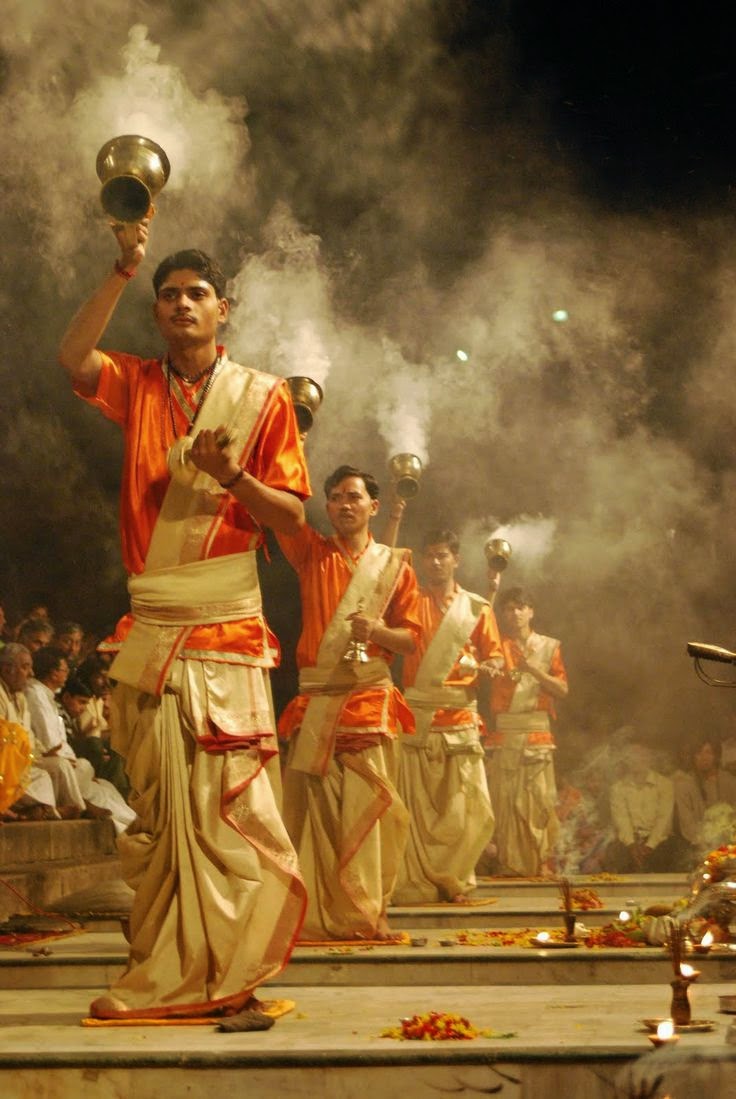
Ganga Aarti during Kumbh Mela 2013

In Indian Culture

Why do we do aarati?


       Towards the end of every ritualistic worship (pooja or bhajan) of the Lord or to welcome an honoured guest or saint, we perform the aarati.  This is always accompanied by the ringing of the bell and sometimes by singing, playing or musical instruments and clapping.

       It is one of the sixteen steps (shodasha upachaara) of the pooja ritual.  It is referred to as the auspicious light (mangala niraajanam).  Holding the lighted lamp in the right hand, we wave the flame in a clockwise in a circular and vertical plane at the lotus feet, then two at the navel, once over the face and finally seven times around the whole body to light the entire form of the Lord.

       In Sanskrit, aarati is called nirajanam, meaning: to fully illuminate Lord.  Each part is revealed individually and also the entire form of the Lord.  As the light is waved we either do mental or loud chanting of prayers or simply behold the beautiful form of the Lord, illumined by the lamp.  We experience an added intensity in our prayers and the Lord's image seems to manifest a special beauty at that time.  At the end of aarati we place our hands over the flame and then gently touch our eyes and the top of the head.


Why do we do the aarati?


       Having worshipped the Lord with love - performing abhisheka, decorating the image and offering fruits and delicacies, we see the beauty of the Lord in all His glory.  Our minds are focused on each limb of the Lord as it is lit up by the lamp.  It is akin to silent open eyed meditation on His beauty.  The singing, clapping, ringing of the bell etc., denote the joy and auspiciousness which accompanies the vision of the Lord.

Camphor


       Aarati is often performed with camphor.  This hold a telling a spiritual significance.  Camphor when lit burns itself out completely without leaving a trace of it.  Camphor represents our inherent tendencies (vaasanas).  When lit by the fire of knowledge which illumines the Lord (Truth), our vaasanas thereafter burn themselves out completely, not leaving a trace of the ego which creates in us a sense of individuality that keeps us separate from the Lord.  Also while camphor burns to reveal the glory of the Lord, it emits a pleasant perfume even while it sacrifices itself.  In our spiritual progress, even as we serve the guru and society, we should willingly sacrifice ourselves and all we have, to spread the "perfume" of love to all.

      We often wait a long while to see the illumined Lord but when the aarati is actually performed, our eyes close automatically as if to look within.  This is to signify that each of us is a temple of the Lord - we hold the divinity within.  Just as the priest reveals the form of the Lord clearly with the aarati flame, so too the guru clearly reveals to us the divinity within each one of us with the help of the "flame" of knowledge (or the light of spiritual knowledge).  At the end of the aarati, we place our hands over the flame and then touch our eyes and the top of the head.  It means - may the light that illumined the Lord light up my vision; may my vision be divine and my thoughts noble and beautiful.


Philosophical meaning of 'aarati'


       The philosophical meaning of aarati extends further.  The sun, moon, stars, lightning and fire are the natural sources of light.  The Lord is the source of all these wondrous phenomena of the universe.  It is due to Him alone that all else exist and shine.  As we light up the Lord with the flame of the aarati, we turn our attention to the very source of all light which symbolises knowledge and life.

       Also the sun is the presiding deity of the intellect; the moon, that of the mind; and fire, that of speech.  The Lord is the supreme Consciousness that illumines all of them.  Without Him the intellect cannot think, nor can the mind feel nor the tongue speak.  The Lord is beyond the mind, intellect and speech.  How can these finite equipment illumine the infinite Lord?  Therefore, as we perform the aarati we chant the following prayer:

In Sanskrit


Na tatra suryo bhaati na chandra taarakam
      Nemaa vidyuto bhaanti ktoyamagnih
Tameva bhaantam anubhaati sarvam
     Tasya bhaasa sarvam idam vibhaati.

Translation in English


He is there where the sun does not shine,
     Nor the moon, stars and lightning.
Then what to talk of this small flame
     (in my band)!
Everything (in the universe) shines
     only after the Lord,
And by His light alone are we all illumined.

     In ancient temples of India, hardly any daylight reached the inner recesses of the garbha gruha.  The darshan of Lord was made possible with divas.  To have the darshan of all parts of Lord, the divas - lights were held near each part.

      Lord has graced all life on earth by the gift of the panchabhutas - the five elements.  To maintain stability He created pruthvi - the Earth.  He gave jal or water for life to flourish.  He gave tej - light in the form of sunlight and moonlight, as well as agni - fire to cook and the jathar agni - digestive fire to digest food.  He also gave vayu - air as a medium for breathing and for holding prana - the vital air.  For movement He gave avakash-akash - space or etherTo remember our debt to Lod, we represent the panchabhutas - five lements at His feet in aarati, by offering their symbolic representations. 

       Sound is a part of akash or space.  Therefore, the drum, bell and the words (lyrics) Sun in aarati are symbols of akash.  The dhoop or smoke from an incense stick is a symbol of vayu - air.  The flame of divo is a symbol of tej (light).  The water in the conch shell is a symbol of jal (water).  By doing the dandvat pranam the pruthvi (earth) element is symbolically offered at Lord's lotus feet.  In this manner, aarati is a symbolic offering of the panchabhutas - five elements to Lord.


       In some temples, the aarati is performed using five objects which symbolically represents the panchabhutas - five lements:

1.  flower - pruthvi (because smell is an attribute of pruthvi).
2.  water in a conch shell - jal.
3.  divo - tej (light)
4.  chamur (wisp) - vayu.
5.  whitecloth - akash (space).

       By performing aarati using these articles in the above sequence, people feel that they have offered the panchabhutas - five elements at Lord's feet.

-------------------------------------------------------------------------------------------------
Source:
(1) Excerpts from the book on "In Indian culture Why do we" written by Swamini Vimalanda and Radhika Krishnakumar.
(2) Excerpts from the book on "Hindu rites and rituals" by Sadhu Mukundcharanandas.
--------------------------------------------------------------------------------------------------

08 March, 2013

Why do we not touch papers, books & people with the feet?


In Indian Culture

Why do we not touch papers, books and people with the feet?


       In Indian homes, we are taught from a very young age; never to touch papers, books and people with our feet.  If the feet accidentally touch papers, books, musical instruments or any other educational equipment, children are told reverentially touch what was stamped with their hands and then touch their eyes as a mark of apology.


Why do we not touch papers, books and people with the feet?


       To Indians, knowledge is sacred and divine.  So it must be given respect at all times.  Now a days, we separate subjects as sacred and secular.  But in ancient India every subject - academic or spiritual - was considered divine and taught by the guru in the gurukula.

       Books represents knowledge.  The deity of knowledge is (Goddess of Learning) Saraswati.  Touching the books with feet or kicking somebody's school bag which contains books is considered sinful.  It shows disrespect for Saraswati.  The bad karma of kicking or nudging a book with the feet results in bad fruit; we do not gain knowledge.  Our education suffers.  We get less marks in school.

       Similarly, one should not let feet touch any musical or educational instrument.  Hindus respect every object from which knowledge is gained.  Children in India respect even new notebooks, pens, pencils, etc., by taking them to their nearest mandir (temple) so that the pujari (priest) may sanctify them at Bhagwans's feet. 

       If one's feet accidentally touch a book or even a person, then one should mentally pray for forgiveness, as well as ritually bow down and touch that person's feet as a gesture of regret and also ask him to pardon one.  Such humility develops one's character immensely.  Additionally, knowledge becomes useful for only he who is humble, according to the Sanskrit sutra; vidya vinayena shobhate.

       The custom of not stepping on educational tools is  a frequent reminder of the high position accorded to knowledge in Indian culture.  From  an early age, the wisdom fosters in us a deep reverence for books and education.  This is also the reason why we worship books, vehicles and instruments once a year on Saraswathi Pooja or Ayudha Pooja day, dedicated to the Goddess of Learning.  In fact, each day before starting our studies, we pray:
 

Saraswati namasthubyam
Varade kaama roopini
Vidyaarambham karishyaami
Sidhirbhavatu me sadaa

O Goddess Saraswati, the giver of
boons and fulfiller of wishes,
I prostrate to You before 
starting my studies.
May You always fulfill me.


       Children are also strongly discouraged from touching people with their feet.  Even if this happens accidentally, we touch the person and bring the fingers to our eyes as a mark of apology.  Even when elders touch a younger person inadvertently with their feet, they immediately apologize.

To touch another with the feet is considered an act of misdemeanor.


Why is this so?


       Man is regarded as the most beautiful, living, breathing temple of the Lord!.  Therefore, touching another with the feet is akin to disrespecting the divinity within him or her.  This calls for an immediate apology, which is offered with reverence and humility.

       Thus, many of our custom are designed to be simple but powerful reminders or pointers of profound philosophical truths.  This is one of the factors that has kept Indian culture alived across centuries.

       The sastra (scriptures) also forbid touching the following with one's feet: cosmetic pastes, bathing water, excreted matter, blood, mucous, spit and vomitted food (lying on the ground).
 
~~~~~~~~~~~~~~~~~~~~~~~~~~~~~~~~~~~~~~~~~~~~~~~~~~~~~~~
Source: 
1) Excerpts from the book on "In Indian Culture  Why do we ... by Swamini Vimalananda & Radhika Krishnakumar.
2) Excerpts from the book on "Hindu rites and rituals" by Sadhu Mukundcharandas.
~~~~~~~~~~~~~~~~~~~~~~~~~~~~~~~~~~~~~~~~~~~~~~~~~~~~

27 February, 2013

From Despair to Hope: The Tihar Story


       Tihar Central Jail is the largest prison complex in Asia.  Earlier, it was considered one of the most notorious as well.  It was meant to house 2,500 inmates, but around 9,000 prisoners were incarcerated there -- and that included women and young children, some of whom had been born in prison and had never seen the outside world.  As for healthcare and education... well, they were non-existent.  One often heard monstrous tales of corruption and extortion both by guards and criminals inside the prison.  Besides, Tihar was filthy.  It was lawless, and violence was a way of life there -- the gang wars, the drugs, and the inhumane living conditions made Tihar a hell on earth.  A place where all hope was lost.

       On 1st May 1993, when I was appointed Inspector General of Prisons and assumed charge of Tihar, I was well aware that it was a 'punishment posting'.  That morning, I stepped out of the staff car and walked towards my new office at Tihar, with the strange feeling that I was walking on quicksand with a mountain on my back.  I was in charge of the place, but had no idea what lay in wait for me within those high walls topped by barbed wire.

       My office was claustrophobic, and the rats there apparently had the right of way.  And when I called my first staff meeting, I sensed that the staff were neither enthusiastic nor motivated -- merely curious to find out what my agenda was.  And whenever I asked a question they looked at one another through the corners of their eyes, and gave me guarded, non-committal answers.  One did not have to be psychic to realise that the task ahead would be an uphill one.

       My mother would always say, 'Do everything with passion and purpose, and help others.  That's the only way to live.'  It had become a way of life with me -- my mission, in fact -- and I was determined to do just that.  Ever since my early days as police officer, I had believed that the purpose of prison should not be to punish offenders but to rehabilitate and reform them.  I believe everyone (if given a chance), will try to change, and I wanted to give them that chance.  Now, it had become possible for me to translate that desire into action.  I was confident that we -- the prison staff, the prisoners and I -- would, in due course, find ways of working together as a team, for collective growth and reform.  The prison would somehow be transformed into a humane place where the convicts could pick-up the skills to live productive lives and stay away from crime, even after.

       I had joined the police force because of the power it gave me to change 'the system', and nudge things in the right direction.  But how did one do that in a place such as Tihar?  I was all too aware that I was venturing into the unknown... walking the razor's edge, as it were... and no, it would not be easy.  My spiritual beliefs, however, have always been an enormous source of strength and comfort to me.  So I decided to follow the call of my inner voice.  I wanted to do more.  I wanted to share more.  I wanted to create more.  I wanted to give more.  And transform Tihar -- which was now a training ground for more criminals -- into an ashram.

       The first time I set out on my rounds of the prison wards, I saw faces, and more faces with all sorts of expressions -- angry, anxious, bewildered, despairing, blank ...  They were in dire need of help, but first I had to find a way to reach out to them and earn their trust.  The question was: how?

       I paused, and suddenly, I felt I had the answer, 'Do you pray?'  I asked.  Payer is something that remains internally with me.  If things have been good for me, I thank the Almighty and my circumstances.  If I face a challenge and don't have the answer, I pray.  When I asked the prisoners whether they pray, I was basically asking them whether they were seeking help.

         No one answered.  The prisoners looked confused and turned to the warders who looked even more confused.  I repeated the question, and this time there were a few hesitant nods.  I knew instinctively that prayer would prove to be the big break through, but it would take a little time.  And I needed something right then that would help me connect.

       Did they know the popular song, Heh malik tere bande hum?  Yes, of course, they did!  I asked them to sing it with me, and at the end of the song, I felt as if they had begun to respond to me.  It was a small beginning, but an encouraging one.

       Quickly, I chalked out a simple routine -- every day, I went around the prison, chatted with the prisoners, listened to their problems, got their feedback, sang, joked and laughed with them.  And made sure that they got wholesome food as well, not the usual burnt chapatis and watery dhal.  For me, spirituality is clean thought, clean mind, clean action, and clean human being.  So, one step at a time, we climbed the mountain -- from the problem of drug addiction to healthcare to vocational education and sanitation, we tackled them all.  Nothing is impossible, no target unachievable; we just have to try harder and harder ... focus on the present and do our best.

VIPASSANA MEDITATION

       You can't  steal or kill someone without generating an incredible amount of anger and hatred.  So for any positive transformation a person must cultivate a moral mind first.  It was evident that the prisoners needed more holistic solutions.  The change had to come from within them, and touch them on a spiritual level as well.  I found the answer in vipassana meditation.  Why vipassana?  Well, like the Tihar Jail, my temple has all religions in it.  It is the power of spirituality that I worship, not the form.  and vipassana is not a religion, or a mantra.  It help us understand the true nature of reality and ourselves, by exploring the deepest levels of the mind.  And, most importantly, in a place like prison where there are people of all faiths who hold rigidly to their views, vipassana works well because we can enter the realm of the spiritual without praying to a specific deity.

       Tihar harboured hardcore criminals and was rife with feelings of the revenge, anger and hatred.  Yet, when vipassana meditation was first introduced, it proved to be a success and there was a distinct transformation in the men who attended the course.

       In April 1994, a more ambitious vipassana meditation programme was held in Tihar, this time for over 1000 prisoners (charged with crimes from drug dealing to robbery to murder and terrorism) and staff from various religious backgrounds.  With the productive and cooperative spirit now prevailing in the prison, the inmates drug drainage ditches, laid pipes, weeded and levelled a large area and helped erect a huge shamiana.  To put over one thousand prisoners together in a tent such as this was a high security risk.  Yet, as always, I felt that there was an invisible hand protecting me and I was grateful.  At times, when I could have been killed or hurt, something has always protected and stayed with me.  To me, it is a special spiritual grace.

       In the early hours of the day during one of the vipassana courses, a sudden storm struck, and the shamiana collapsed in the rain and wind.  Everything was soaked and the place was wrecked.

       After breakfast, the weather began to clear, and a large team of prisoners pitched in to put things in order.  They dried the cushions and carpets outside, redid the wiring and baled out the water.  It was a massive cooperative effort, and the tent was ready for the first discourse, on time!

       During the course, the men battled their personal demons.  On the closing day, many prisoners expressed their joy at their 'self-liberation'.  Also, the prisoners and the jail staff began to interact much more harmoniously.

       The meditation had such an effect on the prisoners that, later one convict actually went on the stand confessed to his crime!  Another accused of murder begged forgiveness from a victim's family.  And that year, two girls from the victim's family tied rakhis on his wrist.  'Today, I look after them as if they are my own family,' he says.  There were more tales to remorse and gratitude ... and redemption.  I could not think of a better way to return human beings to humanity!

       And my own journey...?  Vipasana helped me look at my work from a clearer perspective  taught me to police myself before policing others; seek forgiveness and forgive, thus making me more effective ... and leaving me with a lighter heart!

---------------------------------------------------------------------------------------
Source: Excerpts from the book on Chicken Soup for the Indian Spiritual Soul" article written by Kiran Bedi.
----------------------------------------------------------------------------------------

26 February, 2013

Why do we ring the bell in a temple?


In Indian Culture

Why do we ring the bell in a temple?


      It is believed that deities remain manifest in temples in which bells are rung. In most temples there are one or more bells hung from the top, near the entrance.  The devotee rings the bell as soon as he enters, thereafter proceeding for darshan of the Lord and prayers.  Children love jumping up or being carried high in order to reach the bell.


       The bell is rung prior to arti to inform devotees to rush for arti's darshan.  During arti the bell's auspicious sound wards off evil.  When rung with a tuned rhythm, the bell's sound has the power to focus the wandering and hyperactive mind on the deity and sentiments of the arti's lyrics.  During artis, the bell's sound has the effect of spiritually boosting a person in the morning and relieving the day's mayic stress in the evening.  

       In India, bells can be heard ringing in the morning and evening artis, in every city, town and village.  This collectively, spiritually energises the immediate vicinity of a shrine.  The ringing bell ineffably attracts people's attention.  If they happen to pass by a shine during arti, regardless of whether the deity is their Ishtadeva  (one's favourite God) or not, they devotionally offer slight bow or place their right hand on their chest or offer pranams.

       Such is the devotional reverence (bhavana), inherent in the hearts of Hindu.


Why do we ring the bell?


     Is it to wake up the Lord?  But the Lord never sleeps.  Is it let the Lord know we have come?  He does not need to be told, as He is all-knowing.  Is it a form of seeking permission to enter His precinct?  It is a homecoming and therefore entry needs no permission.  The Lord welcomes us all times.  Then why do we ring the bell?

       The ringing of the bell produces what is regarded as an auspicious sound.  It produces the sound Om, the universal name of the Lord.  There should be auspiciousness within and without, to gain the vision of the Lord who is all-auspiciousness. 

       Even while dong the ritualistic aarati, we ring the bell.  It is sometimes accompanied by the auspicious sounds of the conch and other musical instruments.  An added significance of ringing the bell, conch and other instruments is that they help drowned any inauspicious or irrelevant noises and comments that might disturb or distract the worshippers in their devotional ardour, concentration and inner peace.

       As we start daily ritualistic worship (pooja) we ring the bell, chanting the following mantra:

Aagamaarthamtu devaanaam
gamanaarthamtu rakshasaam
Kurve ghantaaravam tatra
devataahavahana lakshanam

I ring this bell indicating
the invocation of divinity,
so that virtuous and noble forces
enter (home and heart);
And the demonic and evil forces
From within and without, depart.

----------------------------------------------------------------------------------------
Source: 1. Excerpts from the Book on "In Indian Culture Why Do we..." by Swamini Vimalananda and Radhika Krishnakumar.
------------------------------------------------------------------------------------------

23 February, 2013

A Meaning of Life


       A young boy left home in search of the Truth.  He met many people and became richer in the awareness of his ignorance.  Since people went to the forests to meditate, he too went to a thick forest.  He did not know how to mediate.  For years, his only mantra was screaming at the forest to give him knowledge.  He believed that if you are committed, existence will help you.
       One day, a monk came to him.  He asked, 'What do you want, my son?'
       I want to know what the meaning of life is,' he replied.
       'Go to the town.  The first three persons that you meet will show you the meaning of life,' the monk replied.
       The boy went to the town.  The first man he met was engaged in carpentry.  The next man he met was engaged in sheet metal work.  The third man he met was making strings.  Disappointed, he sat on the bank of the river.  Suddenly, he heard the sweet strains of violin music.  Something mysterious touched him.  He had suddenly found the answer he was looking for and he started dancing.
       The carpenter was preparing the wood for the violin.  The sheet metal worker was preparing metal for the strings and the strings were meant for the violin.  Life has everything all you need is to be able to connect the dots.  You need to work out new combinations.  And for that you need creative perception.
       You have to change the notion that difficulty is pain ...  In sports, there is difficulty but there is also joy.  In your relationships, when there is difficulty, treat it as joy.  Just re-programme your mind.
       In prayer, you don't have to do anything; just be available to receive God's grace.  Prayer is deep readiness to receive God's flow.  It is passive alertness.  Go deep and you discover your original mind... it is deep passiveness.  A greed mind is richer than a Buddha, but rich with desires and greed; so a Buddha is 'poorer' than you are. 
          And as the Bible says 'Blessed are the poor for theirs is the Kingdom of God.'
When someone asked the Buddha what he attained through his enlightenment, he said, 'I did not gain but I lost.  I lost my ignorance, my dogmas, my likes and dislikes, my ambitions.'

       You can live in two ways - mechanical or meditative.  The meditative way involves your being more aware; that awareness is passive alertness.  When you are passively alert, you will realise that you are born free ... you have choices and that is your freedom.  When there is no freedom, there are no choices.  Be more meditative and you will make the right choices that will help you grow rather than feel trapped.
       If you choose wisely, you are in paradise.  When you eat, eat meditatively.  Totally be in your eating.  When you have a bath, be total in having your bath and a different paradise opens up.  Next, bring in love energy into whatever you do ... feel your inner being.
       With the energy of silence, be 'total' ... and you will be moving heaven.
-----------------------------------------------
Source: Excerpts from the book on "Chicken Soup for the Indian Spiritual Soul" an article written by Swamy Sukhbodhananda.
-------------------------------------------


16 February, 2013

Why do we prostrate before parents and elders?


In Indian Culture

Why do we prostrate before parents and elders?


       Indians prostrate to their parents, elders, teachers and noble souls by touching their feet.  The elder in turn blesses us by placing his or her hand on or over our heads.  Prostration is done daily, when we meet elders and particularly on important occasions like the beginning of a new task, birthdays, festivals etc.  In certain traditional circles, prostration is accompanied by abhivaadana which serves to introduce oneself, announce one’s family and social stature.

Why do we offer prostrations?


       Man stands on his feet.  Touching the feet in prostration is a sign of respect for the age, maturity, nobility and divinity that our elders personify.  It symbolizes our recognition of their selfless love for us and the sacrifices that they have done for our welfare.  It is a way of humbly acknowledging the greatness of another.  This tradition reflects the strong family ties which has been one of India’s enduring strengths.

       The good wishes (sankalpa) and blessings (aashirvaada) of elders are highly valued in India.  We prostrate to seek them.  Good thoughts create positive vibrations.  Good wishes springing from a heart full of love, divinity and nobility have a tremendous strength.  When we prostrate with humility and respect, we invoke the good wishes and blessings of elders which flow in the form of positive energy to envelop us.  This is why the posture assured whether it is in the standing or prone position, enables the entire body to receive the energy thus received.

       The different forms of showing respect are:

* Pratutbana – raising to welcome a person.


* Namaskaraara – paying homage in the form of Namaste (Indians greet each other – two palms are placed together in front of the chest and the head bows while saying the word ‘namaste’).


* Upasangraban – touching the feet of elders or teachers.


* Shaashtaanga – prostrating fully with the feet, knees, stomach, forehead and arms touching the ground in front of the elders.


* Pratyabivaadana – returning a greeting.


       Rules are prescribed in our scriptures as to who should prostrate to whom.  Wealth, family, name, age, moral strength and spiritual knowledge in ascending order of importance qualified men to receive respect.  That is why a king though the ruler of the land, would prostrate before a spiritual master.  Epics like the Ramayana and Mahabharata have many stories highlighting this aspect.

       This tradition thus creates an environment of mutual love and respect among people ensuring harmony in the family and society.
--------------------------------------------------------------------------------------
Source: Excerpts from the book on “In Indian Culture Why do we…”  by Swamini Vimalananda & Radhika Krishnakumar.
------------------------------------------------------------------------------------------

19 January, 2013

Kumbh Mela 2013


Hindu gathers at sacred river


INTRODUCTION:


       One of the largest pilgrim gathering in the world, Maha Kumb Mela takes place at four sacred Hindu destinations in the gap of four years.  The four sacred destinations where conglomerate of devout Hindu pilgrims takes place are Allahabad, Haridwar, Nashik and Ujjain.  However, each destination hosts this auspicious occasion during the 12 year cycle.  If the past statistics of the Kumbha Mela are anything to be believed, devotees more than 3 times of the entire population of Australian participate in this India Pilgrim tour.
 

MYTHOLOGICAL STORY:

      There is a mythological legend, according to which, a tug of war took place between demi-gods and demons millions of years back.  The reason for the battle was the nectar of immortality, obtained from the churning of the milk ocean.  During the tug of war, few drops of the immortality nector spilled from the Kumbh at Allahabad, Haridwar, Ujjain and Nasik.
 

KUMBH MELA 2013 at Allahabad:

       The Kumbh Mela is one for the world's most magnetic sights.  A massive gathering of devotees, pilgrims, holy men (as Sadhu) and tourist, the Mela is one of the Hindu faith's largest and most deeply spiritual event and the 2013 edition has just started in the northern India city of Allahabad, located in the State of Uttar Pradesh.
 
       The festival is held once in every 12 years and will run for 60 days before concluding on the night of Maha Shivaratri on 10th March; translated, this means "the night of Shiva" and marks the occasion of Shiva (one of the primary Gods in the faith) performing the primordial dance of creation, preservation and destruction.
 
 
       All in all, more than 100 million people are expected to throng the banks of the Ganga, the river which occupies the holiest of spaces in the Hindu faith.  The two-month long festival is also the time for traditional bathing in Ganges water, a ritualistic act that signifies the washing away of past sins and a new birth.


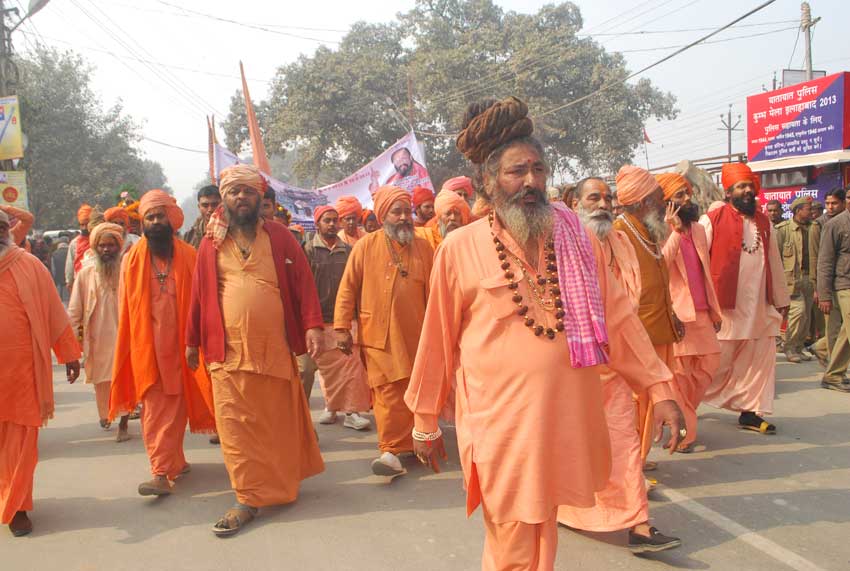
      Some of the photos taken during Kumbh Mela 2013 are given below: