Search This Blog

28 October, 2013

3C Success Formula


Formula for success


       Productivity in business is directly related to business.  In fact success is measured by increase in productivity.  There is a glamour for success all over the world.  But few have attempted to define success and find out the true inputs to effectively achieve it.

       The first lesson to learn about success is that it is an effect.  And an effect  belongs to the future.  Everyone longs for success.  Wishes to gain the effect without really going into its cause.  Not realising that every effect  has a cause.  Not realising that every effect  has a cause.  That you reap what you sow.  It is an impeccable law.  But the mass of humanity craves for the fruit without even planting the seed.  You therefore need to attend to the cause for gaining success.  And the cause for success is appropriate action.  If your action is proper, perfect it would result in success.   If improper, imperfect  it would be a failure.  In truth, your present action itself transforms into success or failure at a future period of time depending upon its quality.  


Ideal action


      An ideal action is made up of three essential constituents:
  1. Concentration

  2. Consistency

  3. Cooperation


       A practitioner of these three disciplines has the appropriate action to command success in his field of  operation.  Productivity in business requires continual intellectual supervision while applying these rudiments of success.  These three words may be used liberally in management lobbies but few have gone into their deeper import.  Much less put them into practice.  You, therefore, need to thoroughly understand these concepts.  And apply them in your business.


1.  Concentration


       Concentration is the art of focusing the mind in the present.  The human mind has a natural tendency to slip into worry of the past or anxiety for the future.  Concentration is the technique exercised by your intellect to hold the mind on the present action without allowing it to slip into the past or future.  You would need a powerful intellect to keep the mind focused.  Concentration is measured by the extent the intellect engages the mind in the present.

2.  Consistency


       The second discipline is to be consistent in what you do.  Having set an ideal to reach for, a goal to achieve your actions should flow in that direction.  But there is a problem in maintaining this flow because the mind is prone to stray into other attractions.  You need a strong intellect to overcome the mind's distractions and keep the actions going in the set direction.  This technique of channelising your actions towards the goal is consistency.  The practice of consistency lends power, strength to your action.  You observe this clearly in nature.  Water flowing in one direction has power.  So does wind blowing in one direction.  And light focused to a point.  Thus through consistency your actions turn powerful.

       A simple example taken from sports would illustrate the part played by consistency in achieving success.  Consider an internatinal tennis star being inconsistent in his practice of the game.  Being often drawn to playing othe games he fails to keep up with the rigorous practice that international competition demands.  He would then be deprived of success in his field regardless of his proficiency in the game.

3.  Cooperation


       The third discipline is cooperation.  To achieve an objective you need a spirit of cooperative endeavour.  It is difficult to be successful and productive in a business without the active cooperation of colleagues.  The principle applies to companies, communities and countries.  Germany and Japan were devastated in the last World War.  No sooner the war ended than the nations pooled their efforts cooperatively to rebuild their nations.  They returned to power and strength both economically and politically.  The United States and Australia could boast of nothing a little over two hundred years back.  The early settlers had to pool their resources in a spirit of cooperative endeavour to build their nations.  Both have emerged as powerful nations of the world.  Thus the third essential requirement for success is met with when the intellect maintains a true spirit of cooperation among those concerned in the business.


Conclusion:

      Maintaining the above three disciplines your actions should spell success and productivity in any field of endeavour.

~~~~~~~~~~~~~~~~~~~~~~~~~~~~~~~~~~~~~~~~~~~~~~~
Source: Excerpts from the book on "Governing Buisness and Relationship" by Swamy A Parthasarathy.
~~~~~~~~~~~~~~~~~~~~~~~~~~~~~~~~~~~~~~~~~~~~~~

23 September, 2013

Lord Dattatreya


As an Avatara


      Let me tell you about an Acharya, an Avatara of the Lord, who is  worshipped  by many Hindus as a God.  He is Lord Dattatreya, who is regarded as a Divine Incarnation of the Holy Trinity, Brahma, Shiva and Vishnu. The word Datta in Sanskrit means 'given'; and 'Atreya' signifies the lineage of the great Sage Atri.  Dattatreya was 'given' to sage Atri and his wife, Anasuya, as a gift of the Gods.  Dattatreya is also regarded as the Aadi Guru in the Nath tradition of worship.

       There are many versions of the legend of Dattatreya, and each one of them is deeply symbolic and significant.  I shall narrate to you the version of his story as it is told to us in the Markandeya Purana.  


Birth


     Sage Atri and his wife Anasuya were a pious and a devoted couple; Anasuya was an ideal rishi patni, who was a tremendous source of support to her husband in his spiritual practices.  A fe rishis who had met the couple, happened to speak very highly of her faith and devotion to her husband.  Indeed, they praised her to the skies.

      This came to the notice of Goddesses Lakshmi, Parvati and Saraswati.  When they heard of Anasuya and her great qualities as a pativratta, they begged their husbands - Vishnu, Shiva and Brahma - to put Anasuya to the test, so that they may see how devoted she was.

       The Holy Trinity of the Gods assumed the role of mendicant sanyasis and went to Atri's ashram, there, they begged for food with the traditional words:  Bhavati bikshaam dehi.  As you know, India's ancient scriptures tell us that it is our duty to feed those who come to our door.  Athiti devo bhava; the guest is the equivalent of God.  And when they happen to be ascetics who are obliged to live on food that is begged as biksha, it is incumbent upon the lady of the house to offer them food, even if t happens to be last  morsel  in the house!  Accordingly, the pious and devout Anasuya came out immediately, to ffer them food.  But, the three mendicants laid an impossible condition before her: they would not accept food at her hands, unless she served them without any clothes on her person - in other words, completely naked.

      This might sound shocking to us in the modern age!.  But in those days of Tretayuga, people were made of sterner stuff, and would analyse the reasons behind such strange requests.  So did Anasuya.  Being the perfect grahasti, she knew it was her sacred duty to feed the mendicants, who had begged food from her, in this sense, they would be like her children, and she, who offered them food, would be in their mother's position.  But the strange condition they had laid, revealed that they were no ordinary mendicants.  Above all, so true and faithful was her devotion to her husband, that Anasuya was certain that no harm or shame would ever come to her.  She decided to accept the strange condition and offer food to the visitors.

       She meditated on the form of her husband, took refuge at his feet, and sprinkled over the three Sanyasins, a few drops of water which were used for washing the feet of her husband.  The moment Anasuya did this, the Gods who wee standing before her, turned into tiny infants, mewling and crying at her doorstep.  Overjoyed at this Divine Miracle, Anasuya picked the infants up and feed them with her own milk.  When the babes were fed, she put them to sleep.  Upon her husband's return, she narrated the story to him, and he was delighted and proud to hear of her noble conduct.  The couple decided that they would keep the 'divine children' with them - and such was the Sage's taposhakti, that the Holy Trinity stayed in his ashram as three tiny, helpless infants.

       However, alarm bells began to ring for their wives, who quickly descended to the earth to explain the leela to Anasuya.  They  freely   acknowledged  that she was indeed, a true pativrata and begged her to return their consorts to them.  Instantly, sage Atri turned the infants into their original form - and Vishnu, Shiva and Brahma blessed the holy couple and granted them a boon of their choice.

       Anasuya prayed that she should be blessed with a son, who would be the very incarnation of the Holy Trinity - and by this Divine Boon was born Dattatreya.

       When Dattatreya attained manhood, he was gentle, peaceful and amiable.  As he had the grace of the Tri-Murtis, and as he was a great Jnani, all rishis and ascetics worshipped him.

       When the Adinath Sampradaya regards Dattatreya as the Lord of yoga and the first Guru, He is worshipped by millions of Hindus as a benevolent God.

      Dattatreya is usually depicted with three heads, symbolising Brahma, Vishnu and Shiva - as well as past, present and future; and the three states of consciousness,  waking, dreaming and dreamless sleep.  He portrayed sitting in meditation beneath an adumbara (wish-fulfilling) tree.  Infront of him are four dogs representing the Vedas.

      According to the Brahma Purana, Datttreya performed taspasya on the banks of the River Gautami, and was blessed by Shiva to become Brahma Gnani.  Thus, he is worshipped as Adi Siddha. 

       Dattatreya is one of the oldest deities, and mention is made of him in the Mahabharata and Ramayana.  Several different sects and traditions have accepted him as an avatar and he continues to be worshipped widely in Maharastra, Gujarat, Karnataka and Andhra Pradesh.

Srimad Bhagawatam


       In the Srimad Bhagawatam, we have another fascinating reference to Lord Dattatreya, narrated by Sri Krishna to his friend Uddhava.  Dattatreya, speaking to King Yadu, a great ancestor and forefather of Sri Krishna, had revealed that he had learnt invaluable lessons and precepts from each of his twenty-four Gurus - the different aspects of creation.

       It is said that King Yadu was wonderstruck by Dattatreya's spiritual radiance and the perfect contentment and peace in which he seemed to live, and begged him to reveal the secret of his happiness, as well as the name of the Guru who had imparted the same to him.

       To this, the illustrious avatara purusha replied, "The Self alone is my Guru.  Yet, I have learned wisdom from twenty-four other sources.  Therefore, I regard them too, as my Gurus." He then mentioned the names of his twenty-four Gurus, and spoke of the wisdom they had bestowed on him.

Twenty-four great Teachers

Who were these fascinating group of twenty-four great teachers?


      They were:

      Earth, water, air, sky, fire, the sun, the moon, a pigeon, a python, the ocean, a moth, a honeybee, an elephant, a honey-gatherer, a deer, a fish, a dancing girl, an osprey, a child, an arrow-maker, a maiden, a serpent, a spider and a wasp.

What was the nature of the Wisdom that these Gurus imparted to Dattatreya?


1)  EARTH


       The Earth taught him the qualities of patience, forbearance and doing good to others.  From the moment we get up from sleep, we stand upon the earth, we stamp upon it, we tread upon it, we jump and walk upon it.  The earth puts up with it all - it puts up with billions upon billions of people like us and continues to support us.

       The trees that grow upon the earth share this quality with their earth mother.  They provide shelter and fruits to everyone - even to those who throw stones at them.

       The true seeker learns to cultivate  endurance, compassion and selflessness from the earth.


2)  AIR


       The Air taught him detachment.  It carries to so many smells and vapours with it - good and bad - but it remains unaffected by them all.

       The seeker must realise that his Atman too, is like the air - good and bad karmas cannot affect its essential nature.


3)  SKY


       The sky taught him the nature of all-pervading Brahman which is all around us, everywhere - and yet not in contact with any object.

       The seeker must learn that deep within himself is the unlimited, infinite space of pure awareness that is the Self.


4)  WATER


       The Water taught him the lesson of purity.  Water quenches thirst; its quality if sweet, its feel is smooth; water also washes, cleanses and purifies.

       The seeker should aspire to become like the water - cleansing, purifying and thirst-quenching in the service of others.


5)  FIRE


       The Fire taught him about the quality of illumination and effulgence.  Fire burns everything; it gives out light and removes darkness.

       The seeker must be like the fire which destroys all evil, and continues to shed radiance.  His self-knowledge should dispel the darkness of ignorance around him.


6)  SUN


       The Sun taught him the unity of all Being.  Although thee is one Sun in the sky, its reflection is found in various forms in reservoirs, rivers and even in the smallest earthen pots.

       The seeker learns from the sun that the jivatmas are but reflections of the one great Paramatma.  


7)  MOON


       The Moon taught him that Reality is unchanging - while appearances are illusory.  The moon seems to wax and wane in our sight, but it is ever he same.  So too, the Self is perfect and changeless - while man rises or falls according to his actions in life.

8)  PIGEON


       A Pigeon taught him an unforgettable lesson on  worldly  attachments which often become entanglements for the soul.

      The sage saw a family of  pigeons living on a tree.  One day, the father and mother had left their young ones behind and flown out to gather food.  Finding the young ones alone, a hunter spread his net and caught the young birds.  When the  parents  returned and saw their young ones ensnared, they were disconsolate.  In profound grief,  overwhelmed  by her inability to save her children, the mother threw herself into the net.  Seeing her, the father followed her example - and thus the whole family was trapped in misery.  Perhaps, if the parent-birds had applied themselves to the problem, they could  have  found  ways and means to save their little ones.  But, as it happened, all of them perished at the hands of the hunter.

       The seeker must learn that attachment is the root cause of all  worldly  bondage.  Our worldly entanglements only lead to misery.


9)  PYTHON


      The Python taught him that God provides for all creatures, according to their needs.  The python is a gigantic creature which cannot move about nimbly to gather its food; yet God, in His wisdom and mercy, sends food to this creature.

       The aspirant must learn from the python the spirit of surrender and acceptance, in the complete faith that God will deal with us according to our karmic needs.

10) Ocean


       The Ocean taught him the quality of tranquility, of being unmoved by all incidents and  accidents  of life.  Just as the ocean remains in  place  even as hundreds of rivers and waterways pour into it, so the soul must rest within its own bounds, in its own sense of fullness.

       The aspirants must learn profundity and depth from the ocean, that he may remain calm and still and deep, as the tides of change rise and flow all around him.


11)  Moth


       The Moth taught him two valuable lessons; when ma becomes dazzled by earthly enchantments, he will perish by his own desires even as the moth rushes into the flame, to be destroyed. A higher and more profound lesson is that when it seeks light, it enters the light and llows itself, its individuality to be merged with the light.

       from the moth, the seeker must learn to keep away from self-destructive passions and desires wile aspiring to become One with God.


12)  HONEYBEE


       The Honeybee taught him that the nectar of life is gathered from different sources.  Similarly, a sanyasi begs for a little food from each household that he may not become a burden on any one individual.

       The seeker must learn that spiritual qualities can be imbibed from all sorts of experiences.  He must learn to absorb and assimilate his experiences and gather the honey of the spiritual wisdom from all these sources.


13)  ELEPHANT


       The Elephant taught him to be wary of temptation and lust.  Lured by the sight of the female  elephant, the male elephant walks foolishly into the trap laid by men - falling into a pit cleverly covered with grass so as to make it trip and fall.

       The aspirant must learn from this that he must practise self-control and avoid being lured by lust and passion.


14)  HONEY-GATHERER


       The Honey-gatherer is a bird which is a kind of robber among the fauna and flora.  After the industrious bees have worked hard to gather and store the honey in the hives, they relax, hoping to enjoy the fruit of their labour later.  At this time, the honey-gatherer arrives and steals all the honey, leaving very little for the bees.

       The lesson that the seeker must learn is not to hoard and preserve wealth for an unknown, unseen future - for that future may never be ours!  It is better we utilise our wealth for the present benefit of us and others, instead of hoarding  excessive wealth beyond our needs.

15)  DEER


       The Deer is often lured and trapped by hunters using a strange device - they plan upon drums creating a kind of music that enthralls the deer.  It pursues the music, walking into the trap laid by the hunters.

       For the aspirant, this 'enchanting' music repesents the fleeting, alluring sensory pleasures that the world has to offer.  When we are lured by these pleasures, we have no time to spare for the higher, loftier aspects of our life.  Therefore, we must resist the "call" of the senses.


16)  FISH


      The Fish taught Dattatreya a valuable lesson: its eyes ae always open: its swims about freely in the water; and yet, it allows itself to be 'hooked' miserably by, 'swallowing the bait' that is put out to catch it~  The bait is a pathetic worm -  and the fish falls for the sake of this little worm, suffering horrible pain and then a miserable death.

       The aspirant should learn that he should not 'rise to the bait' by yielding to every temptation that is presented, to him. More particularly, he should guard against greed for the wrong kinds of food.


17)  DANCING-GIRL


       A Dancing-girl named Pingala taught the hermit another valuable lesson.  She depended for her livelihood on wealthy 'customers' who would pay her in return for her company.  One day, she waited and waited for her rich clients - and not one of them appeared.  At first she gave in to hopelessness - but out of this grew her sense of dispassion.  She became determined to devote all her efforts and attention to God, rather than to her earthly patrons.  The 'treasure' she would earn by this would be far more valuable than the material wealth her customers brought her.

       The seeker too, must learn that worldly ambition is less worthwhile than higher aspirations.  Instead of directing our desire towards people and treasures which come and go, we should direct it towards God - for in His Love is our salvation.


18)  OSPREY


       An Osprey taught Dattatreya to guard against the sense of greed and covetousness.  This bird found a piece of meat and grabbed it in his beak.  As he flew away with it, he was pursued by vultures and hawks and other birds of prey. Feeling threatened by their pursuit he dropped he piece of meat he was carrying and low and behold, the birds of prey quit following him and swooped down on the meat itself.

       From this the seeker learn that the man who covets  worldly  wealth and  pleasures must face enmity,  hostility  and unforeseen dangers. When he, 'lets go' of these, he attains peace and tranquility.


19)  CHILD


       A Child, an infant, taught him the value of carefree existence and true happiness.  When you scold him or speak harshly to him, the child cries; but he forgets your anger and harshness very soon and smiles at you happily.  He does not labour any grudge or resentment; he holds no ill-will against anyone for long.

       The aspirant must also cultivate this quality of child-like innocence and simplicity, which will enable him to be positive and cheerful at all times, with all people.


20) POOR MAIDEN


       A Poor maiden was husking paddy, when visitors bringing a proposal of marriage for her, came to see her parents.  They were seated in the outer room, while her chores kept her busy in the kitchen.  She realised that the many bangles and bracelets she wore on her arm were jingling and making too much noise; embarrassed, sh removed a few of them - but the noise did not abate.  One by one, she  removed  all of them until there was just one bangle on each writ.  Now, she continued peacefully with her work.

       The many 'bonds' and 'attachments' of this world only add to the stress and clamour of life.  They breed dependence.  Likewise, multiplicity of wants and constant company of crowd hampers us from self-realisation.   Solitude, breaking away from crowds, will help us move towards our goal unhindered.


21)  ARROW-MAKER


       The Arrow-maker was a role-model of focus and concentration.  His mind, his eyes and his hands were all directed towards his chosen task of forging arrows and directing them at their target.  When the King passed by him in a long, royal procession, the arrow-maker did not even notice them; such was his concentration and focus.

       The aspirant too, must learn to practise his sadhana with one-pointed mind, ekagrita.  Our soul should be like the arrow which is direced at the target of Liberation - Moksha.  We must not let our attention be distracted by the shouts and shows of this world.


22)  SERPENT


       A Serpent taught Dattatreya the lesson of non-possession and independence.  A serpent does not make a home for itself; it dwells in holes dug by other animals.  And a serpent lives on its own - not in groups or with other serpents.

       An aspirant must also learn to do without possessions and attachment.


23)  SPIDER


       The Spider spins its web out of its own saliva, and sometimes, he himself gets entangled in it.  We must guard against getting entangled in the web of our own desires.  Also, the spider reminds us that this vast Universe is a web of illusion created by Brahman.  The world is not material, not real; it is made up of the subtance of God.


24)  WASP


       The Wasp, in its life-cycle, passes from the egg, through the larva and pupa to its final form.  It teaches us not to identify with the body - our physical form - and realise that we are the atman, the  immortal  soul, which is ever ready to fly towards God and Liberation~

Conclusion


       These were the twenty-four Gurus of Dattatreya - and he himself acknowledged them as such.

       May we be inspired by his illustrious example.  Let us also have open minds; let us be free from prejudice and intolerance; let us learn from all; let us learn in every way we can!

~~~~~~~~~~~~~~~~~~~~~~~~~~~~~~~~~~~~~~~~~~~~~~~~~~
Source: Excerpts from teh book on "Short sketches of SAINTS Known & Unknown" written by Dada J.P. Vaswani.
~~~~~~~~~~~~~~~~~~~~~~~~~~~~~~~~~~~~~~~~~~~~~~~~~~

25 August, 2013

Acceptance Meditation


       In the world, we have several relationships - in the family, outside the family etc.,  But according to our (sastras) scriptures all those other relationships are incidental which can maximum last for 100 years.  Whereas, there is one relationship, which is eternal relationship and that is with the Lord, the Creator, with Bhagavan which we consider as the primary relationship.

       Everyone of us is a Jiva from vyavaharika dhrishti.  Every one of us as Jiva is related to Iswara, Iswara being the cause of everything.  Between the Jiva and Iswara, there is a karya karana sambandha.

       The Lord is the universal parent and we are all the children.  As Ardhanaareeshwara He is both the father and the mother.

       And therefore this one relationship is the most stable relationship, and therefore we have to nourish and preserve this stable relationship.  And not only this is the most stable relationship, this is most reliable relationship also, which we can depend upon in our day-to-day life.

Spiritual benefit of bhakti [Devotion]  


       In and through all the functions that we celebrate, we want to nourish this bhakti or this relationship with Iswara.  This nourishment of Bhakti has got two-fold benefits.

      One is the spiritual benefit.  This kind of puja will give purity of mind and gradually we will get a desire for liberation, which is our primary goal.  And thereafter the very same bhakti will give an opportunity to pursue moksha, an opportunity to gain spiritual knowledge.  This is the spiritual benefit of the bhakti that we nourish.

       In addition to spiritual benefits, we do have some worldly benefits also.  Even if a person is not interested in moksha, still bhakthi is worth nourishing, because it has got some practical benefits also.

       I would like to discuss,  some of the practical benefits of nourishing bhakti in our hearts.  I would like to share some thoughts with regard to one practical benefit.  All of us, as human beings have a basic psychological problem.  It is in the form of an attitudinal problem, which is natural and which is universal also.

Attitudinal problem


       We have got mental or psychological resistance, when we have to face difficult situations in life.  By mental resistance, what I mean is - we don't have a willingness to go through the situationWe have got unwillingness to go through difficult situations.  And it is natural because, if any difficult situation comes in life, we consider, look upon it as a threat to life, for our own life.  The conscious mind, backed by sub-conscious mind perceives a survival threat.  The moment there is a difficult situation or there is a possibility of a difficult situation, instinctively there is an emotional resistance in the form of - I am not willing to go through this difficult situation.

       This natural resistance to face difficult situations in life is a very serious psychological problem all have.  Why do I say it is a serious problem?

       Because, in life there is one fact, which we all have to acknowledge.  The fact is every human being has to necessarily confront difficult situations in life.  It is law of life.

       It is an integral part of life - that every living being, every human being will have to confront difficult situations in life.
       If a person is very skilled, very wealthy, very capable and takes lot of precautions in life, perhaps he can reduce the frequency of the difficult situations.  Perhaps, he can reduce the intensity, the duration of the difficult situations.  But, he can never never can avoid difficult situations - 100%.

       All our puranic stories of Dharmaputra, Nala, etc., are meant to reveal this fact.  Life means "difficult situations are integral part".  Not only emperors have failed, even [Lord] Bhagavan - when he comes in the form of avatara - whether it is Rama or Krishna even the avatara confronts difficult situations. Therefore, What is the law of life?  One has to confront difficult situations. What is our emotional problem? Our unwillingness to face difficult situations.

These two are the laws of life.


       I have to face difficult situations.  My natural, emotional attitude is - I am not willing to confront difficult situations.  These two diagonally opposite situations create a lot of problems in human life.


       One has to face difficult situations in life.  But our natural, emotional attitude is - We are not willing to confront difficult situations.  These two diagonally opposite situations create lot of problems in human life.  Difficult situations are bound to come - is one law.  My mind is not willing to face it is another.

       Whenever there is difficult situation, either it has arrived or there is a possibility of arrival - The moment that looms in front of my mind, parallely along with the arrival of the difficult situation or the possibility of the arrival, internally within my mind - the emotional resistance also rises.

       Therefore, at any time, when a difficult situation comes, we have to confront two problems simultaneously. One is the external difficult situation, the other is internal mental resistance - unwillingness of the mind to go through the situation.

      Difficult situation is external problem.  Mental resistance is internal problem.  Thus, parallely, every time a difficult situation comes, I have to face two enemies simultaneously.

       Unfortunately when these enemies are there, we generally notice the external enemy, but we don't recognize the internal enemy of resistance, which is perhaps more powerful and dangerous than the internal one.

Adverse consequences of Mental resistance


       This resistance is a serious mental problem because, it causes several adverse consequences.  Only when we understand the consequences, we will know how serious this internal problem is.  When I don't know how serious it is, I will never try to remedy that.

Emotional resistance


       One problem the emotional resistance produces is, it magnifies the difficult situation.  It becomes a magnifying glass and the magnitude of the difficult situation is enlarged.


1) First adverse consequence - 

Magnification of the external problem


       The magnification of the difficult and the pain, is directly proportional to the resistance.  Greater the resistance, greater the magnification both of the difficult and pain.

       So, the first adverse consequence of our inner enemy is the magnification of the external problem.

2) Second disadvantage of resistance - 

Obstruction of problem solving skills


      The second disadvantage is when the problem or the difficult situation is magnified multifold, naturally my mind perceives a larger than life problem and therefore the mind is overpowered by the magnified problem.

       The mind is overwhelmed, overpowered and it gets paralyzed.  A paralyzed mind cannot use its resources, its skills to handle the difficult situation.

       Thus the second problem is resistance obstructs my problem solving skills.

3) Third consequence of resistance - 

Negative thinking


       The third consequence is - resistance always generates negative thoughts about the future.  Even though we don't know the future, when there is mental resistance, I look at the difficult situation, what all events will happen I don't know.  But my mind becomes highly creative, negatively.

       I imagine future negative events in all directions.  Any direction of thinking my mind goes - it generates negative events.  All are worst types of negative events.

      Therefore, resistance is the cause of thinking negatively.  The negative thinking is directly proportion to resistance.

       There is an important law.  Negative thinking attracts negative events.  The mind has got such a power, it is called sankalpa shakti, which we are applying negatively.

       Mind has got tremendous power - that any thought will attract an event similar to that thought.

      Any thought when it is repeated several times, that repeated that will attract the event and an event similar to the thought.

       Positive thought will attract positive event.  Negative thought will attract negative event.

       Resistance generates negative thoughts.  And by my own negative thoughts, I attract negative events.  Somebody looked at the astrology [jatakam] and said, it is bad period.  Because the astrologer has said, one keeps on repeating that this is bad period and negative event should happen.

       I do this meditation [dhyanam].  Whether the planets brings the event or not, by my sheer thought, I crystallize the negative event.  Like the cloud seeding by Silver iodide - which can crystallize the clouds and bring rain, we crystallize the possibility of negative event and make it happen.

       This is called self-fulfilling prophecy.  I myself repeat the thought and make sure that astrologer is right.  I validate the astrologer by my cooperation with negative thinking.  Thus, resistance produce negative thinking, attracting negative events.  This is the third danger.

4)  Fourth danger of resistance - STRESS

       The fourth danger is resistance generates stress. When I am not willing to go through difficult situation in keeping with the intensity of my resistance, a tremendous tension or stress is created in my physical body and in my mind also.  Generally it is experienced, all over body and everything is stretched.  This is stress generated by resistance.

       We think stress is generated by difficult situation.   Unfortunately, stress is not generated by difficult situation.  Stress is generated by resistance to difficult  situation.

      Now a days, we are reading continuous stress will create several health problems viz., short term health problem, long term health problem, physical health problem, psychological health problem, reversible health problem, irreversible health problem.  All because of stress medically proved and the stress is generated by not by difficult situation, stress is generated by resistance.

      Therefore, we should understand our unwillingness to face difficult situation in life is a powerful internal enemy which strengthens the external enemy also and it creates several problems for me. Like anti-national people within the country who are supporting the terrorists outside.

This is the fifth column.  Resistance is like the fifth column.  It magnifies our external enemy, weakens our  skills  and creates all this negative problems.  Therefore, I should understand that my primary enemy in life is resistance.  Resistance meaning my unwillingness to face difficult situations which is inevitable in life, which is the law of life.

MONSTRESS


      To remember these problem, we can remember these four points.


1) Magnification
2) Obstruction of the skill.
3) Negative thinking.
4) Fourth one is stress.  


    Take the first letters to remember, MONSTRESS.

M-Magnification,
O-Obstruction,
N-Negative thinking and
STRESS - Stress
 

MONSTRESS


       Hence, resistance generates a MONSTRESS.  The word "MONSTRESS" word is only refers "male gender", there is no female gender word for word "MONSTRESS".  This is the consequence of resistance.  Therefore, if the quality of our life has to be improved and if we want to avoid health problems caused by resistance, we have to address this problem.

How do I solve the problem?


      Very simple, you have to bring the opposites.  If there is darkness is the problem, what is the only solution, light the opposite has to be brought in.

     If unwillingness to face the difficult is our problem, what is the opposite of that.  The opposite of unwillingness is WILLINGNESS to face the difficult  situations, as a life's package.  Life includes whether we like it or not, difficult situation.  Therefore, I should be  intelligently, skilfully, willing to confront the problems.  Therefore, I have to generate deliberate thoughts of WILLINGNESS.

     Because, unwillingness is a habitual thought which is there.  Unwillingness thought, you need not entertain.  Why?  We are naturally "not willing".  Therefore, willingness is not going to naturally come, we have to deliberately practise saying "in life, difficult situations will be there and since it is an integral part of life, I am willing to go through difficult situations".

  This practice of  willingness  not one thought.  The willingness thought must be also be repeated several times.  Therefore, I will call it as meditation of this particular thought. This willingness thought is called ACCEPTANCE.  The opposite of resistance is ACCEPTANCE. The opposite of unwillingness is WILLINGNESS.  Therefore, acceptance meditation we all have to practise regularly to neutralise the psychological problem of resistance.

      Acceptance meditation has to be practised to neutralise the the weakness of resistance.  This acceptance meditation must be regularly practised, whenever difficult situation is arriving at that time, acceptance meditation should be practised more vigorously.  Because, only at that time, resistance is going to come up.  Therefore, whenever difficult situations are arriving or they have arrived, we have to practise acceptance meditation.  If that is not practised, what will happen? Resistance will come.  If resistance will come, who will come.  MONSTRESS will come.  Do you want MONSTRESS to come.

      This acceptance meditation we can practise effectively.  If we practise this as a Bhaktha.  This is where bhaktha and bhakthi is going to be very handy.  While practising the acceptance meditation, I medidate as a Bhaktha and I invoke the Lord and creates an utmost fear of Bhakthi by certain thoughts which will promote a healthy attitude.

What are the those thoughts that will create an ideal Bhakti atmosphere?


       I will mention three of them to create ambiance.

       To mediate that, "I am willing to go through the difficult situation", I need an  ambiance  of Bhakti.

First Thought pattern


      The first thought pattern is, as a bhakta I note that the entire universe is the creation of Bhagvan.  Bhagvan is an intelligent creator.  He has created a wonderful universe.  Everything in the creation is meaningful and purposeful.  I intensely appreciate and acknowledge this.

      If everything in the creation is meaningful and purposeful - as a part of the creation - Bhagwan himself has kept difficult situations also, which is an integral part of the creation.

       If difficult situations are also, integral part of the universe, therefore created by God, that also has got a meaning and purpose.

      Every difficult situation for anyone, at any time has got a purpose and meaning, whether the meaning is explicit or hidden, whether I can recognize this now or later, I am convinced as a Bhakta - Every difficult situation is meaningful and purposeful.  Therefore, I accept the purpose, validity and necessity of difficult situations in life.  This is the atmosphere I have to create.

Second thought pattern


       The second thought pattern is - whatever difficult situation I face, it is all the result of my own past karma.  The situation is karmaphalam.  As a bhakta I know that Bhagvan [Lord] is in-charge of distributing karmaphalam.  The department of karmaphala daanam is presided over by Bhagvan.  He is defined as karmaphala dhata.

       As a bhakta, therefore I know that every difficult situation is given by Bhagvan Himself as a karmaphalam - not by the local people.  As a bhakta, whatever comes from Bhagvan - it has got only one name - it is not called difficult situation or comfortable situation - it is a blessing.  Iswara Krupa - whatever comes from Bhagvan.  I never have unwillingness to receive it.  There is no resistance at all.  I accept the difficult situation.

       It does not mean that I should not take-up remedial measures.  I am going to take-up remedial measures and I also know that the difficult situation will pass away.  Until it passes away, I have to go through that.  Until that, my attitude is - (natural resistance will come), but my deliberate approach is "I am willing to go through the difficult situation, until it passes away".

       It is there, I am accepting the difficult situation.

       So, the second thought pattern is - Accepting everything as Iswara Krupa.  Whatever difficult situations I go through until it is remedied, I am willing to go through it.

Third thought pattern


       The third pattern is - because of my devotion to the Lord, I have got the most stable and reliable relationship - through that I can draw any amount of strength and therefore with the strength that I borrow from the sacred relationship - I am confident that I will be able to come through the situation and I will be able to become purer, stronger and wiser.

       I am confident that every difficulty has got a hidden blessing.  And the blessing is that I will come out purer, stronger and wiser.  Like a washerman, when he washes a cloth, what all things he does - rubbing against his hand, he will beat and all those things.

       We can say that the washer man is torturing the cloth.  But, we say that the washer man is cleaning the cloth.  It is the difference in perception.  Similarly when I come out of this washing machine called difficult situation - I will come out purer, stronger and wiser.

       And having thought these three points - therefore because of these three reasons I am willing to go through the difficult situation, I don't know how long it is going to last, if it is a treatment, the treatment may cure the disease in a day, in a week, in a month or in a year.

       I don't know how long I have to go through.  Let the treatment proceed, until it goes through, I am willing to go through it.

       And the beauty is as even I practice this acceptance meditation, we find that the resistance will become weaker.

       And you can physically and emotionally feel the monstrous disappearing from the system, as even willingness thought is repeated, unwillingness thought will go away.  As even unwillingness thought goes away, monstrous disappears.  The churning sensation in the stomach, which one can literally feel, at least you take a tablet, fever will subside only after 20 minutes.  But, acceptance meditation will remove this churning of the stomach instantaneously.

       You can practise this acceptance meditation and feel the result.

Acceptance meditation


     Acceptance meditation is surrendering the resisting will.  Acceptance meditation is sarangathi dhyanam.

Sloka from Mukunda Mala


       For practising this acceptance meditation - we have got so many beautiful slokas and prayers.  One is from Mukunda Mala.

naasthadharme navasunilaye naive kamopabhogeyadyartbhavayam bhavatu bhagavan purvakarmanurupametatprarthyam mama bhahumatam janma janmaantarepitvatpaadamboruhayugagataa nischalaa bhaktirastu

This is a beautiful prayer.  Only relevant portions are referred to here.

       yadyat bhavyam bhavatu bhagavan - that is our slogan - let whatever happen.  Bhavyam means the difficult situation, which I have to  necessarily  go through.  I will willingly, without any complaint go through that.

       Not only I should verbally say that, my facial expression also should not get changed when I am talking about that.  I avoid facial changes, the language is also not negative, bodily expression is also not negative, there is a difficult situation - I am willing to go through it without any grudges.  I should learn to talk about that, without frowning.

       I should hold on to Bhagavan's feet.  I should be confident in my Bhakti, Calmness, Cheerfulness and Confidence - all these three are part of Karma Yoga. I should have the confidence that I will go through the situation successfully and come out purer, stronger and wiser.  So I remain calm, cheerful and confident.

Sloka from Sri Rudram


       If we read Sri Rudram, we find a greater statement there. Difficult situation is not Iswara Krupa.  Difficult situation itself is Iswara!

       Sri Rudram says, "World is not created by Bhagavan; World is nothing but Bhagavan himself in the costume of things and beings".  Therefore, difficult situation is not something coming from Bhagavan; difficult situation itself Bhagavan.  So, I have no resistance, I will  successfully  go through it.

     Another sloka in Sivananda Lahiri.  Sankaracharya says, "Lord Shiva is Panchamukha:  Panchamukha: word is used in double meaning.  One meaning is Lord with five heads.  (Lord Siva has got five heads).  Another meaning is a lion.  The word pancha has another meaning wide.  Panchamukha: means - a wide mouthed animal, a lion.

       Panchamukha: (Lion) always lives in mountain aves.  And panchamukha:  siva also lives in caves - the heart cave of beings.  If lion is with me, why should I be afraid of facing other local animals?

       When panchamukha Siva is there, why should I fear?

       Adisankara gives various descriptions - all of them have got two-fold meanings.  One description is for Siva, another is for lion.


karalagnamruga: karindrabhango
ghanashardoolavikandanostajantu:
girisho vishadaakritishca ceta:
kuhare panchamukhosti me kuto bhi:

       Why should I fear?  I am Bhakta, I willingly go through the difficult situation.  I am not at all afraid.  Monstress can never come near me.  I can certain come out of it.  And I will come out purer, stronger and wiser.

Sloka from Bhagavad Gita


       The third sloka is from Bhagavad Gita itself.

macchittaha: sarvadurgaani matprasaadaat tharishyasi

      The one who keeps the Lord in the cave of the heart, will cross over all difficult situations.

       Using these verses [slokas] or independently, when I practise this acceptance meditation, I am solving the internal problem.  The general mistake that we commit is, we always focus on the external situation.  We never address the resistance problem.

       If we are giving fifty percent of our time for solving the external problem, we have to give fifty percent time for acceptance meditation.  Whenever any problem comes, forget the problem and spend one hour exclusively for acceptance meditation.  Then work on the problem for one hour.  Again practise acceptance meditation.

       We have to attack the external enemy, as well as the internal enemy.  When internal enemy is tackled, there is no magnification of the problem.  Once resistance is gone, the de-magnification takes place.  That is called shrinking of the problem.  For this, there is a sloka (verse).

Ghoshpatikritavaaraashim mashakeekritaraakshasam.

De-magnification

       For Hanuman, ocean became puddle of water.  De-magnification took place, because he doesn't have any resistance.  And all the rakshasas of Lanka became  mosquitoes!  For killing mosquitoes, do you strain yourself.

      By practising acceptance meditation, all problems become simple.  We can cross over any problem.  Therefore, Bhakthi is useful for acceptance meditation.  It will remove all resistance.  Once resistance goes, monstress goes away.  Once monstress goes away, our life will become healthier.  Thus, Bhakthi has got a practical benefit also.

----------------------------------------------------------------
Source: Talks delivered by Swami Paramarthananda.
---------------------------------------------------------

17 August, 2013

In Indian Culture... Why do we celebrate Lord Krishna's birthday?


In Indian Culture...
Why do we celebrate Lord Krishna's birthday?


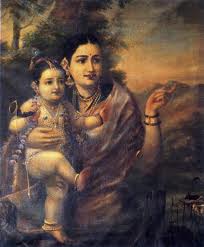
       Krishna was a dynamic incarnation of Lord Vishnu.  He was an Avatara.  An Avatara is one who is attuned to the supreme Consciousness from birth.  Krishna's incarnation brought about a profound and powerful influence upon Indian thought and life.  There is no aspect of Indian life, culture and civilisation which does not receive his revitalising touch.  India's philosophy and religion, mysticism and poetry, painting and sculpture, music an dance articulated Krishna's theme and thought.  Every aspect of Krishna's life and deeds has a mystic symbolism indicating a sublime truth.  Some of them are explained below.  They should set a direction to the reader for deeper study and discovery of the allegorical significance of the entire story of Krishna.


Krishna meaning


       Krishna in Sanskrit means dark.  Krishna represents the inner Self, Atman.  The Atman is dark in the sense that it is unknown to man as long as he is involved in his terrestrial experiences. Man's  knowledge  is limited to the realms of perceptions, emotions and thoughts.  He gains these experiences through his three equipments of body, mind and intellect.  He knows not the Atman within.  The body, mind and intellect by themselves are inert and insentient.  They constitute the material aspect of man.  The Atman is his spiritual being.  The Atman is the living principle in man which transforms his inert matter into a living being.


Krishna in blue colour and wears yellow clothes


       Krishna in blue colour and wears yellow clothes. Blue colour has always been associated with infinity.  The sky appears blue.  So does the ocean.  Yellow colour  represents  earth.  When sand is introduced in a colourless flame, the flame turns yellow.  The blue form of Krishna clothed in yellow therefore suggest the infinite Reality reduced to finite human being.


Krishna's incarnation


       The incarnation of Krishna represents the descent of God on earth.  This idea of the limitless, formless Reality being constricted and restricted to a limited, human form is again suggested by Krishna's birth in a prison.  The divine child was however not confined to the prison.  No sooner was Krishna born the prison doors miraculously flung open.  The guards could not hold the child back.  The child's father, Vasudeva, carried him out of the prison in spite of the severe restrictions imposed on him.

      This episode is meant to convey that the infinite Being can never be really restricted or limited to the human form.  A Godman is ever free and liberated.  The Atman in a man is limitless.  Only his body, mind and intellect are limited finite.  These material equipments have a beginning and an end.  They cannot restrict the Atman.  The Atman is eternal, all-pervading, infinite.  Krishna represents that Atman.


       Krishna was born in Mathura.  His uncle, Kamsa was a tyrant.  Kamsa imprisoned his father and usurped the throne of Mathura.  He reigned over Mathura.  His minister Chanura was equally wicked and cruel.  Under the rule of these two tyrants Mathura suffered greatly from confusion and chaos.  Krishna destroyed both and restored peace and order in that land.  The word mathuram means sweetness.  The land of Mathura represents the personality of man.  Man's essential nature is his Atman.  His real nature is ever sweet, peaceful and blissful.  But when the evil forces of ego and egocentric desires usurp man's personality he suffers from stress and strain, worries and  anxieties He is agitated and sorrowful. He loses his blissful nature.  To regain the lost bliss man as to destroy his ego and egocentric desires and establish his identity with his supreme Self.


Puranic Story


       There is a Puranic story which speaks of Krishna killing a mighty serpent with many heads.  It lived in a lake poisoning its water.  The entire village suffered because of this dragon.  Krishna ultimately crushed down its heads.  But as he crushed them other heads sprung up in their place.  Krishna ultimately crushed all the heads and vanquished the serpent.  He danced on its crested head playing the flute.  The wives of the dragon paid homage to the Lord.


Allegorical significance


       This story again has an allegorical significance.  The lake represents the mind.  The dragon and its many heads the ego and egocentric desires.  The ego and egocentric desires poison the mind and make its world miserable.  When man turns his attention inwards, when he contemplates and meditates upon his Atman, upon Krishna he overcomes his ego and egocentric desires. Thereafter he revels in the bliss of Realisation.  the sense-objects of the world become subservient to such a man.  This is symbolised by the wives of the serpent paying homage to Krishna.


Krishna playing a flute


       Krishna is often represented as playing a flute.  The enchanting music emanating from the flute of the Lord is the bliss of Godhood enjoyed by the Man-of-Realisation.  The flute is hollow but it can produce enchanting music.  So too when man empties himself of his vasanas and desires the Divinity within him flows out with enchanting bliss.  Man has to give up all his claims upon his body, mind and intellect, give up all his egocentric connections, all thoughts of 'mine' and 'thine', rise above them all and chant Om (Krishna), to remove all selfishness from the flute of his body and fill it with the divine breath of om.  Man becomes God.


Krishna with Gopis


       The milkmaids of Brindavan were called gopis.  These gopis were enchanted by the divine music flowing out of Krishna's flute.  They danced in their  ecstasy  around Krishna.  The dance of the gopi is known as rasa-lila.  


      Krishna again represents the Atman, pure consciousness while gopis represent thoughts.  Atman in man is the enlivening factor by which he becomes conscious of his thoughts.  Thoughts by themselves are insentient.  In the presence of Consciousness thoughts gain sentiency or consciousness.  Thoughts dance around the Atman as it were.  But the Atman is ever-immaculate.  It is unaffected by the thoughts around it.  So is Krishna pure, immaculate.  He remains detached and unaffected by the dancing gopis.  Losing this allegorical significance of the rasa-lila much criticism has been levelled against Krishna's association with the gopis.  

     The gopis were in fact deeply devoted to Lord Krishna.  They remembered Krishna  throughout  the day in all their activities.  Their limbs were ceaselessly engaged in their obligatory duties while their minds were constantly attuned to the Lord.  To dedicate oneself to a higher being and work in the world without ego and egocentric desire is karma yoga.  When man works in a spirit of karma yoga he gets rid of his vasans, desires. This idea is suggested by Krishna stealing the butter which the gopis had churned and collected in their pots.  The desires for realisation of the Self alone  remains.  The last  trace of desire gets eliminated by itself through single-pointed meditation upon the Lord.  

       In verse 66 of Chapter XVIII of the Bhagavad Gita the Lord gives man this assurance:

"Abandoning all dharmas, take refuge in Me alone, I will liberate thee from all sins, grieve not."

       There is yet another beautiful incident in Krishna's life indicating his absolute state of detachment.  It served as an eye-opener to the two wives of Krishna when they began to  doubt  his association with many gopis.

Sage Durvasa - Nitya upavasi


       One day the great sage Durvasa camped with his many disciples on the opposite bank of river Yamuna where Krishna lived.  Krishna wives saw the sage and prepared a lot of sweetmeats to take to him.  In the evening when both the ladies with their trays of delicacies approached the river it was flooded.  They could not cross over to the other bank to make the offering to the sage.  They returned and sought krishna's help.  Krishna asked them to go back to the river-side and pray to Mother Yamuna (the rivers in India are deified as goddesses), "If sage Durvasa is nitya upavasi please show us the way".  Nitya means eternal, permanent.  Upavasi means one who fasts.  So nitya upavasi is one who is always observing fast.  The ladies did not understand the implication.  They  followed Krishna's advice and prayed to Goddess Yamuna.  The goddess granted their prayer and instantly the waters subsided.  They crossed over and offered sweets to the sage.  The sage ate every bit of the food and returned the empty trays.  A nitya upavasi!

Krishna - Nithya brahmacari


       Krishna's wife took the sage's blessings and reached the river bank to return home.  Again, the river was flooded preventing them from crossing over.  This time they sought the help of Durvas.  The sage advised them to go back to the river bank and pray to goddess Yamuna, "If Krishna is a nitya brahmacari please show us the way".  Nitya brahmachari means permanent celibate.  The ladies followed the advice and prayed to the Yamuna.  To their amazement the waters subsided forthwith enabling the to cross over to the other bank.

Significance of the Durvasa Story


      The significance of this episode is obvious.  Durvasa was totally free from mental attachment to any type of food.  He had absolutely no desire or craving for them.  Eating to him was a ritual, an obligatory function.  Such a person though eating eats not.  A man of perfect detachment "even though acting acts not"  (BHagavad gita Chapter IV, Verse 20).  Durvasa belonged to that rare category.  He was ever mentally detached from food.  Hence, he was called a nitya upavasi even as he was eating like any other man.

       The same principle applies to Krishna.  It is not man's physical expression but his mental impression that determines his attachment or detachment to the world.  Krishna's association with the gopis did not in any way affect his total detachment, his mental resignation from them.  He was ever maintaining an inward dispassion and disinterest even as he was closely associating with the gopis.  His mind was ever in a state of Brahmacharya celibacy.  Hence, he was called nitya brahmacari. 


Krishna eaten mud


       In his childhood, Krishna is said to have eaten mud on an occasion.  His mother Yasoda chided him.  Krishna denied having eaten mud.  Yasoda would not take his word.  She asked him to open his mouth.  The child did so.  Yasoda was  wonder-struck  to see the entire universe within the child's mouth.  This episode has a deep philosophical implication.


       Krishna is the Infinite, Omnipresent, Omnipotent Reality. The Reality alone exists.  Nothing else does.  The universe is nothing but the same Reality, though seen differently by men with limited vision.  Yasoda was one of those who could not see the supreme Being in Krishna.  She only saw her child in him.  But in truth Krishna is that all-pervading Reality which includes the earth as well.  The earth is a part of the Reality which Krishna is.  Krishna therefore gave the right answer to his mother when he denied eating earth.  How can Krishna (Reality) eat mud (Reality)? Krishna was therefore speaking the Truth.  when Yasoda insisted on knowing the truth Krishna had to reveal it by opening his mouth and showing the universe in Him.


Krishna as a baby sucking his own big toe


       Man's essential nature is the supreme Reality.  The world is also nothing but Reality.  Yet man finds the necessity to run after the world of objects for his pleasures.  Is this not an absurd situation--Reality in the form of man  craving  to enjoy Reality in the form of the world?  This absurdity of man's pursuit is subtly implied when Krishna as a baby is showing sucking his own big toe.


Krishna holding a staff & jnana mudra in hand


       Lord Krishna is also described as a holding a staff in one hand and showing a symbol of wisdom, jnana mudra with the other.  A staff is used by a cowherd boy to drive the cattle to the pasture lands for grazing.  The jnana mudra is a symbol made by holding the little, ring and middle fingers erect and bringing the index finger to touch the middle portion of the thumb.  This again has a philosophical meaning.  Krishna represents the Atman in man.  Atman is the Life-Principle which enlivens his body, mind and intellect.  Without the life spark man cannot act at all.  All actions are possible because of the life spark.  Actions broadly classified fall under two distinct heads - actions that are degrading and devolutionary and those that are elevating and evolutionary.  Man can make use of the Atman to evolve or to devolve.  Atman is neutral.  It helps man to pursue whatever direction he wants.

       The first type of actions is indicated by Krishna holding the staff.  The cattle represents the sense organs.  The sense organs constantly feed upon the sense-objects of the world.  Eyes go to colour and form, ears go to sound, the tongue to taste etc.,  the sense-objects are the  pastures  for the sense organs.  Man spends all his life driving his sense organs to their respective fields of enjoyment for sensual pleasures.  He uses his Life-Principle   merely to indulge in sense gratification.  That seems to be his main occupation in life.


Jnana Mudra

     The other type of actions, indicated by the jnana mudra, leads man to Self-realisation.  the index finger represents the ego.  It is the pointing finger which creates duality, plurality.  Man develops his ego by his association and identification with his body, mind and intellect, with his gross, subtle and causal bodies, with his sattvika, rajasika and tamasika gunas.  This idea is indicated by the index finger remaining in contact with the other three fingers. The thumb  represents  represents the Atman by virtue of the vital role it plays in all actions.  The index finger bending towards the thumb to form a circle shows the ego's detachment from the three bodies or gunas and total surrender to the Atman.  When man does that he reaches his Infinite state, the state of Self-realisation.  This Infinitude is indicated by making a circle.  The circle has no beginning or end.  That which has no beginning or end is said to be infinite. Krishna gives this choice of action to man, that is to spend his life time in merely gratifying his senses or to transcend the limitations of his body, mind and intellect and reach the state of Realisation. Krishna is a mere witness, a sakshi.  He does not interfere with your choice.  He merely presents the truth for you to decide your course of life.


BHGAVAD GITA

       In the Bhagavad Gita, Arjuna surrenders to Krishna completely and seeks his advice.  Krishna gives him the entire philosophy of life in the eighteen chapters of the gita.  Towards the end of the last chapter he declares to Arjuna, "I have declared the highest wisdom to you, reflect upon it and act as you choose to".

----------------------------------------------------------
Source:  Excerpts from the book on The Symbolism of Hindu Gods and Rituals by Swami A Parthasarathy
-----------------------------------------------------------