Search This Blog

26 November, 2016

Arjuna, who has temporarily castrated for showing restraint


Curse by Urvashi


       When she was bored, Urvashi would leave Indra's realm and come to the realm of men to pleasure herself.  One of the men who fell in love with her was Pururava of the Kuru clan.  When she left him, as apsara often do when bored of earthly life, he went mad.

       Hundreds of years later, Urvashi saw a handsome young man in Amaravati.  He reminded her of Pururava and so, dressed in finery, she approached him with the desire to make love.

       But the young man turned away from her.  This had never happened before.  A furious Urvashi asked for an explanation and the man said, 'I am Arjuna, the Pandava, descendant of Pururava.  As you were his wife, you are like a mother to me.  I cannot be your lover.  Besides, you are the beloved of Indra, my father.  This would be incest.'

       'I am apsara,' said Urvashi, 'I belong to no one.  I can go to whoever I please.  The morality of mortals does not apply to me.  Come, let us make love.'

       Arjuna refused because mortal rules still applied to him.  Peeved by his intransigence, Urvashi hissed out a curse, 'Only a eunuch refuses a willing woman.  So be one,' and walked away in a huff.'


       When Indra heard of the curse, he told his son, 'Curses cannot be revoked, but they can be modified.  You will lose your manhood, as Urvashi wills it, but only for a year of your choice.'  So it came to pass; Arjuna was obliged to spend one year of his life without his manhood.

       This worked well for Arjuna for he and his brothers had been exiled from their kingdom of Indraprastha.  They had gambled it away and could reclaim it only after spending twelve years in the forest and the thirteenth year incognito.  There was also a clause that should their true identities be discovered during the final year of the exile, they would return to the forest for another twelve years. Arjuna realised that he could live out his curse as a eunuch in the final year of exile.

Brihanalla at Virat's Kingdom


       After enduring the harsh wilderness stoically for twelve years, the five Pandavas hid their weapons, disguised themselves as servants and sought refuge in the court of King Virata.  Arjuna disguised himself as a eunuch-transvestite, introduced himself as Brihanalla or Brihananda, the dance-teacher, and gained employment in the royal women's quarters where he taught dance to the princes, Uttara.

       As the year drew to a close, the Kauravas - whose spies had informed them of the Pandavas' whereabouts - invaded Virata's kingdom to smoke out their cousins, while the king and his soldiers were away chasing cattle-thieves.  Petrified, the women turned to Virata's young son Uttar who boasted he would drive the invaders away single-handed.

       As there were no charioteers around, Brihanalla offered to take up the reins of the war-chariot. This caused great mirth until the prince realised he had no other option.

As Charioteer to Prince Uttara Kumara


       As the two rode towards enemy lines, Uttar caught sight of the formidable formations of the invading army - the shining spears, the array of trumpeting elephants - and panicked.  He leapt out of the chariot and ran towards the city.  Brihanalla ran after him, caught him by the scruff of his neck and dragged him back. Those who witnessed this scene roared in laughter.  Unable to bear his public humiliation, Uttar decided to end his life but was stopped by Brihanalla who said he could drive the enemy away provided Uttar served as his charioteer.  The prince did not like the idea of serving eunuch until Brihanalla, after much difficulty, convinced him to have faith.

       Brihanalla then took the prince to the forest, collected a massive bow from a secret place, strung it and ordered Uttar to take the chariot straight towards the enemy.  There, to Uttar's astonishment, the effeminate eunuch - now transformed into a fierce warrior - shot lethal arrows and in no time drove the invaders away.

       When the duo returned to the city, Brihanalla resumed his position as charioteer and the palace woman - who had not witnessed the scenes in the battlefield - hailed the prince as their saviour.

       The king was very proud of his son.  When his courtier, Kanka, who was Yudhishtira in disguise tried to clarify matters and explain what really could have happened, the king got so angry that he slaped Kanka. Everyone wanted to believe that the inexperienced young prince had defeated the mighty Kauravas.  It seemed more plausible than the idea that a eunuch-dancer could wield the bow.

Taking Uttara as Daughter-in-Law


       When Brihanalla's true identity was revealed, King Virata was so overcome with gratitude that he offered Arjuna the hand of the princes Uttara in marriage.  Arjuna politely refused since in his role as dance-teacher he looked upon Uttara as his daughter.  Instead, the princes was given in marriage to Arjuna's son Abhimanyu.

~~~~~~~~~~~~~~~~~~~~~~~~~~~~~~~~~~~~~~~~~~~~~~~~~
Source: Excerpts from the book on "Shikandhi and other tales that they don't tell you" by Devdutt Pattnaik
~~~~~~~~~~~~~~~~~~~~~~~~~~~~~~~~~~~~~~~~~~~~~

09 October, 2016

Likhita Japa - The Science of Repetitive Mantra Writing


       Write down daily in a note book your Ishta Mantra or Guru-Mantra, for half an hour.  When you write the Mantra, observe Mouna.  Write the mantra clearly in ink.  On Sundays and holidays, write this for one hour.  In a common place collect your friends also and let them write the Mantras.  This is Likhita Japa.  You can develop a wonderful power of concentration.  Prescribe this to all of your family-members.  Incalculable spiritual benefits are derived from Likhita Japa (Mantra-writing).


       Of the various methods of Japa described in the scriptures, viz., Vaikhari, Upamsu and Manasika, etc.,  Likhita Japa is very efficacious.  It helps the Sadhaka in concentration of the mind and gradually leads to meditation.


       An aspirant should select the Mantra of his tutelary deity or Ishta, according to his liking or inclination. Repetition of the same Mantra with meaning and Bhava should be practised both orally and in writing.  For oral Japa, the help of a Maala or rosary is required.  For Likhita Japa a note book and a pen should be used.  In Mantra-writing there is no restriction about any particular script.  It may be written in any language. 


Rules observed


       The following rules may be observed while practicing Mantra-writing: - 

1.  Regularly and punctuality of time should be observed.  This would itself bring the requisite help and be of the utmost benefit to the Sadhaka.

2.  Physical and mental purity should be observed.  Before sitting for Mantra-writing, the face, hands and feet should be washed.  Effort should be made to keep the mind pure during Mantra-writing.  Drive out all worldly thoughts while writing Mantra.

3.  Continue to sit in one pose as long as possible.  Frequent change of a pose or Asana should be avoided. Sitting in one Asana would increase your power of endurance and also considerable energy will be preserved.


4.  Observe silence during the practice.  Too much of speaking results in wastage of energy and wastage of time.  Silence helps in an increased turnout of work.

5.  Avoid looking hither and thither.  Fix your eyes on the notebook.  This would help concentration of mind during the practice.

6.  Repeat the Mantra mentally also while writing it in the notebook.  This will make a threefold impression in your mind.  Gradually your whole being will be involved and engrossed in the Mantra.

7.  Fix a particular number of Mantras for one sitting.  This will keep your practice intact and you will never get out of touch with the Mantra.

8.  When you have once started the practice, do not leave it till you have finished the daily quota of one sitting.  Do not allow your mind to be diverted to other engagements, as this would be an obstruction in the Sadhana.  Have at least half an hour's writing at one sitting.


9.  To help concentration, one uniform system of writing from top to bottom or from left to right, may be maintained during a particular sitting.  The whole Manta should be written at once in continuity.  Do not break the Mantra in the middle when you come to the end of a line.

10.  When a Mantra is selected by you, try to stick to it tenaciously.  Frequent change of Mantra is not advisable.


       The above rules if strictly observed, will help you much in your quick evolution.  You will develop concentration wonderfully.  By prolonged and constant practice the inherent power of the Mantra (Mantra - Sakthi) will be awakened, which will fill your very existence with the Divinity of the Mantra.

       The notebook should be well kept and treated with respect and purity.  When completed, it should be stocked in a book and kept in your meditation room in front of the Lord's picture.  The very presence of these Mantra-notebooks will create favourable vibrations requisite for your Sadhana.

BENEFITS


       The benefits of Mantra-writing or Likhita Japa cannot be adequately described.  Besides bringing about purity of heart and concentration of mind, Mantra-writing gives you control of Asana, control of Indriyas, particularly the sight and the tongue, and fills you with the power of endurance.  You attain peace of mind quickly.  You approach nearer to God through Mantra-Sakthi.  These benefits can be expreienced only through regular and incessant practice of Likhita Japa.  Those who are not conversant with this Yoga should start the practice immeidately and even if they take to this practice for half an hour daily, they will relelise its benefits within six months.


~~~~~~~~~~~~~~~~~~~~~~~~~~~~~~~~~~~~~~~~~~~~~~~~~~~~~~
Source: Excerpts from the book on "JAPA YOGA" written by Swami Sivananda
~~~~~~~~~~~~~~~~~~~~~~~~~~~~~~~~~~~~~~~~~~~~~~~~~~~~~~

15 September, 2016

Shikandi


Shikandi, who became a man to satisfy her wife


Amba


Bhisma taking the three princes of Kashi
after Swayamvara

       There was once a princess called Amba, who wanted to marry a man called Shalva.  But on the day she was to select him as her husband, a warrior called Bhisma abducted her and her sisters and took them to his city of Hastinapur where they were told they would have to marry his younger and far less competent half-brother, Vichitravirya.

       Amba begged that she be allowed to marry the man of her choice and Vichitravirya let her go, as the idea of having to satisfy two wives was stressful enough.

       Unfortunately for Amba, Shalva refused to accept her as his wife as she had been tainted, touched by another man.  So Amba returned to Vichitravirya.  He too refused to accept her, as 'a "gift" given away,' he said, 'cannot be taken back'.

Bhishma

       Amba then went to Bhisma and begged him to marry her.  He said he could not as he had taken the vow of celibacy.  'Go back to your father,' he said, 'Or stay in the palace as a maid.'

       A furious Amba prayed to Kartikeya, god of war, killer of men, who gave her a garland of ever fresh lotuses.  Anyone who accepted this garland would kill Bhisma.  Unfortunately, no man on earth accepted it, celestial grace notwithstanding.

       When even Drupada, powerful king of Panchala, turned his back on her, a frustrated Amba flung the garland and it landed up hanging from a pillar in Drupada's palace.

Sage Parashuram


Sage Narada and God stops Bhishma's battle
with Parasuram

       Amba then approached Parashuram, a sage who was expert in the martial arts, and who was renowned for his hatred or warriors.  She requested him to be her champion and punish Bhisma, who had ruined her life. Parashuram tried, but failed, 'His vow of celibacy has granted him the power to choose the time of his death.  I cannot defeat him,' he said.

Death of Amba


       A desperate Amba invoked Shiva, the destroyer.  Shiva  appeared, pleased with her intense austerities, and said rather cryptically that she would be the cause of Bhisma's death but only in her next life. To hasten her next life, Amba leapt into the fire and died.


Appearance of Shiva


       She was reborn as Drupada's daughter.  But Drupada wanted a son and had been promised one by Shiva.  Convinced that Shiva would not lie to him, Drupada claimed his daughter was actually his son and ordered her to be raised as one.

Birth of Shikhandi


       The girl, named Shikhandi, was taught all the skills reserved for men.  She grew up believing she was a warrior.  She was even given a wife.  But on the wedding night, when the bride discovered that her husband was a woman, Shikhandini not Shikandi, she ran to her father in a state of shock.  

King Hiranyavarna


       Determined to avenge this insult, the bride's father, King Hianyavarna of Dasarna, raised an army and threatened to invade Panchala.  Drupada knew that the only way to save his kingdom was to prove that his 'son' was truly a man.  He also knew that this was impossible.

Sthuna raksha


       Confronted with her femininity for the first time in her life, Shikhandi felt responsible for this calamity.  Resolving to kill herself, she went to the forest.  But a yaksha called Sthuna saved her. Was it a woman he saved or a man?  For the girl thought like a man and felt like a man and had always been treated as a man.  But that body of hers was certainly not a man's.

       On hearing Shikhandi's story, Sthuna lent her his manhood for one night.  Thus equipped. Shikhandi could prove his masculinity to anyone who cared to test it.  Hiranyavarna sent his courtesans who sent back a satisfactory report.  Concluding that his daughter had made a mistake, Hiranyavarna apologized to Drupada and sent his daughter back.  Shikhandi then performed his husbandly duties to the satisfaction of his newly wedded wife.

Kubera


       Kubera, king of yakshas, was very angry with Sthuna for lending out his manhood; such things are not to be done.  But when Shikhandi, true to his promise, came to the yaksha to return the borrowed organ, Kubera was so pleased with his integrity that he allowed Shikhandi use of the yasha's manhood as long as he lived. It would return to Sthuna only after Shikhandi died.

     Drupada was happy to finally get a son, but then, to his dismay, Shikhandi in a rather cavalier moment placed around his neck Amba's garland of ever-fresh lotus flower that for years had been hanging on a pillar of his palace. 'He will kill Bhisma,' moaned Drupada.  'But I need a son who will kill Drona.'  

Drona


Dronacharya, as commander-in-chief of
Kaurava army.
       Drona was a teacher of the Kuru princes.  And the Kuru princes were Vichitravirya's grandsons. They included the five Pandavas, sons of Pandu, and the hundred Kauravas, the sons of Dhritarashtra. Bhisma had asked Drona to tutor the Kuru princes, and as tuition fee, Drona had asked the Kuru princes to give him one half of Panchala.  Accordingly, after a period of intense training, the boys had invaded Drupada's kingdom and claimed half of it for their teacher.

       Drupada wanted a son who would kill Drona and a daughter who would divide the Kuru household that had supported Drona.  Shikhandi could be neither one nor the other.  He was useless. So Drupada conducted a yagna that would give him the children he wanted.  The fire yielded Draupadi, the perfect woman and Dhristadhyumn, the perfect man.  

Draupadi


       Draupadi became the common wife of the five Pandava brothers who demanded a kingdom of their own as the hundred Kauravas refused to share Hastinapur with them.  Bhisma gave them the forest of Khandavprastha on which they built the very impressive city of Indraprastha, rivaling the old city of Hastinapur.  Thus did Drupada's daughter fulfill her father's wish.

       The jealous Kauravas invited the Pandavas to a game of dice during which the Pandavas were lured into wagering their kingdom.  Foolishly they gambled and lost their kingdom.  Control over it could only be regained after thirteen years of forest exile.

       When the Pandavas returned from exile, the Kauravas refused to return even a needlepoint of Indraprastha.  The only way to get back what was theirs was by declaring war.  Drupada offered his army, led by Dhristadhyumna to his sons-in-law, knowing well that Drona would join the Kaurava side, giving his son the chance to fulfill his wish.

Kurukshetra war


       Unfortunately, the war between the Pandavas and the Kauravas reached no conclusion despite nine days of fighting.  Bhisma led the Kaurava forces.  Though old, he was still formidable force in battle.  'As long as I hold the bow, my children, no arrow will get past me.  Besides no one can kill me as I can choose the time of my death,' declared Bhishma. 

       This was the clue Krishna was looking for Krishna, cousin of the Pandavas and friend to Draupadi, said, 'He cannot be killed but he can be pinned to the ground by arrows.  For that we have to get him to lower his bow.  He will lower his bow not before a man but certainly before a woman. But how do we get a woman into the battlefield?  That is not permitted by law.'

Death of Bhishma 


Bhishma refuses to fight with Shikandi

       Drupada then offered his eldest child Shikhandi who was born a woman and had become a man.  'Bhisma will see him as a woman.  But we will contest his view, for now he is a man with a wife who no longer doubts his masculinity.


       On the tenth day, Shikhandi rode into battle on Krishna's chariot.  Behind him was Arjuna, the third Pandava, greatest archer in the world.  Sure enough Bhisma refused to raise his bow against him declaring, 'Born a woman you are always a woman.'  Taking advantage of this Arjuna released a volley of arrows and pinned the old man to the ground.

Death of Drupada 


       Following this incident, Drona was made commander of the Kaurava armies.  He managed to kill Drupada.  Dhristadhyumna avenged his father's death and fulfilled his destiny by eventually beheading Drona, something no one dared do as Drona was a brahmin.

Drishtadyumna as Commander in Chief
of Pandava army.


       Eventually all the Kauravas were killed and the kingdoms of Hastinapur and Indraprastha came under Pandava control.  But it was no happy ending.

Death of Shikhandi


       On the night of victory, Drona's son attached the Pandava camp when all the soldiers were sleeping and killed everyone there.  Draupadi's sons were beheaded, her twin brother Dhristadhyumna was strangulated and her elder brother Shikhandi was found split in two.


~~~~~~~~~~~~~~~~~~~~~~~~~~~~~~~~~~~~~~~~~~~~~~~~~~~~
Source: Excerpts from the book "SHIKHANDI and other talents they don't tell you" written by Devdutt Pattnaik.
~~~~~~~~~~~~~~~~~~~~~~~~~~~~~~~~~~~~~~~~~~~~~~~~~~~~      

04 September, 2016

12 Forms of Ganesha


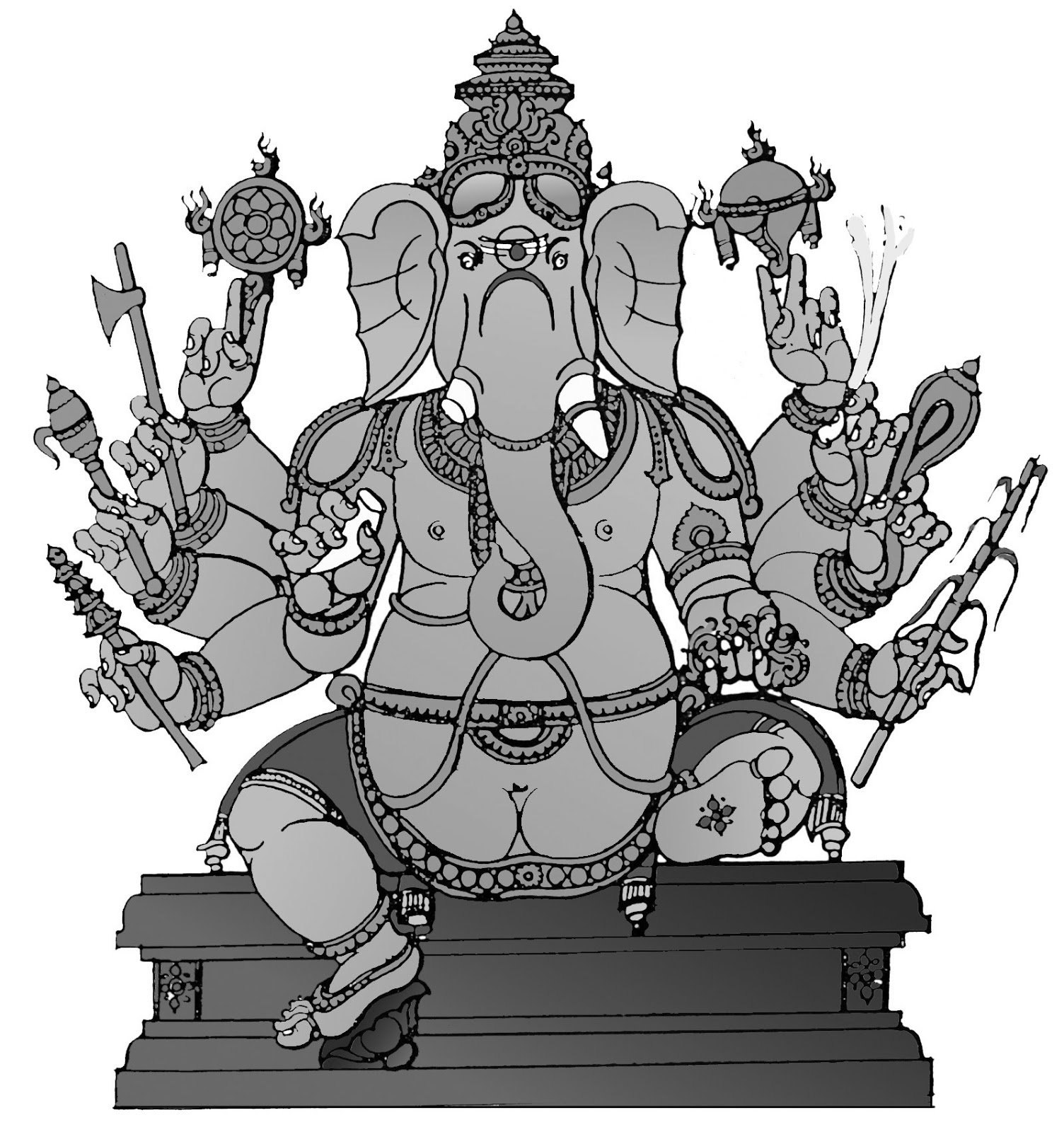
12 Forms of Ganesha explained


Maha Ganapati

1.  MAHA GANAPATI


       The Supreme Ganesha, blesses us with overall success and protection in all aspects of life.

Dwija Ganapati

2.  DWIJA GANESA


       The twice-born, blesses us with good health and prosperity.  He is depicted as having four heads and four hands with rosary beads, a book, a water vessel and a staff.

Heramba Ganapati

3.  HERAMBA GANAPATI


       The Mother's beloved son who is capable of protecting one's wealth, is depicted as five headed Ganesha with ten hands, riding on a lion.

Veera Ganapati

4.  VEERA GANAPATI


Veera Ganapati

       The Valiant warrior form of Ganesha with 16 arms holding 16 powerful weapons, can protect women from all female-related diseases.

Karpaga Vinayagar

5.  KARPA VINAYAGAR


       The two-handed wish-fulfilling Ganesha, seated in ardha padmasana [half-lotus posture], blesses us with wealth. 

Twin Ganapati

6.  TWIN GANAPATI


       The twin Ganeshas, help us remove obstacles, poverty and diseases, balance our dosha and blesses us with good relationship.

Adhi vinayagar

7.  NARAMUGA GANESA


       Also known as Adhi Vinayakar, is an ancient form of Ganesha with a human head rather than an elephant head.

Siddhi and Buddhi Ganapati


8.  SIDDHI AND BUDDHI GANAPATI


Siddhi and Buddhi Ganapati

       The Intelligent, has two consorts named Siddhi and Buddhi; Siddhi, who gives us intuitive intelligence, and Buddhi who gives us analytical intelligence.

Niruta Ganapati


9.  NIRUTA GANAPATI


       The Dancer, depicted dancing under the wish-granting tree, can help us receive the blessings of both the Divine and our ancestors.

Vigna Ganapati

10.  VIGNA GANAPATI


Vigna Ganapati

       The Obstacle Remover, is depicted as having eight hands with a conch shell and wheel, like archetype Vishnu, and is capable of removing all obstacles in life.

11.  SELVI SAITHA GANAPATI


       Selvi Saitha Ganapati, is a unique form of Ganesha who in Kali Yuga protects those who are punished despite their good deeds.

Kalinga Narthana Ganapati

12.  KALINGA NARTHANA GANAPATI


       Kalinga Narthana Ganapati, is a dancing form of Ganesha who is depicted dancing on the forehead of the snake named Kalinga.

17 August, 2016

Gayatri Mantra


Srauta Gayatri


Om bhurbhuvah svah tat-savitur-varenyam bhargo devasya dhimahi |dhiyo yo nah pracodayat.||

Smarta Gayatri


"yo devah savitasmakam dhiyo dharmadi gocharah |
prerayet tasya yat bhargah tat varenyam upasamahe" ||


Japa vidhih


       The first point to be noted is that gayatri is pancavasana, having five stops.  The first stop is after omkara, the second stop is after bhurbhuvah suvah vyahrith, the third stop is after tatsaviturvarenyam, the fourth stop after bhargo devasya dhimahi and the final stop dhiyo yo nah pracodayat.  Many people pronounce wrongly with a long "I", dhiyo yo nah is wrong pronunciation.  The 'i' should be short.  It is dhiyo yo nah pracodayat.

      The second point, it should have only 23 letters and not 24 letters.  Therefore, tatsaviturvarenyam should be chanted and not tatsaviturvareniyam.  If ni yam  are separated, it is gayatri chandah and ni and yam are combined nyam - it is nichrd gayatrichandah.  Ekasara vihina tu nichard gayatrichandamuchyate.  This nichrd gayatri is used for pranayama arghyam danam and japa.  The other gayatri with 24 letters is supposed to be used for homa, etc.,

Japa


      The third point with regard to japa is being pointed out.  Japa is supposed to be of three types -
1. Ucca Japah [2] Manda japah [3] Manasam japah

[1]  Ucca japah is a chanting, which is loud and audible to the people around.  Sometimes it is audible and often times it is disturbing to others, if they are engaged in some other vyavahara.  

[2]  Manda or upamsu japah is chanting with the lip movement and which is audible only to the chanting person.  It is not audible to the people around, like a murmur, murmuring chant with the lip and the tongue movement.  

[3]  Manasam japah where lip movement, tongue movement and even throat movement is not there. It is purely and totally mental chanting.

       Of these three, which one is to be adopted?  All the three can be adopted but there is a gradation. The gradation is described in this manner -

"uttamam manasam japyam, upamsu madyama smrtah |adhamam vacikam prahuh sarva mantresu vai dvijah" ||

"The best is mental japa, mediocre is murmuring, the lowest is said to be loud japa, and this is applicable to all forms of chanting."

        It is not for Gayatri mantra alone, sarva mantresu vai dvijah, it is applicable to all chanting.  Of the three, mental chanting has got the greatest value.  In terms of punya - if loud chanting has got one unit of punya, upamsu japa, murmuring has got ten unis and manasam japa hundred times the benefit.  Of course manasa japa is difficult, because you cannot be that mechanical in manasa japa, whereas in vacika japa mouth can go on chanting and mind can go on worrying.

       Some people hold on to the 'poonoal/yajnopavittam' (the sacred thread) and do all vyavahara! Gayatri will be on but other thoughts like 'Who has come?'  'What does he want?'  'What is the phone call?'  'What is the message?'  Recently I read somewhere that one should not hold on to sacred thread while chanting. We are supposed to use the hand for counting.   This is an incidental point. We can become mechanical in the chanting if it is louder; whereas if it is mental one has to involve oneself.  Therefore, it is going to be difficult and hence the punyam is more.  What is more difficult will give more punyam and what is less difficult will give less punyam.  But if a person is not able to do manasa japa, the only way out is to start with ucha japah and gradually come to manda japah and gradually proceed to manasa japah.  This is ideal for most of the people.

       During the japa one cannot think of the deity (visualize) not only with respect of gayatri, it is with respect to any japa.  The imagination of the deity is only before the mantra chanting during invocation.  If during japa one (visualizes) imagines the deity, either the japa will become mechanical or imagination will become impossible.  Therefore, deity visualization is only before the japa and later the concentration is only on the mantra.

Concentration on the mantra


      The concentration on the mantra is twofold - either the mantra can be sabda pradhana or the mantra can be artha pradhana.  In sabda pradhana japah, I don't think of the meaning I just visualize the sound.  Bhurbhuvassuvah tat saviturvarenyam - the sabda alone I visualize.  The sabda itself sacred and it is capable of giving the phalam.  In fact, it is japa it is sabda pradhana only.  The meaning can be visualized before the beginning of the japa or after the japa but not during japa.  The artha pradhana japa is - I see the meaning of the mantra and I don't give that importance to the sabda.  So in gayatri also, when it is used as a daily ritual it is sabda pradhana, the sound portion only.  


The meaning of  Gayatri mantra


       When we chant the gayatri, we are adding two portions, the pranava and the vyahrti.  Om is called pranava manatra which is not a part of gayatri.  Bhurbhuvah suvah is vyahrti mantra which is also not a part of gayatri  They are appended.  Then what is actual gayatri?   The three lines - tatsavitruvarenyam, bhargo devasya dhimahi, dhiyo yo nah pracodayat.  We will see the meaning part by part.


The first part is Pranava Omkara


      Omkara  is a very much glorified in the scriptures and it is said that irrespective of the meaning of the omkara, the very sound 'Om' is a purifying mantra.

omkarsca atha sabdasca dvavetau brahmanah pura |kantam bhitva viniryatau tasmat mangalikau ubhau ||
      It is said that Brahmaji initiated this creation after uttering the two words 'om' and 'atha', therefore they are mangalam because of the sound and whatever be the meaning.


       Omkara is supposed to be the best name of the Lord.  Lord has got so many names but the best name of the Lord is supposed to be 'Om'.  It is said in the Gita 'om tatsaditi nirdesah brahmanastrividha smrtah' [17.23],    Om tat and sat  -- these three are the names of Brahma or the Lord.  Because of this alone Omkara is known by the name pranavah.  Pranavah means a name which is ideal for the Lord.  'prakarsena nuyate brahma abhidhiyate anena iti pranavah 'om' - by which word Brahman is well understood and that name is called 'pranavam'.  Why Omkara is the ideal name?  Many reasons can be given but we will point out two reasons.

      One is Omkarah is ekasharam.  It is one syllable word and Lord is also one - 'Omkarah ekah brahma ekam'.  Omkarah is aksarah, syllable and Brahman is aksaram, the imperishable one.  In addition to this there are philosophical significances which we find in Mandukya Upanisad.  Omkara is he ideal name for the Lord and therefore by uttering this we remember the Lord.  

       The word Omkara is derived from the root 'av raksane' 'avati raksati iti om.'  The one who protests is called 'om'.  It is applicable to the mantra and also to the Lord.  'padam api raksati padarthah isvarah api raksati'.

The Second part is Vyahrti mantra


       Vyahrti mantra is also supposed to be auspicious irrespective of its meaning and because of the sound it is supposed to be very sacred.  By the very uccaranam, the sound purifies and that is why it is called vyahritih.  There are different definitions given for vyarti.  

1.  Bhurbhuvastatha purvam svayameva svyambhuva vyahrta jnana dehena tena vyahrtayah smrta
      These three mantras have been uttered by Brahmaji Himself.  
      Brahma vyahrta iti vyahritih
      It has been uttered in the beginning itself therefore it is auspicious like Omkara.

2.  'visesena asmantat harati papani iti vyahrtih'  papan apaharati that which removes all the papa when it is uttered.  It is a purifier so it is uttered before beginning the rituals.

Meaning wise bhu bhuvah and suvah represent the three lokas which are the manifestations of the Lord.   The simple meaning is - I remember 'om' the Lord who manifests in the form of the three lokas.

  'trolika rupena paridrsyamanam omkara abhidheyamisvaram smarami'.

       This is the meaning of om bhur buvah suvah.

       From Vedanta  standpoint om-kara represents the nirguna turiyam,  bhur bhvah suvah represent the saguna visva taijasa prajna.  Therefore, om bhur bhuvah suvah represent catuspad brahma.  

       I remmber the nirguna brahma who alone is manifesting in the form of saguna brahma - saguna visva virat, saguna taijasa hiranyagarbha, saguna prajna isvara that Lord I remember.  This is the philossophical meaning of the pranava and the vyahriti.

The third part is gayatri mantrah


       The samanya artah is explained first for the general public.  Then the visesa vedanta artah is being explained.

samanya arthah

       The samanya arthah is invocation of surya devata.  According to the meaning is "yam mam dhiyam pracodayat savituh devasya tat varenyam bhargah dhimahi".  dhimahi means we meditate upon.  Meditate upon what?  varenyam bhargah means, sacred, auspicious, adorable, srestah bhargah, brilliance, effulgence.  We meditate upon that most effulgent or light of whom?  Devasya savituh, of the Lord Sun, surya devasya tejah dhyayamah; dhimahi dhyayomah.  In What way is it sacred?  nah dhiyah pracodayat - which effulgence alone, which energy alone, which light alone pracodayat means enlivens, energizes, activates, prerayapti - which sunlight that energizes dhiyah, our buddhi, our intellect.  So, the simple running meaning of the gayatri is - we meditate upon the sacred effulgence of Sun God which activates our intellect.  The explanation for this in the Gita [Chapter 15.12]:-

Bhagavan says 'Oh Arjuna.  The light and energy in the Sun belongs to me".

       Therefore, you look upon this sunlight in the early morning as the pratyaksa symbol of the Lord because Lord Krishna says "I am in the Sun as the light", there I can worship the Lord.  How much of the glory is there?

gamavisya ca bhutani dharayamyahamojasa |
pusnami causadhih sarvah somo bhutva rasatmakah ||

       That energy of the Sun alone pervades the whole Earth, nourishes all beings, activate all beings and even plants and animals.  Therefore, we get nourishment from the sunlight.  Even though it nourishes the whole being, here the student is interested in the buddhi alone.  A grahastha is interested in health and money because he has to run the family.  He does not have much time to read, so, not much intellect is required.  Buddhi is primarily used by brahacaris and sanyyasis.  Therefore, brahmacari is interested in buddhi posanam.

'mayi medham mayi prajam mayyagnistejo dadhatu mayi medham mayi prajam
mayindra indriyam dadhatu mayi medham mayi prajam mayi suryo bhrajo 
dadhattu'

"May Lord Agni, Lord Indra, Lord Surya, bless me with intelligence, continuity of progeny and radiance born of  Vedic study, prowess and splendor."

       Most of the brahmachari prayers seek medha and prajna.  Gayatri is primarily a prayer or brahmacari, a vedic student.  This world 'brahmachari'  does denote an unmarried person.  Brahmacari means a vedic student and for him memory etc., is required 'yo nah dhivya pracodayat' may the Sun God bless me.  "Bless me" is not explicitly said, it is a mantra or statement, it is indirectly asked for.  This is the samanya arthah of Gayatri.


visesa vedanta arthah


       The visesa vedanta arthah - to understand this, one should have the background understanding of the Upanisadic teaching.  Those who do not have the background can ignore this portion.

       Here dhimahi means meditate upon, nididhyasanam kurmahe.  It is nididhyasanam for a Vedantic student.  'dhimahi' means abhedena dhyayamah.  What do we want to meditate upon?  Bhargah varenyam refers to sachidananta svarupam.  We meditate upon the saccidananda svarupam - tat bhargah varenyam.  Of what?  Savituh devasya - of the Lord, Isvarah, tat padarthah Isvarah.  We meditate upon the saccidananda svarupam of the Lord.

How do arrive at the meaning?  We will analyze one by one.

Here the word savituh literally means that which procreates the universe - suyate iti savita.

Lord Krisna says, 'mayadyksena prakrtih suyate sacaracaram [Gita 9.10] su means to procreate, to give birth to.  'savita' means that which is the creator of the Universe.  This savita is used as the material cause of the Universe.  Mother is the material cause of the baby.  Similarly Isvara is the material cause of the creation.  Savita=upadhanakaranam.

'devasya' means that which is effulgent cetana svarupam, cetanatmakkam, the intelligent principle.  By using the word devasya, the Lord is supposed to be the intelligent cause of the creation also - nimitta karanasya.  

So, the Lord is the material cause of the creation and the intelligent cause of the creation.  Therefore, savituh devasya means abhimna nimitta upadhana karanabhutasya brahmanah  Isvarsya tatpada vacyarthbhtasya mayopaadhikasya.

This is such a short statement but the Sanskrit commentators go crazy with this.  They hae written umpteen numbers of vykhyanams  including Sankaracarya.  

What is the nature of that Isvara?  Upaadhi vinirmukte'pi kim svarupam syat? tat bhargah varenyam. Tat refers to tadeva soumya idamagra asit -- refers to sat svarupam the nature of existence - sattasvrupam.  The word tat has to be taken from tat savituh and join it with tat varenyam bhargah. These three words should be read together 'tat bhargah varenyam'.  So, Brahman or Isvara's svarupam is sattasvrupam.  

Bhargah means that which is light, effulgent capable of removing darkness.  It is derived from the root bhrg dahe - bharjate to burn down, to roast, to fry etc.  This indicates the caitanya svarupam because caitanyam alone devara andhakaram nasayati, andhakaram bharjate, samsaram bharjate.  We have both the meanings now.  That which is effulgent and that which destroys ignorance through vritti, vrittyarudham tat.  By way of removing darkness, ignorance, it removes samsara also.  Thus bhargah stands for the awareness, caitanyam, cit svarupam.

The third words is varenyam.  Literally varenyam means that which is worth choosing by all - varaniyam varana yogyam.  What is that, which is chosen by all?  Can you say money?  Position? On Vedantic analysis we say, in and through everything everybody chooses one thing anandah and purnatvam, fulfilment.  Thus, there is only one purusartha, varaniyam purusartha, there is only one and that is anandah.  Therefore, varenyam means ananda svarupam.

tat means sat svarupam, bhargah means cit svarupam, varenyam means ananda svarupam.  

To whom does the three svarupams belong?  savituh devasya abhinna nimitta upadhana karanatmaka tatpada abhidheyasya Isvarsya etat svarupam dhimahi abhedena dhyayamah.  

What type of svarupam is it?  The third part yah - caitanyam, that all pervading saccidananda svarupam which is the cause of the creation behind the intellect also.  As what?  Saksi rupah yah, ksetrajna rupah yah, anupravishtha rupah yah (anupravesa sruti - tat srstva tadevanupravisat).

       There is also grammatical beauty here - starting with neuter gender word - Brahman, the mantra lands in a masculine gender word - atma.  Yah is masculine which refers to atma, tat is neuter which refers to Brahman.  That Brahman, which is saccidananda svarupam and is the jagat karanam, that Brahman since as atma by illumining the buddhi.  so, the yah, which caitanya svarupam, nah dhiyah, our intellect, or to be precise buddhi vrittih - (dhiyah, dhiyau, dhiyah - dvitiya bahuvacanam), all our thoughts pracodayat, illumine satta sphurti prahanena, by giving both satta and sphurti.

       According to this interpretation, tat savitur varenyam bhargo devasya dhimahi  indicates brahma caitanyam, dhiyo yo nah pracodayat indicate atma caitanyam, all our thoughts pracodayat, illumine satta sphurti pradhanena by giving both satta and sphurti.

       According to this interpretation, tat savitur varenyam bhargo devasyadhimahi indicates brahma caitanyam, dhoyo yo na pracodayat indicate atma caitanyam, dhimahi indicates abheda dhyanam.  

       We meditate upon the atma caitanyam which is nothing but brahma caitanyam - prajnanam brahma.  This idea is contained in the famous Tattirya mantra sa yascayam puruse yascavaditye sa ekah"

"sa yascayam puruse' is dhiyo yo nah pracodayat yascavaditye is tat savittur varenyam bhargo devasya dhimahi sa ekah is abhedena dhyayamah.

      This is the Gayatri mantra from Vedantic stand point.

       If a person chants Gayatri before the study of Vedanta it becomes upasanam.  But the very same Gayatri after the study of the Vedanta becomes nididhyasanam - aham brahma asmi dhyanam. Gayatri visesa arthah sampatah  with this.  

The meaning of smarta Gayatri.


"yo devah savitasmakam dhiyo dharmadi gocharah |
prerayet tasya yat bhargah tat varenyam upasamahe"  ||

This is the smarta Gayatri which is the same as the well known srauta Gayatri.  The only difference is - the Vedic Gayatri has got three lines "tat savittur varenyam, bhargo devasya dhimahi, dhiyo yo nah pracodayat".

Om bhur bhuvassuvah is chanted in the beginning and that is not part of Gayatri, it is merely an introduction.  The real vedic Gayatri has only three lines.  smarta Gayatri has got four lines.  The meanings are the same.  The effectiveness is also the same.  Smarta Gayatri means non-vedic Gayatri.

What is the meaning?


       Savita devah asmakam dhiyah prerayet|  Savitah devah means the Sun God.  When we say Sun God, we refer to the Lord Sun alone who is invoked in the Surya Mandala.  Savita devahprerayet - activate, direct.  What does He activate?  asmakam dhiyah - our intellect.  The Sun God, activates, enlivens, energizes all our intellect.

What type of intellect?


       dharmadi gocarah - Which intellect deals with varieties of knolwedge, light, dharma, Gocarah, visayah means a discipline of knowledge, any subject.  Like what?  Dharmajnanam, satya jnanam, etc., there are varieties of  knowledge and buddhi deals with varieties of knowledge. That  buddhi, the Sun activates.

What is the intention of the statement dharmadi gocarah?


       The mind can also deal with sattic knowledge, sattva vrittayah.  The mind can entertain rajo vrttayah, rajasic knowledge also; the mind can entertain tamasic vrittis also.  Generally sattvic vrittis are less, rajasic and tamasic are more.  Here we say that the Sun God changes the proportion.  dharmadi gocarah dhiyah prerayet means - make the thoughts more and more sattvic.  The adharma vrittis, rajasic vrittis and tamasic vrittis  will reduce.  Daivi sampat  will increase.  So, who does what?  Sun God energizes the mind and makes it sattvic.

      Tasya bhargah varenyam asti - tasya, of the Sun God, bhargah means effulgent, radiance, brilliance or light, prakasah.  Tasya bhargah means suryasya bhargah, surya prakasah.  That surya prakasah is varenyam, holy, sacred.  The light of the Sun God is the holiest and sacred which is capable of making me holy.

Tat upsamahe - I meditate upon that holy sunlight.

       If you combine all the the sentences the meaning will be - "We meditate upon the sacred effulgence of that Sun God who activates our intellect which has got knowledge of dharma etc., a simple translation is  dharmic buddhi - dharmadi gocarah dhiyah (dhiyah is dvitiya bahuvacanam, dharmadi gocarah is adjective to dhiyah strilingam dvitiya bahuvacanam) object of prerayet.

       Savita dharmadi gocarah prerayet.  "We meditate upon the sacred effulgence of that Sun God who activates our dharmic buddhi.

       The smarta Gayatri is a holy Gayatri.  The greatest advantage is that you do not require any sacred thread, there is no differentiation of male or female or young or old or Hindu or Christian, or Islam or devah or asura.  It is janata Gayatri, Universal Gayatri, left and right you can initiate every one.  Even children can be initiated.  Choose an auspicious day, ask them to take bath, let them go to a temple, you can tie a yellow coloured thread in the right wrist, the father or mother or any elder can initiate the child and the child can regularly chant this, a minimum of 11 times and any number of times.  

~~~~~~~~~~~~~~~~~~~~~~~~~~~~~~~~~~~~~~~~~~~~~~~~~~~~~~
Source:  Excerpts from Talk delivered by Swami Parmarthananda at Chennai 
and translated by Swamini Svatmabodhananda.
~~~~~~~~~~~~~~~~~~~~~~~~~~~~~~~~~~~~~~~~~~~~~~~~~~~~~~